By The Lowdown Guide Editorial Team · Last verified on the ground: 2026-06-30
1. How to choose the right day hike for your fitness level
Most people arrive at the South Rim and assume any trail is fine. It is not. The canyon hikes are deceptive: going down feels manageable; coming back up in rising heat on a 7,000-foot rim is where people get into trouble. Before you pick a trail, assess your fitness honestly and check the forecast for afternoon temperatures. The National Park Service offers solid guidance at the trailheads, and the rangers are direct about when to turn around.
The basic rule: if you are not a regular hiker, stay on the Rim Trail. If you hike regularly and want canyon exposure, try Bright Angel to the 1.5-mile resthouse. If you train actively and want real canyon depth, South Kaibab to Cedar Ridge is the better choice. Do not attempt to reach the Colorado River and back in a single day without canyon experience and proper preparation. More on that in our hiking pillar.
2. Rim Trail: the beginner option that still delivers views
The Rim Trail runs roughly 13 miles along the South Rim from Hermit's Rest to South Kaibab Trailhead, but most visitors walk only small segments. The paved stretch between Mather Point and Yavapai Geology Museum is approximately 0.7 miles and appropriate for all fitness levels, including strollers and wheelchairs. Beyond Yavapai toward Bright Angel, the path becomes unpaved gravel but remains relatively flat.
The Rim Trail does not descend into the canyon, which is its main advantage in summer heat. You stay on the rim, gain elevation views at multiple overlooks, and can use the free shuttle system to extend your range without adding walking miles. For families, photographers, and anyone managing mobility limitations, the Rim Trail is the correct choice. See our guide to visiting with kids for shuttle and stroller tips.
3. Bright Angel Trail: the intermediate day hike with shade and water
Bright Angel is the most forgiving below-rim trail on the South Rim. It has two rest houses with emergency water (seasonal at the 1.5-mile resthouse, year-round at the 3-mile resthouse), shade in sections, and a wide, well-maintained path. The round trip to the 1.5-mile resthouse is roughly 3 miles total and manageable for regular hikers in moderate fitness. The 3-mile resthouse round trip is approximately 6 miles with roughly 2,100 feet of elevation change.
Turnaround discipline matters here. Many hikers reach the 3-mile resthouse feeling fine and push further to Havasupai Gardens, adding significant mileage and heat exposure to the return. Unless you are an experienced canyon hiker with a clear plan, the 3-mile resthouse is the appropriate turnaround for a day hike. Our full hiking guide covers Bright Angel conditions by season.
4. South Kaibab Trail: exposed, steep, no water below the rim
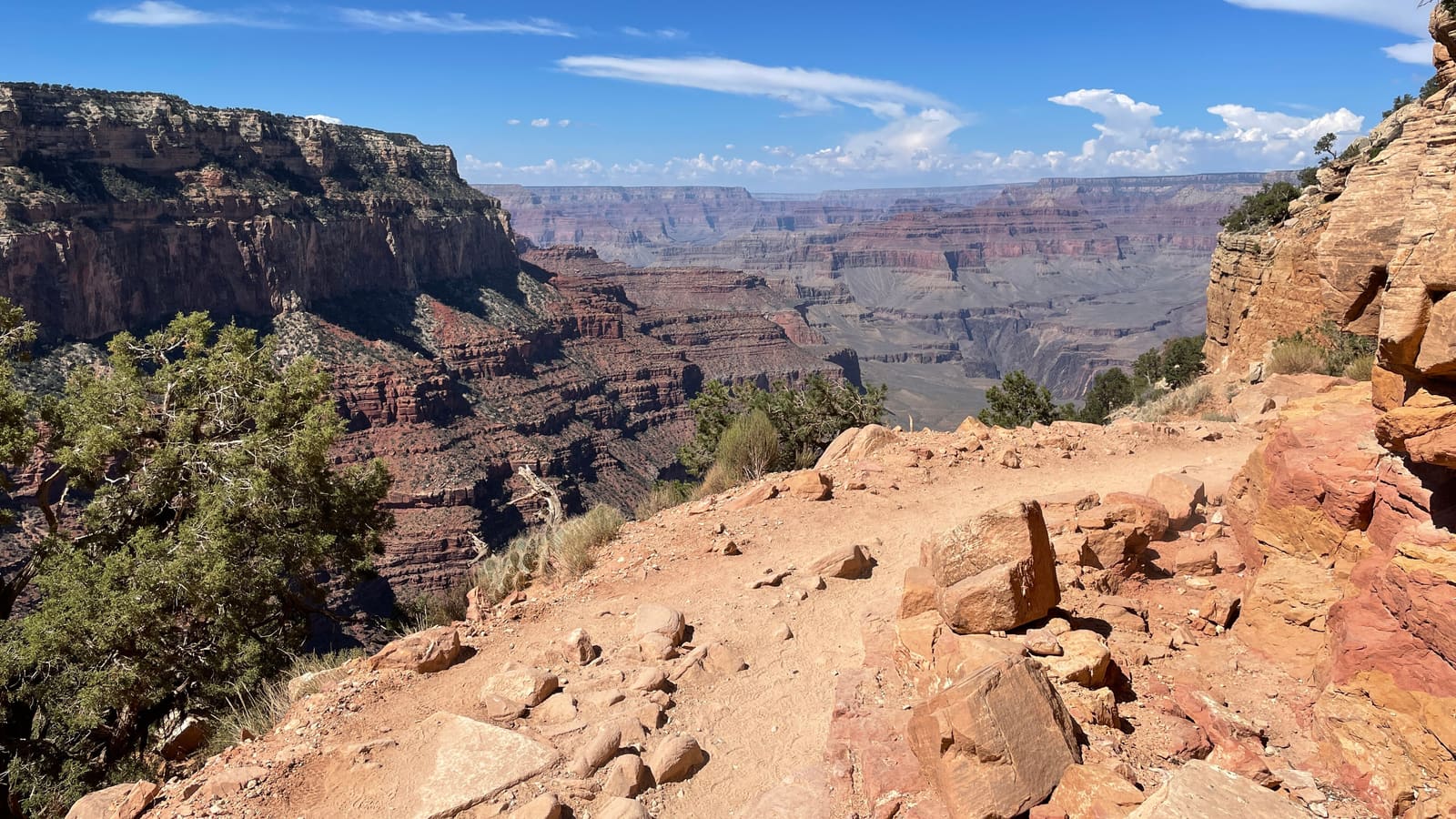
South Kaibab is the most photogenic trail at the Grand Canyon and also the least forgiving for unprepared hikers. It has no shade, no water sources below the rim, and the descent is steeper than Bright Angel. The payoff is panoramic ridge-top views that Bright Angel does not offer. The turnaround to Cedar Ridge is roughly 3 miles round trip with about 1,100 feet of elevation change and is the recommended day hike goal on this trail.
Because South Kaibab offers no water, you must carry all you need for the round trip, roughly two liters minimum per person in moderate temperatures, more in summer. The park service recommends against daytime descents in summer months. If you plan to go down South Kaibab and return via Bright Angel (the Kaibab-to-Bright Angel loop), that requires a shuttle from Yaki Point and is an advanced option covered in our travel planning guide.
5. Heat, hydration, and turnaround discipline
Every year, visitors require emergency assistance on Grand Canyon trails, and the majority of incidents involve hikers who pushed past a safe turnaround point. The pattern is consistent: the canyon is cooler going down; coming back up in afternoon heat on tired legs is where trouble starts. The park service recommendation is to turn around at your turnaround point regardless of how you feel.
Hydration strategy: carry at minimum one liter of water per person per hour of hiking in summer. Electrolyte supplements are worth bringing. Canyon temperatures increase by roughly 10 to 20 degrees Fahrenheit for every 1,000 feet of elevation drop, so inner-canyon conditions are considerably warmer than the rim. Start early, ideally before 7 AM in summer, and be off the exposed trail before 10 AM if temperatures are expected above 90 degrees Fahrenheit on the rim. We expand on seasonal planning in our best time to visit guide.
6. Logistics: trailheads, parking, and shuttle access
Bright Angel Trailhead is at Bright Angel Lodge in the Village area and is the easiest to access by shuttle or on foot from most South Rim lodges. South Kaibab Trailhead is accessible via the Kaibab/Orange Route shuttle from the Visitor Center; private vehicles are not permitted at the trailhead except early morning. Rim Trail access points are spread across the entire rim and connect to all shuttle routes.
Parking at the South Rim fills by mid-morning in peak season. If you are driving, arrive before 7 AM or plan to park at the Visitor Center complex and use the shuttle system. Both Bright Angel and South Kaibab trailheads are reachable without a car if you are staying on-rim. For detailed parking and shuttle routing, see our things to do guide.
Book a Guided Grand Canyon Experience
Viator runs helicopter flights, guided rim hikes, and Grand Canyon Railway day packages that bundle transport, entry, and a guide — useful when you would rather skip the driving and parking logistics.
Browse Grand Canyon Tours on Viator →Affiliate link — we earn a small commission at no cost to you.