By The Lowdown Guide Editorial Team · Published April 29, 2026
Lowdown Verdict
Jerome has lived three completely distinct lives in 150 years. The first one (copper) lasted 77 years and made millionaires. The second one (ghost town) lasted barely a decade. The third one (art colony) is still going. If you understand which era built each building you're looking at, the town reveals itself in layers that most visitors miss entirely.
Act One: The Copper Boomtown (1876–1953)
In 1876, prospectors confirmed what local Yavapai people had long known: the hillside above the Verde Valley was saturated with copper ore. The United Verde Copper Company was organized in the early 1880s, backed by investors including a man named Eugene Murray Jerome — a Manhattan attorney, cousin of Jenny Jerome (Winston Churchill's American mother), and a financier who reportedly never visited the Arizona desert town that bore his name.
The early years were modest. Ore had to be hauled by mule to Prescott for processing. The first smelter came in 1883. The real inflection point arrived when William A. Clark — a Montana copper baron and future U.S. senator — acquired the United Verde in 1888 and poured capital into infrastructure. By 1894, a narrow-gauge railroad connected Jerome to the main rail line at Jerome Junction, and the smelter output climbed dramatically.
At peak production, Jerome sat at roughly 15,000 residents and was one of the largest copper-producing operations in the United States. The population wasn't monolithic: miners came from Mexico, Ireland, Croatia, and the American South. At least three distinct ethnic neighborhoods existed on the hillside simultaneously. Chinese merchants held Main Street storefronts.
The Money and the Violence
Fortunes were concentrated at the top. James Douglas — whose family eventually controlled United Verde Extension (UVX), the sister mine — built the Douglas Mansion above town in 1916. It's now Jerome State Historic Park and one of the best-preserved artifacts of the era. Douglas poured Italian tile and indoor plumbing into the structure at a time when most miners' families lived in one-room company housing on the lower slopes.
Labor unrest ran through the boomtown years like copper seams through shale. The Industrial Workers of the World (IWW) organized miners across the Southwest during World War I. On July 10, 1917 — two days before the much larger Bisbee Deportation — a group of armed Jerome citizens and mine operators loaded 67 IWW organizers and sympathizers onto cattle cars and transported them to Kingman, Arizona, with instructions not to return. No one was prosecuted. Copper production continued uninterrupted.
Learn more about the mining heritage and what remains of it at the Jerome Historical Society Mine Museum on Main Street — it houses equipment, photographs, and labor records that document this period with uncomfortable specificity.
The Sliding Town
Jerome's hillside was never stable. Underground blasting for copper ore shifted the ground beneath the town. The old Traveling Jail — a concrete building in the lower district — was originally constructed at the top of its lot and crept downhill by roughly 225 feet over several decades. It's now a roadside attraction in its current location, far from where it started. The full copper mining history page walks through what the blasting did to the hillside's geology and why some streets downtown still tilt at odd angles.
Act Two: The Ghost Town (1953–mid-1960s)
When Phelps Dodge acquired the United Verde in 1935, the mine had already seen its peak production years. The company worked the ore body steadily through World War II — copper demand for wartime manufacturing kept the mine economically viable even as the easiest deposits were exhausted.
In 1953, Phelps Dodge closed the United Verde and ceased active mining. After 77 years of near-continuous operation, Jerome's economic engine simply stopped. The population dropped precipitously — from thousands to fewer than 100 permanent residents within a decade. Businesses closed. Families left. Buildings sat empty.
The remaining residents were predominantly older, property owners with nowhere obvious to go and no reason to sell. They watched Jerome deteriorate: roofs collapsed, storefronts rotted, the hillside vegetation reclaimed vacant lots. For about twelve years, Jerome was the thing it's still occasionally marketed as — an actual ghost town, not a metaphorical one.
1960 census records show fewer than 300 residents. Local accounts from that decade describe entire blocks of Main Street with no operating businesses.
Act Three: The Art Colony (1967–Present)
The first artists arrived in the late 1960s for the same reason anyone moves to a depressed small town: rent was effectively zero. Jerome had more vacant storefronts and empty Victorian houses than it had residents. A group of artists, craftspeople, and counterculture migrants from larger Arizona cities began settling in around 1967 — the same year Jerome was designated a National Historic Landmark district, which helped stabilize property ownership and slow further deterioration.
The early settlers were making a bet. Building a studio in an abandoned copper town with a sliding jail and a hundred-foot view of the Verde Valley is romantic in retrospect. In practice, it meant no reliable plumbing in some structures, aggressive wildfire risk every summer, and the social dynamics of a very small, very isolated community.
How the Tourism Economy Developed
Jerome's current economy is built almost entirely on day visitors and overnight guests from Phoenix, Sedona, and Flagstaff. The shift from art colony to tourist destination wasn't abrupt — it accumulated through the 1980s and 1990s as galleries multiplied and the Jerome Grand Hotel opened in what had been the United Verde Hospital (1996, a major catalyst for overnight tourism).
The Jerome Grand Hotel itself is a direct artifact of the copper era: built in 1926 as the United Verde Hospital, it closed in 1950 and sat empty for 44 years before reopening as a hotel. The building's history — and the stories attached to it — is a significant part of what makes Jerome's haunted reputation feel grounded rather than manufactured.
The current resident population of Jerome holds at roughly 450 people. The town receives an estimated 1.5 million annual visitors. That ratio — 3,000 visitors per resident per year — creates a town that lives in a permanent negotiation between authenticity and performance.
What the Three Acts Left Behind
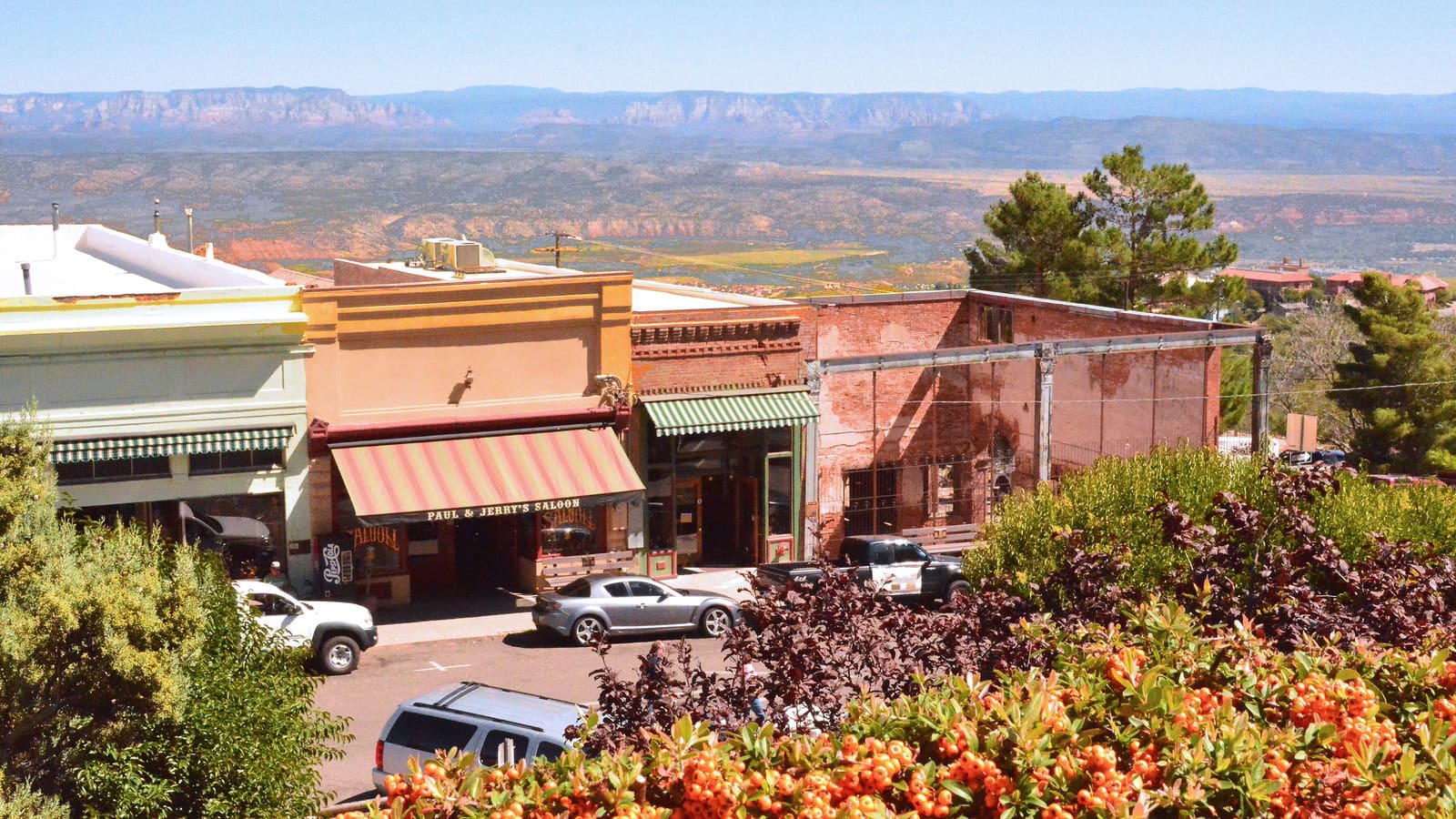
Walk Main Street in 2026 and you're reading three stratigraphic layers simultaneously:
- The copper era left the infrastructure: the Grand Hotel, the mine museum, the Douglas Mansion, the retaining walls that keep the hillside streets in place, the sliding jail in its current wrong location.
- The ghost town era left the gaps: the vacant lots, the foundation outlines, the stories of structures that didn't survive the abandonment decade.
- The art colony era left the galleries, the restaurant culture, the population of 450 people who chose to live in a place that makes no economic sense and wouldn't trade it.
The Jerome State Historic Park (Douglas Mansion) anchors the copper-era narrative best and is worth the modest admission (check current rates at azstateparks.com) even if you only have two hours. The Mine Museum on Main Street is the densest collection of primary-source material — labor records, photographs, equipment — and costs less than a glass of wine at the Asylum next door.
Stay Long Enough to See It in Layers
Jerome's history doesn't fully land on a two-hour day trip. An overnight stay — especially at the Grand Hotel in the old United Verde Hospital — turns the history from a surface read into a full experience.
Compare Jerome Hotel Rates →Affiliate link — we may earn a small commission at no cost to you.
Frequently Asked Questions
Who was Jerome Arizona named after? +
Jerome was named after Eugene Murray Jerome, a New York attorney and cousin of Jenny Jerome (Winston Churchill's mother). He was a financial backer of the United Verde Copper Company but reportedly never visited the town that bears his name.
When did Jerome become a ghost town? +
Jerome effectively became a ghost town after Phelps Dodge closed the United Verde mine in 1953, following 77 years of near-continuous copper mining. The population fell from a peak of roughly 15,000 to fewer than 100 residents over the following decade.
What caused the IWW deportation in Jerome in 1917? +
On July 10, 1917, armed Jerome citizens and mine operators loaded 67 IWW labor organizers onto cattle cars and transported them to Kingman, Arizona. The action was driven by mine owners who feared labor organization would disrupt wartime copper production. No prosecutions followed.
When did artists start moving to Jerome? +
Artists began arriving in Jerome in the late 1960s, attracted by near-zero rent in abandoned buildings. The town was designated a National Historic Landmark district in 1967, which helped stabilize property and draw creative residents. By the early 1970s, Jerome had a small but established arts community.