By The Lowdown Guide Editorial Team · Last updated: 2026-07-26
The Drive from Lake Havasu City
Kingman sits north of Lake Havasu City along a more direct highway route than the winding mountain road to Oatman, which generally makes for an easier, faster drive. Even so, treat any specific drive-time figure as a rough estimate rather than a fixed number -- desert highway conditions, seasonal traffic, and road work can all affect actual travel time, so check current conditions before you leave.
Because the route is more direct than the Oatman road, Kingman also works well as a standalone half-day or full-day trip for visitors who would rather skip the mountain driving altogether and focus on Route 66 history in a single, walkable downtown.
Whichever route you take, fuel up and check your vehicle before heading out, and carry more water than the drive seems to call for. There are long stretches of this corridor with no services and unreliable cell coverage, and a breakdown in summer is a heat problem before it is a mechanical one -- Arizona summers here run well past 110 degrees. The National Weather Service is categorical that it is never safe to leave a child, a disabled person, or a pet in a parked vehicle: interior surfaces can reach 180 to over 200 degrees, cracking the windows does not meaningfully help, and animals can die of heatstroke within 15 minutes.
Arizona's monsoon season runs June 15 through September 30. During those months a storm you cannot see can push water across a dip or a wash within minutes; six inches of fast-moving water can knock down an adult and twelve inches can carry off most cars. Turn around, don't drown -- and be aware that under A.R.S. section 28-910, Arizona's so-called Stupid Motorist Law, a driver who goes around a barricade onto a flooded roadway can be billed for the emergency response that comes to get them. Check current road conditions with ADOT before you set out.
Kingman: The Heart of Route 66
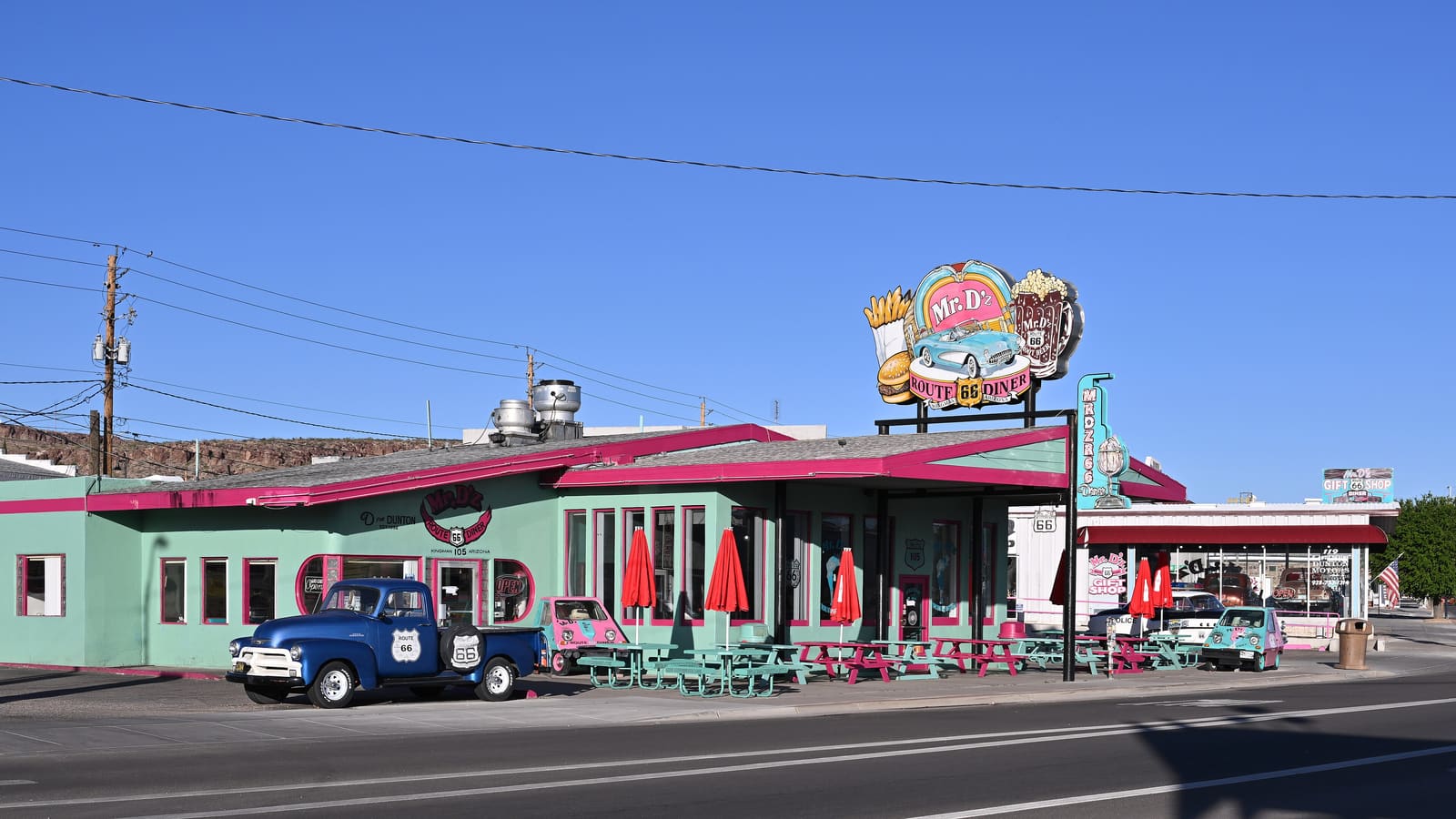
Kingman sits at the junction of several historic Route 66 alignments and has branded itself around that history for decades -- the city's tourism office bills it as "The Heart of Historic Route 66." The town came first, though. The National Park Service dates its founding to 1882 as an Atlantic and Pacific Railroad town, named for railroad surveyor Lewis Kingman; it became the county seat in 1887 and grew into a supply and shipping center for miners and ranchers across western Arizona. Route 66's original 1926 course followed the National Old Trails Road straight through town. That layered railroad-mining-highway history is what the downtown museums cover today.
Unlike Oatman's compact tourist-town feel, Kingman is a functioning small city with its own infrastructure, which means services like fuel, food, and lodging are easier to find here than in a smaller stop along the route.
That combination of a working city and a Route 66-branded identity is part of what makes Kingman a practical anchor point for the wider corridor -- it is a place travelers can restock, refuel, and take a break, not only a historic attraction to photograph and move on from.
Route 66 Museums and Historic Downtown
Kingman's historic downtown includes museums dedicated to Route 66 history alongside the area's mining and railroad past, plus a walkable stretch of vintage motels, neon signage, and storefronts dating to the highway's peak years. The core of it is the Kingman Commercial Historic District, listed on the National Register of Historic Places in 1986; just outside the district, the historic Powerhouse has been restored as a visitor center. Because museum hours and special exhibits change, check current schedules directly before planning a visit around a specific stop.
The downtown area is compact enough to explore mostly on foot once you arrive, which makes Kingman a manageable stop even if you are also planning to drive on to Oatman the same day.
Vintage motel signage and roadside architecture from the highway's peak decades are scattered throughout downtown as well, and several buildings retain their original mid-century look even where the businesses inside have changed. Photographers and Route 66 history buffs in particular tend to find this stretch worth a slow walk rather than a quick drive-by.
Gateway to Oatman and the Longest Remaining Stretch of Route 66
The superlative here is real and it is sourceable. According to the Bureau of Land Management, Arizona holds more than 385 miles of Route 66, including 158 unbroken miles across western Arizona running from Topock in the west to Crookton Road near Ash Fork in the east -- one of the longest remaining continuous stretches of the historic highway anywhere in the country. Kingman sits in the middle of that corridor rather than at one end of it, which is a large part of why the town claims the Route 66 identity it does.
BLM's Kingman Field Office manages a 42-mile section of that corridor as the Route 66 Historic Back Country Byway, which runs from the McConnico exit five miles south of Kingman, west through Golden Valley, over Sitgreaves Pass, down through Oatman, and out to the Topock/Golden Shores exit on Interstate 40. Driving west from Kingman to Oatman puts you on that byway.
If you make that drive, note the vehicle limit. BLM restricts vehicles to no more than 40 feet over Sitgreaves Pass between Golden Valley and Oatman, with signage posted in Golden Valley. The pass is a genuine mountain crossing -- hairpin curves, steep grades, switchbacks -- and BLM advises that wider vehicles such as RVs use caution and recommends an automatic transmission because of the grades. This is the leg of the trip where vehicle size actually matters; the approach to Oatman from the Lake Havasu side does not cross the pass.
For visitors who want the fuller Route 66 experience, treating Kingman as the gateway rather than the destination -- a stop for museums and a meal before continuing on to Oatman's Main Street and wild burros -- tends to make for a more complete day.
Pairing Kingman with Oatman
Because Kingman and Oatman sit along the same general Route 66 corridor, many visitors combine both into a single longer day trip from Lake Havasu City rather than treating them as two separate outings. Doing both in one day does add meaningful drive time, mostly because of the winding mountain road on the Oatman side, so build in extra time for that leg rather than assuming Kingman's easier drive sets the pace for the whole day.
See our dedicated Oatman day trip guide for the mountain-road drive details, the wild burros, and the gunfight shows if you plan to continue past Kingman the same day.
If you would rather split the two towns across separate outings, Kingman on its own still makes a complete, worthwhile day trip built around Route 66 history, and you can always plan Oatman for a return visit when you have more time for the mountain drive.
Planning Your Day
If Kingman is your only stop, a half-day is usually enough for the downtown museums and a walk through the historic district, leaving time to head back to Lake Havasu City for the afternoon or evening. A full day gives more room to linger over the museums, grab a meal downtown, and take the drive at an easier pace.
Kingman can also work as an alternate overnight base for travelers splitting time between Lake Havasu and other Route 66 stops further along the corridor. For the wider set of day-trip options from Lake Havasu City, including Parker Dam and the wildlife refuge, see our full day trips roundup.
However you split the day, check current road and weather conditions before you leave Lake Havasu City, particularly in summer when desert heat and occasional monsoon storms can affect driving conditions on the highway corridor between the two areas.