10,000 BCE – 1425 CE: Before the Settlers
Human presence in the Flagstaff area predates the town by at least 10,000 years. Archaic hunter-gatherers moved through the ponderosa pine forests and high desert grasslands seasonally, following game herds and plant resources. Their campsites and lithic scatters appear throughout the Coconino National Forest.
The most visible pre-European presence is the Sinagua culture, which occupied the Flagstaff region from approximately 500 CE to 1425 CE. The Sinagua were dry farmers who grew corn, beans, and squash, and they traded extensively with the Hohokam of southern Arizona and the Ancestral Puebloans of the Colorado Plateau. Their cliff dwellings at Walnut Canyon (10 minutes east of Flagstaff) preserve 25 rooms you can walk past at arm's length. Their largest community, Wupatki Pueblo (36 miles north), grew rapidly after the 1085 CE Sunset Crater volcanic eruption — the ash acted as moisture-retaining mulch that made agriculture suddenly viable in the surrounding volcanic landscape.
By 1425 CE, the Sinagua had vacated most of their sites — likely migrating to the Hopi mesas, where their descendants live today. The Hopi consider the Sinagua among their ancestral people (Hisatsinom).
1876: The Flagpole That Named a City
The name "Flagstaff" comes from an unlikely source: a July 4, 1876 centennial celebration. A group of Anglo-American settlers — part of a sheep-grazing expedition from Boston — stripped a ponderosa pine tree of its branches and flew an American flag from the top to mark the nation's 100th birthday. The bare trunk stood visible for miles across the high plateau and became a landmark. When railroad surveyors arrived a few years later, they noted the distinctive pine and the name stuck.
1882: The Railroad Arrives
The Atlantic and Pacific Railroad (later absorbed into the Atchison, Topeka and Santa Fe Railway) reached the Flagstaff area in 1882, establishing a water stop at a spring near the base of the San Francisco Peaks. The railroad created the town instantly: where there had been a small collection of tent merchants serving sheep herders, a commercial district appeared within months. The current Amtrak depot building on Route 66 (built 1926, still operating as a train station) replaced the original wooden depot and remains one of the finest historic railroad stations in the American Southwest.
1894: Incorporation and the Lumber Economy
Flagstaff incorporated as a town in 1894 with a population of roughly 1,000 people. The economic foundation was timber — the Coconino National Forest surrounding the city is the largest ponderosa pine forest in North America, and the Arizona Lumber and Timber Company (run by the Riordan brothers) became the dominant employer. The Riordan Mansion (1904), now a state historic park on Riordan Road, was built by brothers Timothy and Michael Riordan and is one of the best-preserved Arts and Crafts mansions in the Southwest.
1894: Lowell Observatory Founded
The same year Flagstaff incorporated, Boston financier Percival Lowell chose the city as the site for his new astronomical observatory. Lowell specifically selected Flagstaff for its elevation (6,909 feet), distance from city light pollution, and the number of clear nights per year (300+). He built the original Clark Telescope dome on Mars Hill west of downtown and spent the next 22 years searching for evidence of civilizations on Mars — work that was largely discredited, but that also laid the observatory's infrastructure and reputation.
February 18, 1930: Pluto Discovered
Lowell had predicted the existence of a ninth planet before his death in 1916. In January 1930, 24-year-old Clyde Tombaugh — a Kansas farm boy with no college degree who had built his own telescopes and sent drawings to Lowell Observatory — began comparing photographic plates looking for movement against the fixed star background. On February 18, 1930, he spotted an object that had moved between plates taken January 23 and January 29. It was Pluto.
The discovery was announced on March 13, 1930 — Percival Lowell's birthday. A contest was held to name the planet; an 11-year-old English girl named Venetia Burney suggested "Pluto" (god of the underworld, appropriate for a planet so far from the sun). The original blink comparator machine and photographic plates are still on display at Lowell Observatory.
1926: Route 66 Established
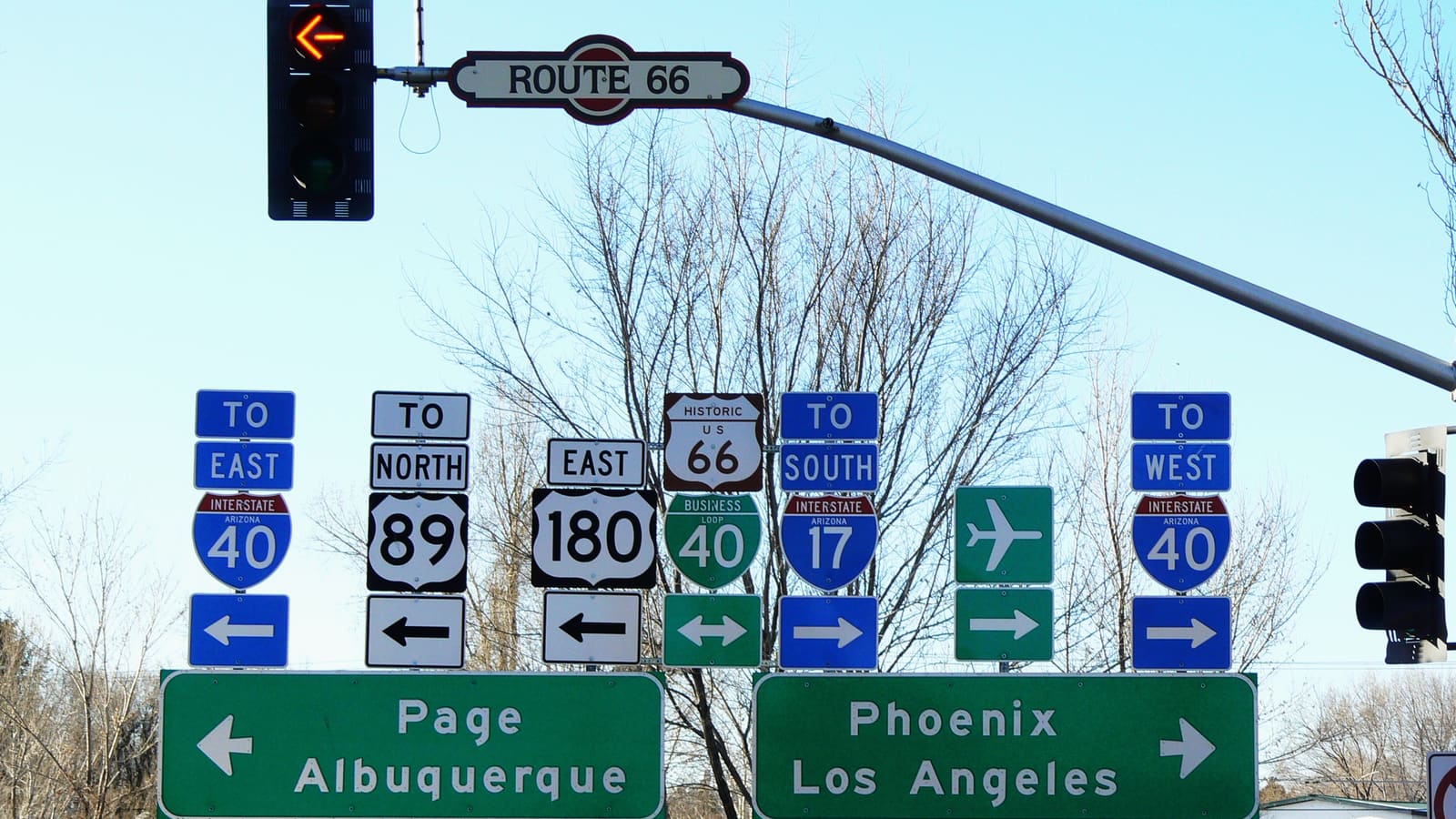
When U.S. Route 66 was officially designated in 1926, it followed the earlier National Old Trails Road alignment through Flagstaff — running directly through downtown along what is now Santa Fe Avenue and the street currently signed as "Route 66." The railroad depot anchored the commercial district, and the quarter-mile of Route 66 through downtown Flagstaff became one of the most concentrated stretches of motor courts, diners, and service stations on the entire highway.
The Dust Bowl migration of the 1930s brought hundreds of thousands of Okies and Arkies through Flagstaff on their way to California — the same westward exodus along Route 66 that John Steinbeck immortalized as the "Mother Road" in The Grapes of Wrath. When I-40 bypassed downtown Flagstaff in 1968, much of the original commercial strip fell into decline, but key buildings survived: the Weatherford Hotel (1900), the Amtrak depot (1926), the Hotel Monte Vista (1927), and the Orpheum Theater (1917).
1899: Northern Arizona University Founded
Northern Arizona University was established in 1899 as the Northern Arizona Normal School — a teacher training institution serving the territorial territory. It became Arizona State Teachers College in 1925, Arizona State College at Flagstaff in 1945, and Northern Arizona University in 1966. Today NAU enrolls approximately 30,000 students and is the city's largest employer, contributing significantly to the craft beer, music, and arts scenes that define modern Flagstaff's character.
Where to Experience Flagstaff History
- Lowell Observatory — The Pluto discovery site. Evening programs with the 24-inch Clark Telescope still operational.
- Riordan Mansion State Historic Park — 1904 Arts and Crafts lumber baron mansion, fully preserved.
- Historic Route 66 downtown corridor — Weatherford Hotel (1900), Hotel Monte Vista (1927), Amtrak depot (1926). Take our Historic Downtown Walk Audio Tour to connect the buildings to their stories.
- Walnut Canyon National Monument — Sinagua cliff dwellings, 10 minutes east.
- Wupatki & Sunset Crater — Sinagua's largest pueblo, 36 miles north.
- Museum of Northern Arizona — 15,000 years of Colorado Plateau human history.
Frequently Asked Questions
When was Flagstaff founded?
Incorporated as a town in 1894, though Anglo-American settlement began in the late 1870s around the railroad water stop. The name comes from a July 4, 1876 centennial celebration where settlers stripped a ponderosa pine and flew a flag from it.
Where was Pluto discovered?
Lowell Observatory in Flagstaff, Arizona. Clyde Tombaugh spotted it on February 18, 1930 using a blink comparator to compare photographic plates. The original plates and comparator are still on display at the observatory.
Did Route 66 go through Flagstaff?
Yes — Route 66 ran directly through downtown Flagstaff along Santa Fe Avenue and the street now signed "Route 66." Key surviving buildings: Weatherford Hotel (1900), Amtrak depot (1926), Hotel Monte Vista (1927). I-40 bypassed downtown in 1968.
Who lived in Flagstaff before European settlement?
The Sinagua people (500–1425 CE) built cliff dwellings at Walnut Canyon and Wupatki. Before them, Archaic hunter-gatherers used the area for 10,000+ years. The Navajo and Hopi peoples have traditional ties to the surrounding region.
What is the Riordan Mansion in Flagstaff?
A 13,000-square-foot 1904 craftsman mansion built by brothers Timothy and Michael Riordan of the Arizona Lumber and Timber Company. Now a state historic park. One of the best-preserved Arts and Crafts homes in the American Southwest.