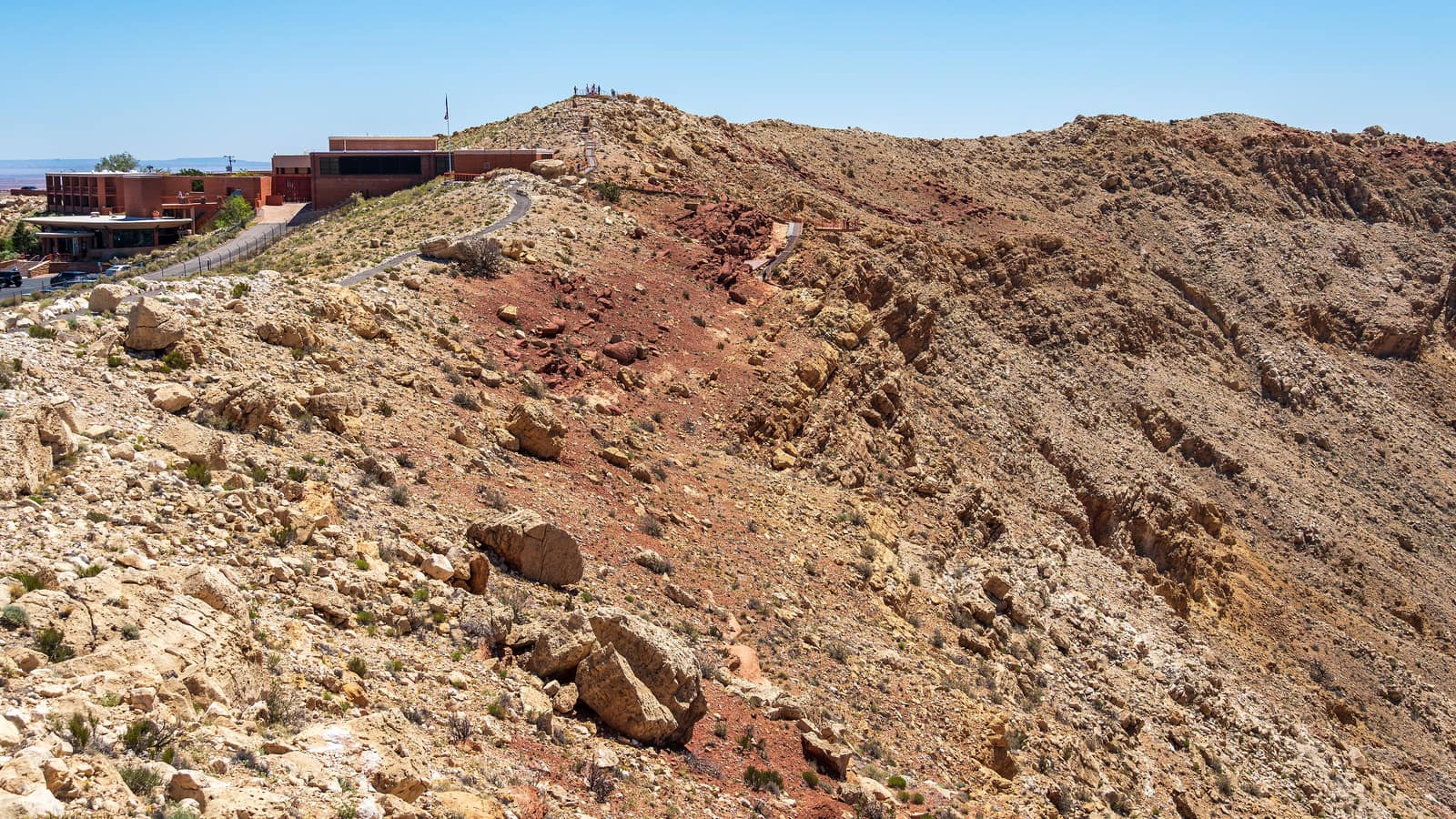
Fifty thousand years ago, a nickel-iron meteorite 150 feet across traveling at 26,000 miles per hour hit the Colorado Plateau east of what is now Flagstaff. The impact released energy equivalent to about 2.5 megatons of TNT — roughly 150 times the yield of the atomic bomb dropped on Hiroshima. The resulting crater is three-quarters of a mile wide, 2.4 miles in circumference, and 550 feet deep. Ejecta — rock blasted from the impact — scattered across a 100-square-mile area.
The crater is still here, nearly unchanged, because the desert climate preserved it. NASA trained Apollo astronauts here because it's the closest thing on Earth to a lunar surface. Geologists still come to study it. It is privately owned by the Barringer family, which has operated it as an attraction since the 1960s.
It is 37 miles east of Flagstaff on I-40. On a clear day you can be standing on the crater rim in 40 minutes.
What Is Meteor Crater?
Officially named Barringer Meteor Crater after Daniel Moreau Barringer, the mining engineer who first proved it was an impact structure in 1903 (against significant scientific skepticism at the time), the site is recognized as the best-preserved meteorite impact crater on Earth. Its youth — 50,000 years is geologically very recent — combined with the arid climate that prevents erosion has kept it remarkably intact.
The meteorite itself is largely gone. Most of it vaporized on impact; some fragments are scattered across the surrounding desert and have been collected over decades. The largest surviving piece, the Holsinger Meteorite, weighs 1,406 pounds and is on display in the visitor center.
Getting There
From Flagstaff: Take I-40 east 37 miles to Exit 233. The crater is 5 miles south of the interchange on Meteor Crater Road. Total drive time: 40–45 minutes. From other Arizona cities:- Phoenix: 3.5 hours (I-17 north to I-40 east)
- Sedona: 2.5 hours (AZ-179 to I-17 to I-40)
- Williams (Grand Canyon area): about 1 hour 15 minutes east on I-40
What's Actually There: The Visitor Experience
The Crater Rim Observation Deck
The main event. The observation deck extends several hundred feet along the northern rim with glass-windowed overlook platforms and outdoor viewing areas. The scale of what you're looking at doesn't register immediately. The crater is wide enough that the far rim appears slightly hazy. The floor is flat and distant — much farther down than it looks in photos.
The deck has multiple platforms at different levels. Rangerled guided rim tours depart from the main viewing area at scheduled times and walk you along the rim with commentary on the geology and impact dynamics. This is worth taking even if you're not usually a guided tour person — the rim walk without a guide lacks the interpretive layer that makes the science click.
Photography: Midday light is harsh and casts the interior in flat shadow. Early morning and late afternoon give better contrast and shadow detail inside the crater. The western sun hits the crater walls well in the late afternoon.The Barringer Space Museum and Visitor Center
The indoor visitor center is substantial — better than you'd expect from a remote roadside attraction. It has:
- The Holsinger Meteorite: The largest surviving fragment, 1,406 pounds of nickel-iron, on display. You can touch a smaller piece (museum staff rotate these out)
- Impact science exhibits: Genuinely clear explanations of how impact craters form, the size-to-energy relationship, the frequency of large impacts over Earth's history
- Apollo astronaut training materials: Photos and equipment from NASA's use of the crater for lunar surface training in the 1960s and 1970s. The astronauts practiced here specifically because the crater floor is the closest analog to the lunar surface they could reach
- The Meteor Crater Enterprise: A short film about the crater's history and the Barringer family's role in proving its origin
The Astronaut Wall of Fame
A small memorial display near the entrance recognizing the Apollo astronauts who trained at Meteor Crater. Neil Armstrong, Buzz Aldrin, and others are represented. For anyone interested in the Apollo program, it's a quiet detail that adds meaning to the site.
Top-Rated Tours & Activities
Book guided hikes, stargazing tours, Grand Canyon day trips, and more.
Browse ToursWe earn a small commission if you book — at no extra cost to you.
Tickets and Hours
Current admission prices: Check the official site at meteorcrater.com before your visit — prices adjust periodically and group/senior rates apply.As of this writing, admission is charged per person (adults and children have different rates). The crater is privately owned, so no national park passes apply.
Hours: Open daily, year-round. Hours vary seasonally — the site typically opens between 7–8 AM and closes between 5–8 PM depending on the season. Check the website before planning an early or late visit. How long to spend: 2–2.5 hours covers the rim walk, guided tour, visitor center, and film. Budget 3 hours if you want to spend time in the museum or have young children with you.Best Time to Visit
Weather: The crater sits at roughly 5,640 feet elevation — lower than Flagstaff, and considerably hotter in summer. July and August afternoons on the crater rim can reach 105°F. Bring water regardless of season; the rim is exposed and there are no shade structures on the observation deck. Best season: April–May and September–October for moderate temperatures. The crater is beautiful in winter with snow on the rim and clear cold light, but verify the access road conditions. Crowds: Summer weekends bring the most visitors; weekday mornings in summer are your best bet for shorter lines and more space on the observation deck.Tips for Getting the Most Out of Your Visit
Take the guided rim tour: Ranger-led tours add a significant amount of context. The tour covers the impact mechanics, the Barringer family's role, the Apollo training history, and points out specific geological features in the crater wall that aren't visible without knowing where to look. Allow 45 minutes for the full tour. The asteroid simulator: There's an interactive display that lets you adjust impact velocity, meteorite size, and impact angle to see the resulting crater. Kids spend more time at this station than at anything else in the visitor center. It's also genuinely useful for understanding the energy scales involved. Bring binoculars: The detail in the crater walls — layered sedimentary rock exposed by the blast, impact melt on the walls, the subtle floor topography — is visible with binoculars in a way it isn't with the naked eye. Gift shop: The meteorite samples sold in the gift shop are real. Campo del Cielo meteorite fragments are reasonably priced. Widmanstätten pattern iron-nickel specimens are the most visually striking.Combining Meteor Crater with Other Flagstaff Day Trips
Meteor Crater + National Monuments loop: Take I-40 east to Meteor Crater (40 min), spend 2–3 hours, then drive back past Flagstaff and continue north to Wupatki and Sunset Crater National Monuments. This is a full day (8–9 hours) but covers three completely different geological and historical sites. Meteor Crater + Petrified Forest: Continue east on I-40 past Meteor Crater to Petrified Forest National Park (another 90 miles). The Painted Desert overlooks along I-40 are free and visible from the highway. The park itself requires entry. A long but achievable day trip from Flagstaff. Meteor Crater + Winslow: Winslow, AZ is about 18 miles east of the crater. "Standin' on a corner in Winslow, Arizona" — the Eagles lyric is commemorated with an actual corner park and mural on Kinsley Avenue. Low-key, free, takes 20 minutes. Worth the detour if you're already this far east.Meteor Crater with Kids
This is one of the better science-oriented stops in Arizona for children who are old enough to be interested in scale and impact. The key ages are roughly 8 and up — young enough to be genuinely amazed by "a rock hit the Earth here" and old enough to conceptualize what 50,000 years means.
The asteroid simulator is consistently the most popular element with kids. The guided tour works for interested children 10 and up; younger kids may lose patience with the pace. The film in the theater runs about 25 minutes and holds attention reasonably well.
Practical: There are restrooms and a café at the visitor center. The café is basic (burgers, hot dogs, snacks) but functional. The gift shop's meteorite samples are affordable enough that buying a small piece is a reasonable memento without breaking the budget.Find the Best Hotel Deals in Flagstaff
Compare prices across 100+ hotels. Free cancellation on most bookings.
Check Hotel PricesWe earn a small commission if you book — at no extra cost to you.
Frequently Asked Questions
How far is Meteor Crater from Flagstaff?
37 miles east of Flagstaff via I-40. Take Exit 233 and drive 5 miles south on Meteor Crater Road. Total drive time: 40–45 minutes.
How much does Meteor Crater cost to visit?
Meteor Crater is privately owned and charges admission per person. Prices vary for adults, children, and seniors. Check current rates at meteorcrater.com — no national park passes apply.
How long should I spend at Meteor Crater?
Plan 2–3 hours. This covers the guided rim tour (45 minutes), the visitor center exhibits, the film, and time on the observation deck. Families with young children who enjoy the interactive exhibits may want to budget closer to 3 hours.
Is Meteor Crater worth visiting?
Yes, particularly if you're already in Flagstaff — it's 40 minutes away and the scale of the crater doesn't translate through photographs. The guided rim tour is the key differentiator from a drive-through stop; skip it and the visit feels thinner. Book your trip in the morning to avoid afternoon heat in summer.
Can you go inside Meteor Crater?
No. The crater floor is inaccessible to visitors for safety and preservation reasons. All visitor access is from the observation deck along the northern rim. Guided rim walks take you along the edge; the floor is visible from above.
Who owns Meteor Crater?
The Barringer family, descendants of Daniel Moreau Barringer, who purchased the land in 1903 and spent decades (and his personal fortune) proving it was a meteorite impact crater. The family still owns and operates the site.
Is Meteor Crater near the Grand Canyon?
Not directly — Meteor Crater is east of Flagstaff on I-40, while the Grand Canyon is north of Flagstaff. They're not on the same route. Most visitors do Meteor Crater as a standalone half-day from Flagstaff rather than combining it with the canyon. If you're planning a Grand Canyon day trip, do it on a separate day.