There is a specific type of Las Vegas visitor this drive is built for: someone who has done the Strip enough times to know it by heart, who comes to Las Vegas for a reason but needs the weekend to contain something that is not the casino floor, not a pool party, not a headliner. Jerome is about four and a half hours southeast and is the deliberate opposite of Las Vegas in almost every measurable way.
Las Vegas at 2,030 feet is flat, remade in 1946, and has more than 40 million visitors per year. Jerome at 5,066 feet is a cliff, built in 1876, and gets perhaps 400,000 visitors per year at its busiest. Las Vegas has 30 hotels along a 4-mile Strip corridor. Jerome has 2 hotels and 41 rooms between them. Las Vegas sells spectacle at scale; Jerome sells the absence of spectacle and the presence of history, altitude, and quiet. For people who spend significant time in Las Vegas, that contrast is the point.
The drive itself — US-93 south through Boulder City and across the Hoover Dam corridor, then AZ-93 south through the Mojave high desert to Kingman, then AZ-89 south through Prescott into the Verde Valley — is about 270 miles in roughly 4.5 hours. It is not a scenic-corridor drive in the Oak Creek Canyon sense. It is a drive through the high desert of the American West that gives you enough road and silence to shift registers before you arrive. For route details, fuel stop distances, and Prescott navigation notes, see the Las Vegas to Jerome route logistics page. This is the story of why the trip makes sense.
📌 Full route logistics: Las Vegas to Jerome driving guide
Complete directions (US-93 south, Hoover Dam bypass or stop, Kingman junction choices, AZ-89 south through Prescott or AZ-40/AZ-89A alternate), fuel stop locations (Kingman is the last reliable large-format gas on this route, about 165 miles from Jerome), seasonal road notes for AZ-89 through Prescott, and parking logistics at Jerome's Hull Avenue lot (85 spaces, fills by 11 AM on weekends). Practical details on the logistics page.
Why Jerome Is Vegas Counterprogramming
Counterprogramming is a television term for scheduling content that appeals to the audience not watching the dominant program. For Las Vegas weekenders, Jerome is geographic counterprogramming: a destination chosen specifically because it operates on a different logic than the Strip.
The Strip is designed to maximize stimulation, minimize friction, and make time feel compressed. Everything is available immediately — food, drink, entertainment, gambling — at any hour. The architecture is massive and intentionally disorienting; casinos have no windows because losing track of time is a design goal. The social norm is high volume and high velocity.
Jerome has one road in and one road out. Its two restaurants that matter — Haunted Hamburger at 410 Clark St and The Asylum at 200 Hill St — both have waits on weekend afternoons. Caduceus Cellars at 158 Main St, the winery owned by Maynard James Keenan of Tool, pours small-production red wines from Verde Valley grapes and is not trying to move volume. The Jerome Grand Hotel at 200 Hill St has 29 rooms and no pool. The night view from Jerome is 60 miles of Verde Valley in complete darkness, punctuated by Cottonwood's commercial lights and the faint glow of Sedona's resorts to the northeast.
If you are a Las Vegas regular who books this trip, what you are buying is not tourism. It is decompression. And the long drive on US-93 south, with its straightaways through the Mojave and the gradual climb into Arizona high desert, is itself part of the decompression — about 270 miles to shift out of Strip time and into cliff time.
The Drive: Three Landscapes in Four Hours
The Las Vegas-to-Jerome route passes through three distinct landscape types that have nothing in common except the road connecting them.
Segment 1: Las Vegas Basin to Hoover Dam (30 miles, 35 minutes)
US-93 south leaves Las Vegas through Henderson and enters Boulder City — the only city in Nevada where gambling is still illegal, a historical artifact of the federal worker housing built for Hoover Dam construction crews in the 1930s. The road descends into the Lake Mead National Recreation Area at the Nevada-Arizona border.
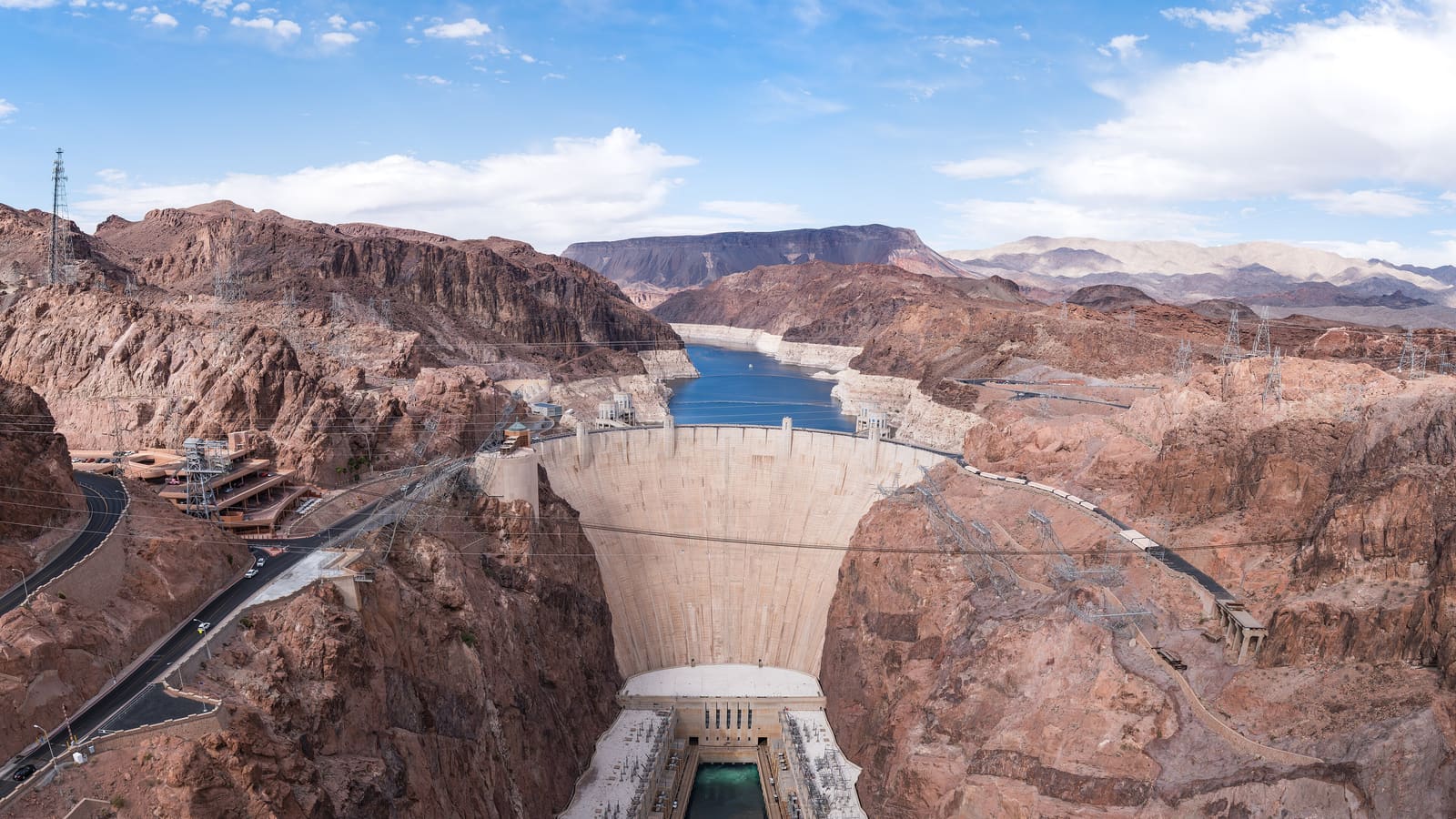
Hoover Dam is 30 miles from the Las Vegas Strip at Flamingo Road. The Mike O'Callaghan-Pat Tillman Memorial Bridge, opened in 2010, carries US-93 vehicle traffic about 890 feet above the Colorado River on a concrete arch span — the longest concrete arch span in the Western Hemisphere. Vehicle traffic no longer uses the original dam road, which is now pedestrian-only and accessible for tours. Dam tours run $15 to $30 per adult, 9 AM to 5 PM daily. The visitor center parking garage holds approximately 600 vehicles in two structures. If you plan to stop, arrive before 10 AM to avoid the midday queue; the dam sees 7 million visitors per year and the parking fills by 11 AM on summer Saturdays.
The bridge viewpoint from the Nevada side of the new bridge is free and takes 10 minutes — a legitimate stop even if you skip the dam tour. Looking upstream, you see Lake Mead (when water levels are up) and the Black Canyon walls that gave Hoover Dam its location. Looking downstream, the Colorado River continues its original canyon route south toward the Gulf of California. This is also the Nevada-Arizona border: step to the east side of the bridge and you are in Mountain Time and Arizona.
Segment 2: Kingman and the Arizona Mojave (73 miles, 1 hour 10 minutes)
South of Hoover Dam, US-93 continues into the Arizona portion of the Mojave Desert through a landscape that most drivers find monotonous and some find clarifying. The high desert here is at 2,000 to 3,500 feet elevation — cooler than the Las Vegas Basin floor but still classic Mojave: creosote, Joshua trees at the northern edge of their range near White Hills, and long straight road sections that give way to occasional dips through dry washes.
Kingman, at 3,330 feet elevation, is approximately 73 miles from Hoover Dam and is the main fuel and food stop on this route. Downtown Kingman on Andy Devine Ave (old Route 66) has several diners and a Walmart. For this drive, Kingman is functionally the last reliable large-format fuel stop before Jerome — the Prescott area (about 145 miles ahead) has gas stations but is a smaller market. If your tank is below half at Kingman, fill up.
Kingman has an unexpected local connection to the Arizona copper economy: the Santa Fe Railway mainline through Kingman carried copper and other ore from Arizona mines to California ports and Eastern markets for decades. The Mohave Museum of History and Arts at 400 W. Beale St has exhibits on the Route 66 era and the railroad history if you have 45 minutes to spend on a detour.
Segment 3: AZ-89 Through Prescott to the Verde Valley (about 165 miles, 3 hours)
From Kingman, AZ-89 south climbs from 3,330 feet in the Kingman Basin through the Hualapai Mountains on the east side of the road (summit 8,417 feet, visible from the highway) and into the Prescott Valley. This is where the drive changes character. The Mojave gives way to Arizona's Central Highlands: oak woodland, granite boulders, and the slow climb toward Prescott's 5,400-foot elevation.
Prescott is about 145 miles from Kingman and is worth a 30-minute stop if you have not been before. Whiskey Row on Gurley Street — the historic saloon district that has operated since the 1860s — is a functioning bar district. The Courthouse Plaza in downtown Prescott is surrounded by late 19th-century territorial buildings. Prescott was Arizona's first territorial capital, and the built environment reflects that early investment in civic permanence. It is also only 35 miles from Jerome via AZ-89A northwest through Prescott Valley — meaning if you want a meal or a grocery stop before arriving in Jerome, Prescott is the place.
From Prescott, AZ-89A northwest drops from Prescott's 5,400 feet into the Verde Valley before climbing the switchback ascent to Jerome at 5,066 feet. On this final approach, Mingus Mountain (7,823 ft summit) rises above Jerome to the north. The Verde Valley floor below is visible on clear days stretching east toward Sedona's red rock formations. The final switchback climb — a steep few miles up the face of the mountain — is the transition from road trip to destination.
The Verde Valley Wine Trail: What Las Vegas Gets That Phoenix Doesn't Market
Phoenix is two hours south of Jerome. Las Vegas is four hours northwest. Both cities drive significant visitor traffic to Jerome. But Las Vegas visitors, because they are making a deliberate 4-hour trip rather than a casual day trip, tend to stay overnight in Jerome and engage more fully with the Verde Valley wine experience — which is what makes the Vegas-to-Jerome trip specifically compelling.
The Verde Valley wine trail encompasses 20-plus tasting rooms within 30 minutes of Jerome. The anchor is Caduceus Cellars at 158 Main St in Jerome itself — small-production reds, $15 to $25 tasting fee, open 11 AM on weekends and noon on weekdays, book in advance for weekend visits. Page Springs Cellars at 1500 N. Page Springs Rd in Cornville (about 25 minutes south of Jerome via AZ-89A) is the most awards-decorated winery in the appellation and pours a range of Rhone and Bordeaux-style wines, open daily 11 AM to 5 PM. Alcantara Vineyards at 3445 S. Grapevine Way in Cottonwood is 8 minutes from Page Springs, with vineyard views and a relaxed patio-tasting environment.
The Verde Valley produces approximately 1,500 tons of wine grapes per harvest. The primary varietals — Grenache, Syrah, Petite Sirah, Viognier — are adapted to the high-desert growing conditions at 3,200 to 4,000 feet elevation. The wines are not Napa Valley; they are desert wines with more mineral character and higher acid than California reds. For visitors who spend time on the Las Vegas Strip, where wine lists are national-brand dominated, tasting Arizona wine that you cannot buy in Nevada is a specific draw.
The Jerome Overnight: Why You Should Not Try to Do This as a Day Trip
The drive from Las Vegas to Jerome is about 4.5 hours. The drive back from Jerome to Las Vegas is about 4.5 hours. Doing both in a single day leaves you 4 to 5 hours in Jerome — enough to see the main sites but not enough to experience the town the way it is best experienced: in the evening, when the day-trippers are gone, the Spirit Room is playing live music, and the cliff is quiet.
The overnight case for Jerome from Las Vegas is strong. The Jerome Grand Hotel at 200 Hill St — the 1926 United Verde Copper Company Hospital, 29 rooms, $175 to $250 per night on weekends — is the only hotel in Jerome with a dedicated paranormal reputation and Verde Valley views from upper-floor rooms. Arriving Friday evening, spending Saturday in Jerome and the Verde Valley wine trail, and returning to Las Vegas Sunday morning is the natural structure: two driving days bookend one full Jerome day.
Alternatively, Cottonwood (15 minutes below Jerome on AZ-89A) has 300-plus hotel rooms at $85 to $140 per night — a third to half the cost of the Jerome Grand Hotel. The Cottonwood basecamp approach gives you the same wine trail and Jerome access without the booking pressure of Jerome's 41-room inventory.
Book Jerome or Cottonwood Hotels on Expedia
Jerome Grand Hotel (29 rooms) and Connor Hotel (12 rooms) sell out 4-6 weeks ahead on peak weekends. Cottonwood has 300-plus rooms at lower rates. Search both options on Expedia — filter by Jerome, AZ for in-cliff options or Cottonwood, AZ for the basecamp approach. Book before Friday departure from Las Vegas; Jerome's limited inventory does not last on weekend spontaneity.
Search Jerome Hotels on Expedia Affiliate link — we may earn a commission at no cost to you.The Weekend Structure That Works
For a Las Vegas-to-Jerome weekend departure:
- Friday departure, 7 to 8 AM from the Strip. Avoid the US-93 Friday evening exodus (southbound Las Vegas on Friday afternoon is notoriously congested). Early Friday departure gets you to Jerome by 11 to noon — check-in time at Jerome Grand Hotel is 3 PM, but you can start with the wine trail and State Historic Park.
- Friday arrival in Jerome by noon. Park at Hull Avenue lot (85 spaces, free). Caduceus Cellars opens at 11 AM on weekends. Jerome State Historic Park at 100 Douglas Rd is open daily 9 AM to 4:30 PM. Gold King Mine & Ghost Town at 1000 Perkinsville Rd opens at 9 AM daily.
- Friday evening. Check in to Jerome Grand Hotel or Connor Hotel. Dinner at The Asylum at 200 Hill St (reserve ahead, $25-$45). Spirit Room at the Connor Hotel for live music. Ghost tour departs at 10 PM from Main Street (book 2 weeks ahead on weekends, $20-$25 per person).
- Saturday. Full day: Page Springs Cellars (about 25 minutes south, open 11 AM), Alcantara Vineyards, Cottonwood Old Town for dinner. Return to Jerome for the evening or drive to Cottonwood for lower-cost lodging on Night 2.
- Sunday morning departure. Leave Jerome by 10 AM for Las Vegas. US-93 north on Sunday morning is largely uncontested. You are back in Las Vegas by 2 PM.
Book Jerome Ghost Tours and Verde Valley Wine Tours on Viator
Jerome ghost tours ($20-$25 per person, 90 minutes, 10 PM departures) fill 2-plus weeks ahead on weekends. Verde Valley wine tours that handle driving and tasting room logistics are also available — useful if your group wants to drink wine without a designated driver. Browse and book via Viator with instant confirmation.
Browse Jerome Tours on Viator Affiliate link — we may earn a commission at no cost to you.Jerome vs. Sedona: Which Arizona Escape Is Right for Vegas Visitors?
Both Jerome and Sedona are within 4 to 4.5 hours of Las Vegas. Both are positioned as Arizona's premium weekend escapes. They are not equivalent.
Sedona at 4,350 feet has 15,000 residents, dozens of resort-class hotels, 200-plus restaurants, spa services, helicopter tours, Pink Jeep Tours, and every other version of commodified nature experience. It is a beautiful destination that is also fully built out for high-volume tourism. Sedona and Las Vegas are not counterpoints to each other — both are extremely good at providing a premium packaged experience at scale. Sedona is Las Vegas with red rocks.
Jerome at 5,066 feet has 450 residents, 2 hotels, and a restaurant scene that closes by 9 PM on weeknights. The Verde Valley wine trail is functional and serious, not themed. The ghost history is atmospheric, not packaged. The town works best for visitors who find Sedona's tourist density exhausting rather than comforting. For that specific visitor — common among Las Vegas regulars who are already living in a tourist destination — Jerome delivers something Sedona cannot: a place that is not designed for you, that exists independent of your arrival, and that will be there regardless.