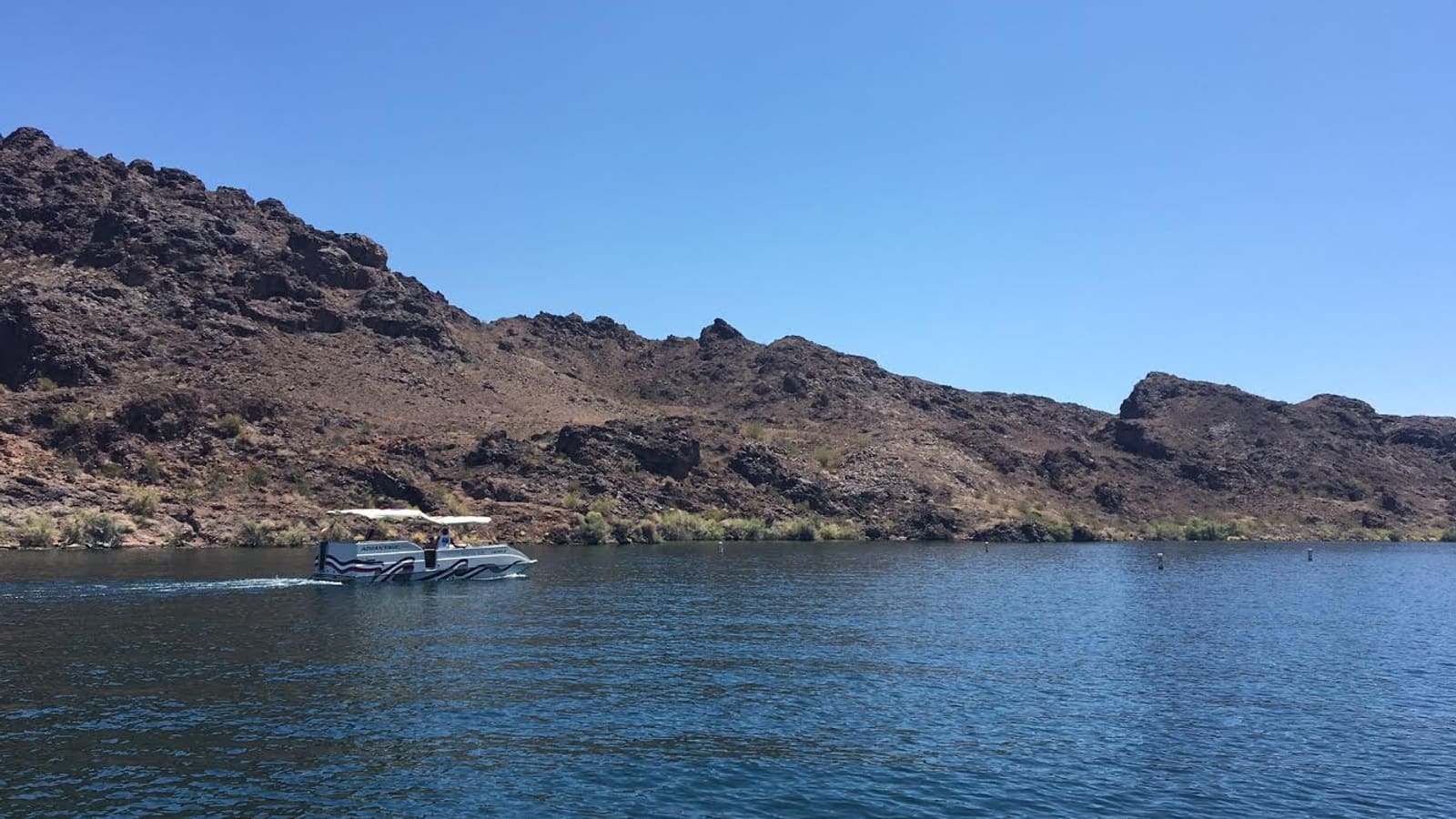
The Lake: A Colorado River Reservoir
Lake Havasu is not a natural lake but a reservoir, formed by Parker Dam on the Colorado River, which the Bureau of Reclamation completed in September 1938. Reclamation puts the reservoir at about 45 miles long and more than 20,400 acres, flanked by the Mohave Mountains in Arizona and the Chemehuevi Mountains in California. Because it is a dammed river rather than a static lake, water levels and current can vary with upstream releases, which is one of several reasons boaters should check conditions before heading out rather than relying on memory from a past trip.
That variability is not incidental -- Reclamation describes Parker Dam's job as re-regulating water releases from the Hoover and Davis powerplants upstream, smoothing the Colorado's flow for downstream users. In practice that means the level and the current you find on any given day are the product of dam operations, not weather alone, and they can change without notice. Treat a beach, a sandbar, or a shallow cove entrance you remember from a previous trip as unverified until you see it.
The lake's size and shape give it real variety for a single body of water -- a narrow developed channel at one end, wide open water in the middle, and a canyon-bound upper stretch at the other. That range is what lets Havasu serve a wakeboarding crew, a family with paddleboards, and a kayaker looking for quiet scenery all in the same weekend.
The Bridgewater Channel: Slow and Social
The Bridgewater Channel is the dredged waterway beneath the London Bridge, lined with the English Village, restaurants, and channel-front lodging. It is a no-wake zone with a 5 mph limit under Lake Havasu City Code 8.16.100, meaning boats idle through rather than open up, and it functions as a social corridor more than a boating destination in its own right -- most days on the water start or end with a slow pass through the channel. Swimming in the channel is prohibited at any time, including swimming across it, under Lake Havasu City Code 8.16.150.
For visitors without a boat, the channel is also the easiest way to see Lake Havasu's water up close -- walk the London Bridge above it, or watch the boat traffic pass beneath from the English Village waterfront.
The Open Lake and the Anchor-Out Coves
South of town the lake opens into a series of coves reachable only by boat, most notably Copper Canyon and Steamboat Cove. Some of these coves, and the famous sandbar near them, are the destination for Lake Havasu's well-known party-boat scene, where dozens of boats raft together on peak weekends like spring break, Memorial Day, and the Fourth of July.
The same coves on an ordinary weekday, or other coves entirely, are calm, family-friendly anchor-outs good for swimming and a quiet afternoon. The distinction matters: pick the wrong cove on the wrong weekend and you will get a very different trip than you planned. Ask locally or check current event calendars before choosing a spot if crowd level matters to your group.
One practical point first-timers miss: many of these shoreline landings are not free-for-all beaches. The Bureau of Land Management's Lake Havasu Field Office manages 73 boat-access campsites spread over roughly 20 miles of the Arizona shore -- Steamboat Cove among them -- and charges a day-use and camping fee. BLM currently lists $10 a day plus an additional $10 a night for up to six people, $2 for each additional person, no fee for children under 16, with a $100 annual shoreline pass available. Fees change, so confirm the current schedule with the Lake Havasu Field Office before you count on a particular site.
Renting a Boat and Launch Ramps
You do not need to own or trailer a boat to get on the lake. In-town liveries rent powerboats, pontoons, personal watercraft, and paddleboards, and guided tours, dinner cruises, and kayak trips are available for visitors who would rather let someone else handle the driving. Because rental fleets, pricing, and availability change season to season, treat any specific rental figures you find elsewhere as a starting point and confirm current rates and requirements directly with a livery before you go.
If you are trailering your own boat, Lake Havasu State Park is the most commonly used entry point. Arizona State Parks lists three boat ramps there: the North and South Windsor ramps in Lot 2 just east of the contact station, and Windsor Ramp 3 toward the south end of the park past the campground in Lot 3. A separate ramp at the north end in Lot 1 is for personal watercraft and jets only and does not allow watercraft with propellers; non-motorized craft may launch at any ramp. Additional ramps and marinas exist around the lake.
Arizona State Parks warns that water levels fluctuate and advises checking ramp conditions with a ranger, so confirm current status with the park or a local marina rather than assuming a prior visit's setup still holds.
Topock Gorge: The Quiet Alternative
North of the lake, the Colorado River narrows into Topock Gorge, a protected stretch running through the Havasu National Wildlife Refuge. The U.S. Fish and Wildlife Service calls it the longest remaining natural stretch of the lower Colorado, accessible only by river, with historic Native American petroglyphs visible from the water and parts of the corridor designated as the Havasu Wilderness. It is the deliberate opposite of the party-cove scene farther south -- scenic, quiet, and best appreciated at an unhurried pace.
Understand before you go that the gorge is a regulated refuge, not open lake, and the rules are different. The Fish and Wildlife Service restricts roughly 17 miles of the Colorado River within Topock Gorge to no recreational towing, tubing, skiing, or wakeboarding. Personal watercraft -- jet skis, WaveRunners, Sea-Doos -- and air-thrust boats are not permitted in the refuge backwaters marked by map and buoys, and those areas are further posted as no-wake zones. Castle Rock Bay is closed to personal watercraft and is a no-wake zone for all other craft. Boat mooring is not permitted on the refuge. Restricted areas are marked by regulatory signs and buoys; stay alert for them and confirm current rules with the refuge before your trip.
Paddlers generally run the gorge downstream rather than out-and-back. The Fish and Wildlife Service names Topock Marina in Arizona and Park Moabi in California as launch points, with Castle Rock at River Mile 220 as a designated take-out for non-motorized boats -- a take-out that requires portaging boats about 100 yards to and from the sandy beach landing. Plan the shuttle and the take-out before you launch, not after, and start early: the paddle pairs naturally with a morning start before the day heats up.
Water Safety: The Rules That Are Actually Law
Two of Arizona's boating rules are statute, not advice, and both are enforced on this lake. Under A.R.S. 5-331, a watercraft must carry one U.S. Coast Guard-approved wearable flotation device in good and serviceable condition for every person on board, stowed so it is readily accessible for immediate use -- and a child twelve years of age or under must wear a properly fitting Coast Guard-approved wearable life jacket the entire time the watercraft is underway. Not have one nearby. Wear it. Confirm before you leave the dock that the boat carries child-sized jackets, not just adult ones.
The second is operating under the influence. A.R.S. 5-395 makes it unlawful to operate or be in actual physical control of a motorized watercraft while impaired to any degree by alcohol or drugs, with a presumptive limit of 0.08 blood alcohol concentration and zero tolerance for minors. This is not a theoretical rule on the Colorado River: Arizona Game and Fish runs multi-agency OUI patrols and checkpoints here alongside the Mohave County Sheriff's Office and the U.S. Fish and Wildlife Service, and those stops include safety inspections for required life jackets and fire extinguishers. AZGFD notes that alcohol is a factor in about one in five boating deaths nationally. Designate a sober operator before the cooler comes aboard, not after.
There are no lifeguards. Arizona State Parks states plainly of the Lake Havasu State Park beaches: "There are no lifeguards on duty. Please swim and use beaches at your own risk." That holds for the anchor-out coves and the open lake too. Nobody is watching your group but your group, so assign an adult whose only job is watching the swimmers -- particularly children -- and rotate that job rather than assuming someone has it.
Warm air, cold water. A desert lake fed by dam releases is colder than the air temperature suggests, and the National Weather Service warns that involuntary gasping on sudden immersion can be triggered by water as warm as 77°F -- which is a drowning emergency if you inhale water during it. Arizona State Parks likewise cautions that water temperatures at the park vary significantly and suggests an insulated swimming outfit. Enter the water deliberately rather than jumping in, and keep a life jacket on anyone who is not a strong swimmer.
Carbon monoxide behind the boat. Engine and generator exhaust collects in the air space under and around the stern deck and swim platform, and the CDC warns that carbon monoxide building up there can kill in seconds. Do not let anyone ride, hang from, or swim near the swim platform of a running boat -- the practice sometimes called teak surfing has killed people -- watch children closely on rear platforms, never block an exhaust outlet, and dock, beach, or anchor at least 20 feet from the nearest boat running a generator or engine.
Heat is the headline hazard. This is not ordinary summer heat. The hottest temperature ever recorded at an official National Weather Service observing site in Arizona was 128°F, set at Lake Havasu City on June 29, 1994 -- hotter than Phoenix has ever been. Summer days above 110°F are routine. Being on the water masks the load without removing it: drink far more water than feels necessary, use shade, watch everyone aboard for heavy sweating that stops, confusion, or nausea, and get anyone showing those signs into shade and cool water immediately. Never leave a child or a pet in a parked vehicle for any length of time, and be careful with hot vinyl seating and metal hardware, which will burn skin.
Monsoon wind and lightning. The National Weather Service fixes Arizona's monsoon season at June 15 through September 30, when thunderstorm hazards are most likely. Storms build fast, and NWS notes lightning can strike as far as 60 miles from the nearest rainfall -- an open boat on open water is the worst place to be when one arrives. Check the forecast before you launch, watch the sky upwind through the afternoon, and get off the water and into a substantial shelter or an enclosed vehicle at the first thunder rather than trying to outrun the cell.
Two more worth stating outright. Sun exposure is worse on the water than on land, because water reflects ultraviolet radiation back at you on top of what comes down directly -- the EPA and CDC both flag water, sand, and snow as reflective surfaces that raise sunburn risk, so plan sunscreen, a hat, and covering layers accordingly. And do not jump from cliffs, jetties, bridges, or rock ledges into the lake: depth and submerged rock change with the reservoir level, which is set by dam operations rather than anything you can see from above, and there is no lifeguard and often no cell signal in the coves.
Arizona's boating and personal-watercraft rules also set minimum operating ages and equipment requirements beyond the ones above, and they are periodically updated, so confirm current regulations with the Arizona Game and Fish Department or your rental livery rather than relying on general boating knowledge.