Where the Bridge Came From: London, 1831-1968
The bridge now standing in the Arizona desert first opened in London in 1831, replacing an earlier medieval crossing over the River Thames. For well over a century it carried the ordinary daily traffic of a growing city, but by the mid-20th century engineers found that the bridge was slowly sinking under a volume and weight of traffic its original builders could never have anticipated. Rather than attempt an expensive repair in place, the city of London decided to replace the span entirely and looked for a way to dispose of the old structure.
That decision -- to sell the old bridge rather than simply demolish it -- is the entire reason this story exists. Most retired bridges are quietly torn down. This one was auctioned, and its next chapter played out on the far side of the world, at the end of a shipping route U.S. Customs records put at roughly 10,000 miles, in a town that did not yet fully exist.
The Sale: Robert McCulloch's Bet on a Bridge
Robert McCulloch, a chainsaw and outboard-motor manufacturer, had founded Lake Havasu City in 1963 as a planned community on the Arizona shore of the reservoir behind Parker Dam. Like many mid-century desert developments, it needed a way to stand out and draw buyers to what was, at the time, a remote stretch of shoreline. In 1968 McCulloch bought the retired London Bridge for a widely cited figure of about 2.46 million dollars, a price that made national news on its own.
The purchase was, by most accounts, as much a marketing move as a preservation effort -- but it worked on both counts. Lake Havasu City got a genuine, one-of-a-kind landmark instead of another anonymous sunbelt subdivision, and the bridge itself avoided the wrecking ball. Exact contemporary figures and financing details vary by source, so treat the widely repeated purchase price as an approximate, well-established figure rather than an audited number.
Stone by Stone: The Journey to Arizona
Moving a bridge across an ocean is not like moving a building. Crews in London carefully numbered each exterior granite facing stone before dismantling the structure, recording where every block had to go back once the bridge was reassembled. Only the facing stones -- the visible outer skin of the bridge -- made the trip; the original Victorian-era interior structure stayed behind.
The numbered stones were shipped across the Atlantic, through the Panama Canal, and up the Pacific coast to the Port of Los Angeles at Long Beach, California, then trucked overland into the Arizona desert to the Lake Havasu City site. It was a slow, deliberate process by the standards of any era, and the fact that it was completed at all -- stone by stone, on schedule, in a location with no existing bridge-building infrastructure -- is part of what makes the relocation such an unusual feat of mid-century engineering logistics.
Rebuilding the Bridge and Dredging the Channel
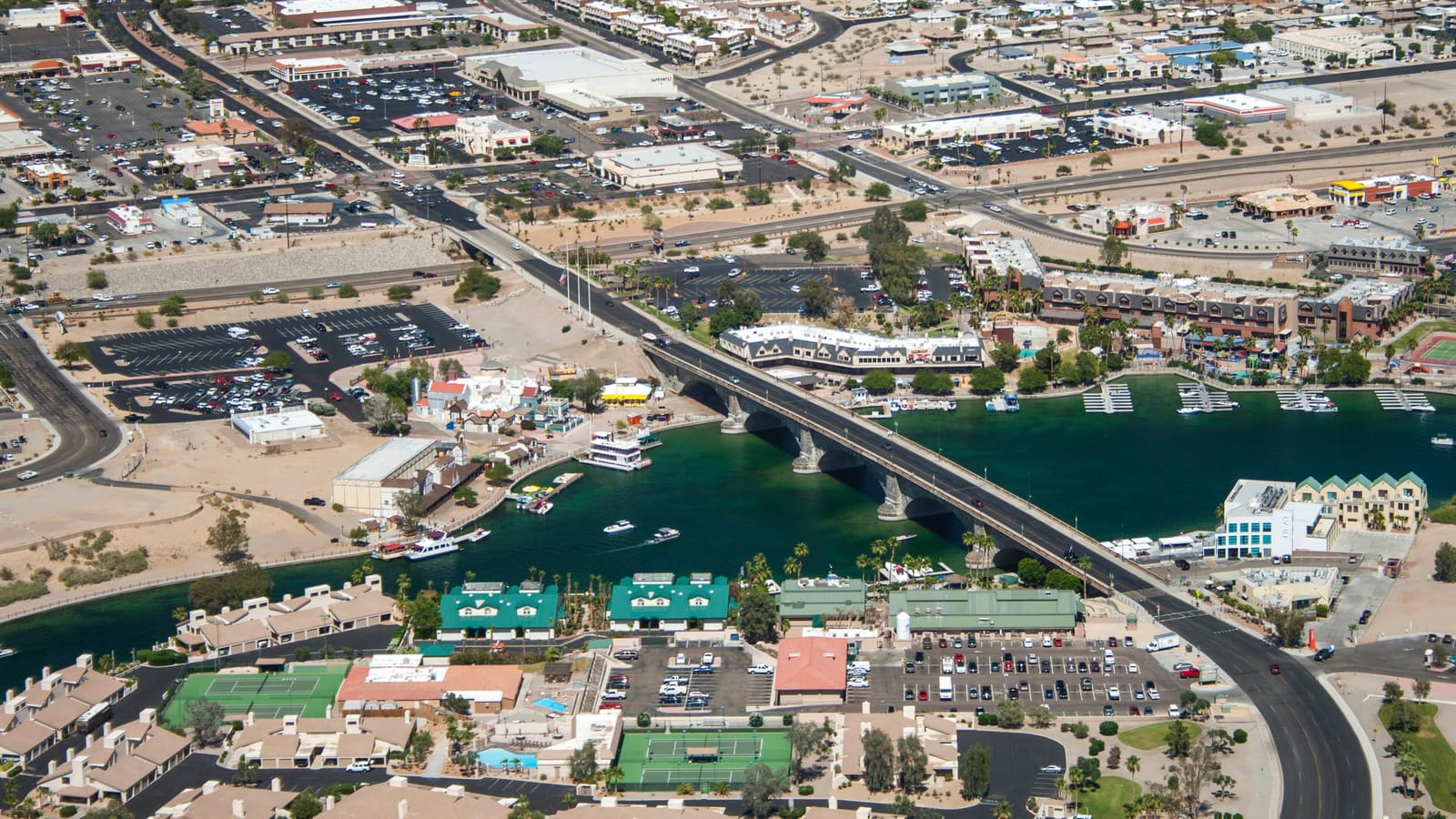
In Arizona, the numbered granite stones were fitted onto a new steel-reinforced concrete structure built specifically to receive them -- essentially a modern bridge wearing its original 1831 stone face. When the rebuild was finished, the bridge stood over dry desert land, not water. Crews then excavated the ground beneath it to create what is now known as the Bridgewater Channel, connecting it to the main body of Lake Havasu.
That order of operations -- rebuild the bridge first, dig the channel under it second -- is one of the details visitors are most surprised to learn. It also explains why the channel is relatively narrow and straight compared to the open lake beyond it: it was purpose-built to give the relocated bridge a body of water worthy of the name.
The English Village and Walking the Bridge Today
At the Arizona end of the bridge sits the English Village, a small waterfront district built with a loosely English architectural theme to match the bridge's origin. It holds shops, restaurants, and lodging along the Bridgewater Channel and functions as the walkable heart of the town's tourist core -- the place most visitors park, eat, and set out from to cross the bridge on foot.
Walking across takes only a few minutes, and interpretive plaques along the route explain the relocation story in more detail than a passing glance can offer. Because specific shops, restaurant names, and operating hours in the English Village change over time, check current listings before you go rather than relying on an older list.
One practical caution: the walk is short, but the setting is not forgiving. Normal daily highs here average about 110°F in July and 107°F in August (Western Regional Climate Center), and the bridge deck and the channel-front walkways offer very little shade. The National Weather Service advises rescheduling outdoor activity to the coolest part of the day, drinking water steadily even before you feel thirsty, and wearing light, loose, light-colored clothing. Never leave a child or a pet in a parked vehicle, even briefly and even with the windows down — NWS notes vehicle interiors reach lethal temperatures within minutes. In summer, do the bridge early in the morning or after sunset.
Why the Bridge Became the Town's Centerpiece
Lake Havasu City is, first and foremost, a boating town built around the reservoir behind Parker Dam. But it is the bridge that gives the town a recognizable identity beyond the lake itself -- a single, improbable image that separates Havasu from any other desert reservoir community in the Southwest. Boats pass under it constantly, sightseers walk it daily, and nearly every itinerary for the town includes at least a stop at the English Village to see it up close.
More than half a century after the relocation, the bridge still does the job McCulloch originally intended: it gives a town on a reservoir a story no other reservoir town can tell, and it remains the first thing most people picture when they hear the name Lake Havasu.