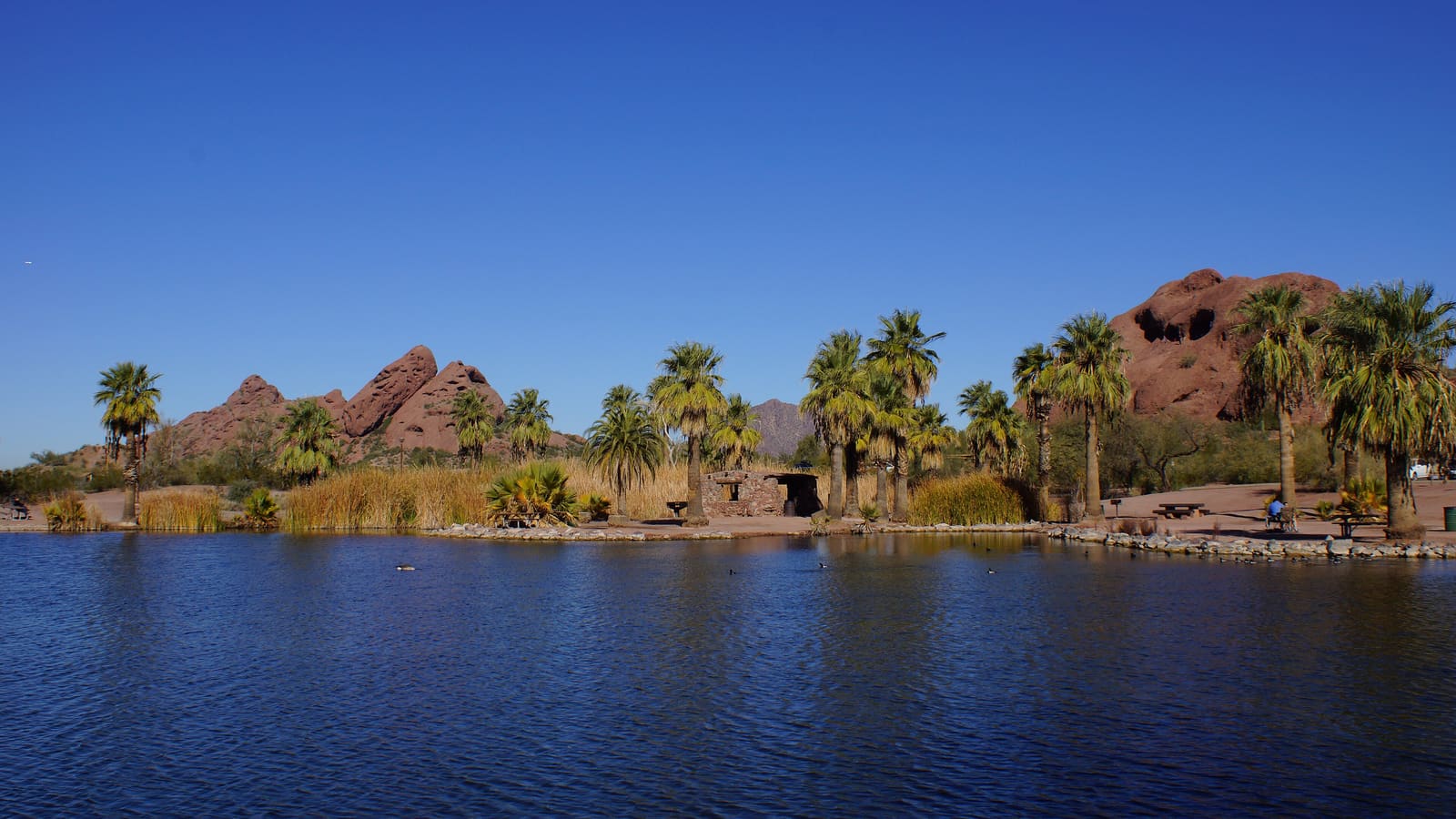
Where Papago Park Is and What It's Like
Papago Park sits along the boundary between Phoenix and Tempe, a low cluster of red sandstone buttes rising out of the flat Valley floor. Unlike the taller peaks around Camelback or Piestewa, the terrain here is gentle -- rounded rock formations, washes, and short rises rather than a summit push -- which makes it approachable for almost any visitor, including families and people who are not looking for a strenuous hike.
This is a City of Phoenix park, and it packs in more than most visitors realize: picnic ramadas, the Papago Ponds fishing lagoon, an archery range, an orienteering course, the Hall of Flame Museum, the Papago Sports Complex, and the Papago Golf Course, home of the Arizona State Sun Devils' golf team. Unlike most City of Phoenix ramadas, the ones at Papago Park require a reservation, made in person at a Parks and Recreation facility. If you plan to fish the ponds, check current Arizona Game and Fish licensing requirements first.
Know the hours before you plan an evening visit. Parking and entrance gates east of Galvin Parkway run 5 a.m. to 7 p.m.; areas west of Galvin Parkway are open sunrise to sunset. Trail hours are 5 a.m. to 11 p.m. Those are not the same thing -- for much of the summer, sunset in Phoenix falls after 7 p.m., so a car parked behind an east-side gate can be shut in before the light is gone. Confirm which entrance serves your parking area on the City of Phoenix Papago Park page before you go.
Hole-in-the-Rock
Hole-in-the-Rock is the park's signature feature -- a red sandstone butte eroded over time into a formation with a natural opening near the top. A short, informal scramble up worn rock leads to the opening, and once inside, the hole frames a view out over the park and the surrounding city. It is one of the more photographed spots in Phoenix, particularly around sunset.
The climb is not technical, but it is still uneven natural rock, so footing matters more than it looks like it should from the parking area. Because it is a small, popular formation, expect other visitors at peak times, and be mindful of loose rock and the drop-off near the opening, especially with children.
Hunt's Tomb
Hunt's Tomb is a white pyramid-shaped monument built in 1932 as the burial place of George W.P. Hunt, Arizona's first state governor, who served seven terms between 1912 and 1933 and died in Phoenix on Christmas Eve, 1934. Family members are also interred there; for the definitive list, the tomb's National Register of Historic Places file is the authority. It sits on a small rise in the park, reachable by a short walk from a nearby parking area, and its stark white shape stands out against the red rock and desert scrub around it.
It's a quick stop rather than a destination hike -- most visitors spend a few minutes at the tomb and the overlook near it before moving on to another part of the park. It's an easy add-on if you're already at Papago Park for Hole-in-the-Rock or the ponds and want one more short stop.
Trails and Difficulty
Papago Park's trail network is generally easy compared to the Valley's mountain hikes -- mostly flat to gently rolling terrain connecting the buttes, ponds, and picnic areas, with a few short, rockier sections near formations like Hole-in-the-Rock. Some paths are paved and suitable for strollers or casual walking, while others are natural-surface trails used by hikers, joggers, and cyclists.
Because the park has multiple access points and connecting paths, it's worth checking a current trail map before you go if you want a specific route, particularly if you plan to link Papago Park with a walk toward the Desert Botanical Garden or the Salt River area on the same visit.
Papago Park and Its Neighbors
Part of what makes Papago Park convenient is what it contains. The City of Phoenix describes the park as home to two of the region's most visited attractions -- the Phoenix Zoo and the Desert Botanical Garden -- so a visitor can reasonably combine Papago Park with either in a single outing without much extra driving. Both the zoo and the garden charge separate admission and are run independently of the park itself, so check their own sites for current hours and pricing.
The park also sits close to the Salt River, and its eastern edges connect toward Tempe, making it a reasonable midpoint stop for anyone splitting a day between central Phoenix, Tempe, and Scottsdale. Its central location is a big part of why it shows up on so many first-time visitor itineraries.
Best Time to Go and What to Bring
Roughly November through March offers the most comfortable conditions for walking around Papago Park, though because the terrain here is gentler than the Valley's mountain trails, it's also more forgiving in the shoulder seasons than a summit hike would be. Late afternoon into sunset is a popular window for Hole-in-the-Rock specifically, since the low light brings out the color in the sandstone.
Summer still gets genuinely dangerous here even though the trails are short. Easy terrain is not the same as safe terrain: the City of Phoenix reports more than 200 hikers a year rescued from its desert parks and preserves, and short exposed trails with no shade are exactly where visitors underestimate the heat. Follow the city's own checklist -- hydrate before you go, carry more water than you think you need, and turn back toward the trailhead before you drink all of it. Wear proper shoes, a hat, and sunscreen, carry a phone, and go early morning or evening rather than midday.
Leave the dog home when it's hot. The Phoenix Parks and Recreation Code of Conduct prohibits endangering dogs on difficult trails or in adverse weather conditions, such as temperatures over 100°F, in any desert park or mountain preserve. Papago's rock and pavement hold heat long after the air starts cooling.
Heat illness: per the National Weather Service, heat exhaustion shows up as heavy sweating with cool, pale, clammy skin, plus weakness, cramps, headache, dizziness or nausea -- move the person somewhere cool, loosen clothing, apply cool wet cloths, and give small sips of water, then get medical help if they vomit, worsen, or don't improve within an hour. Heat stroke is different and far more urgent: confusion, slurred speech, hot red dry or damp skin, body temperature above 103°F. Call 911 immediately, cool the person, and do not give fluids.
Wildlife and weather: venomous rattlesnakes live in these desert parks -- keep well clear and never handle one. If bitten, the Arizona Poison and Drug Information Center advises staying calm, moving as little as possible, removing tight jewelry or clothing from the limb, and getting to the nearest medical facility immediately, while avoiding ice, tourniquets or constricting bands, suction extractors, cutting, and alcohol or medication. The NWS monsoon season runs June 15 through September 30, when afternoon thunderstorms, dust storms, and flash flooding in washes can arrive quickly. Check the City of Phoenix parks page for current hours, closures, and facility-specific rules before you go.