Desert Botanical Garden
Desert Botanical Garden sits inside Papago Park on the east side of Phoenix, at 1201 N. Galvin Parkway, and is built entirely around desert plant life -- its living collection runs to more than 4,800 species across a 140-acre site, with saguaro, agave, and cactus displays laid out along marked trails. The scale of the cactus collections tends to hold kids' attention in a way that a more conventional garden might not. Check the garden's own accessibility information for current trail surfaces and stroller guidance before you go.
Summer changes how the garden works. It runs extended summer hours of roughly 6 a.m. to 10 p.m., but closes its trails, restaurant, and shop from 1 to 5 p.m. for peak heat -- so a summer visit is an early morning or an evening, not a midday stop. The garden also runs a rotating calendar of family and seasonal programming, including Las Noches de las Luminarias, its holiday-season evening event lit by thousands of luminaria, and after-dark light installations in summer. Because programming, hours, and ticket prices change, check the official Desert Botanical Garden site for what is running during your visit before you plan around a specific event.
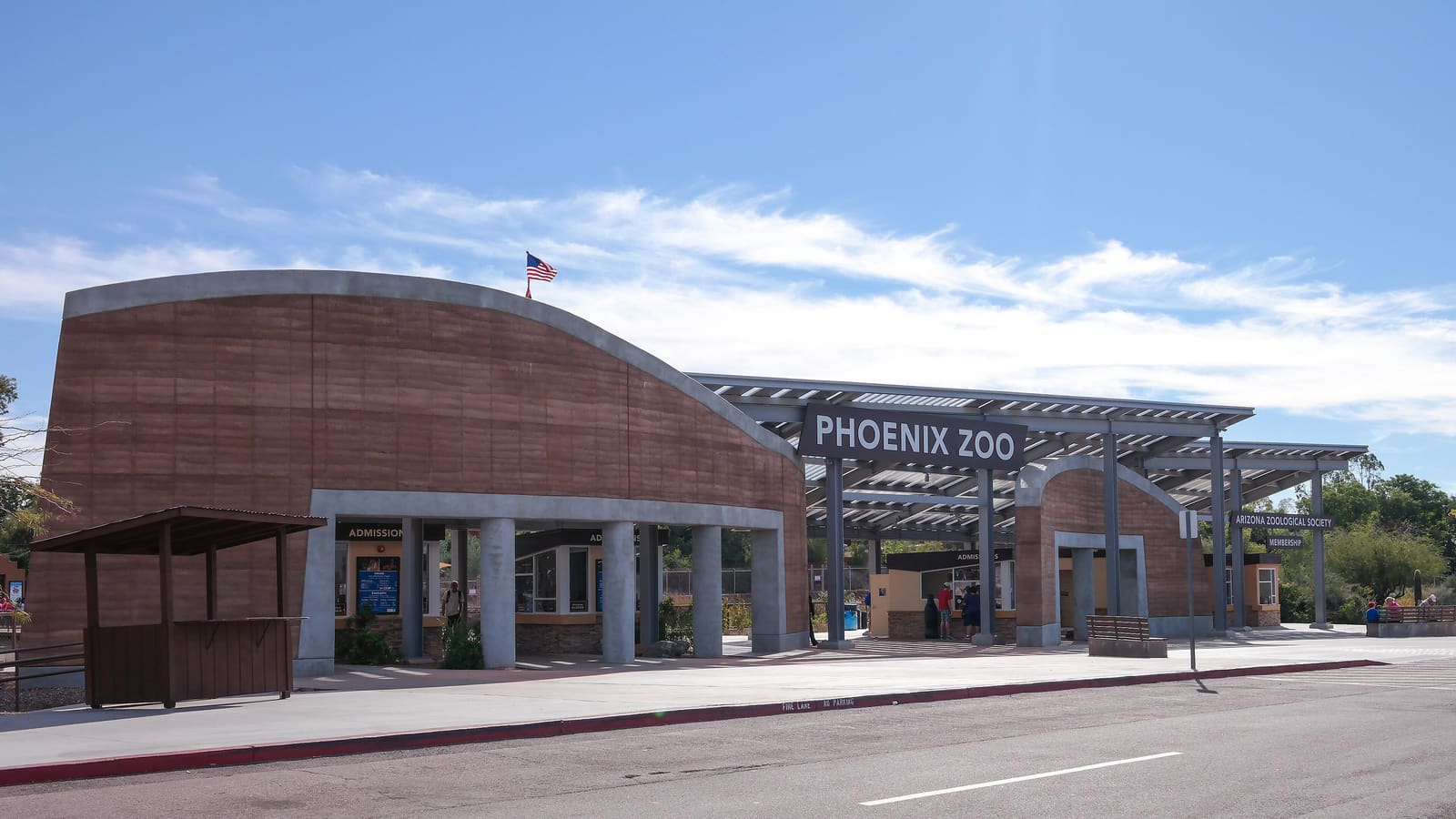
Phoenix Zoo
The Phoenix Zoo shares Papago Park with Desert Botanical Garden, at 455 N. Galvin Parkway, which makes the two easy to pair into a single day without much additional driving. The zoo covers a range of exhibits organized loosely by region, and outside of summer a family visit can run from a couple of hours to most of a day depending on how much ground you want to cover.
The zoo is a largely outdoor attraction, and its posted hours are built around the heat rather than around convenience. The zoo lists June through August hours of 7 a.m. to 1 p.m. daily -- it is simply closed for the afternoon -- with 8 a.m. to 4 p.m. in May, a mixed September schedule, 9 a.m. to 4 p.m. from October to mid-January, and 9 a.m. to 5 p.m. from mid-January through April. Plan a summer visit as a sunrise start, not a mid-morning one, and confirm current hours and ticket prices on the official site before you go.
OdySea Aquarium
OdySea Aquarium is at 9500 E. Via de Ventura, in the Talking Stick Entertainment District on the Salt River Pima-Maricopa Indian Community, just off Loop 101 east of Scottsdale -- a drive rather than a walk from the Papago Park attractions, and on tribal land rather than in the city of Scottsdale proper despite the Scottsdale mailing address. Its galleries are indoor exhibits, which makes it the practical option to hold in reserve for the hottest part of a summer trip or for an extreme-heat day at any time of year.
As an indoor attraction, it is less affected by the season-driven timing rules that govern the rest of this list, though ticket prices, current exhibits, and hours are still worth checking on the official site before you go, since aquarium attractions periodically rotate special exhibits.
Papago Park Beyond the Zoo and Garden
Papago Park itself is more than just the zoo and garden -- it includes its own hiking trails, picnic areas, and the well-known Hole-in-the-Rock formation in the park's sandstone buttes. The City of Phoenix describes the Hole-in-the-Rock Trail as a very short natural dirt-and-step path wrapping around the butte to a large viewing hole looking out over the metro area -- kid-manageable, and a good option if you want an outdoor stop that isn't a full ticketed attraction.
The park's trails are generally gentler than the Valley's marquee mountain hikes, which makes it a reasonable place to introduce kids to desert hiking before attempting anything steeper. Even here, though, the same heat rules apply -- go early, carry water, and treat the middle of a summer day as off-limits for anything more than a quick stop.
Hiking with Kids in Phoenix
Steep, scrambling routes like Camelback Mountain or the Piestewa Peak summit trail are not appropriate for young kids. The City of Phoenix rates Camelback's Cholla Trail extremely difficult and warns that only capable, prepared, experienced hikers should attempt the final third to the 2,704-foot summit, which is extremely steep, boulder-strewn, and hard to follow; the Piestewa Peak summit trail, topping out at 2,608 feet, carries the same extremely difficult rating. Families looking for an outdoor hike are better served by flatter trail segments in Papago Park or the gentler washes in the area's desert preserves.
Know the closure rule before you drive to a trailhead. Under the City of Phoenix Trail Heat Safety Program, whenever the National Weather Service issues an Extreme Heat Warning, Camelback Mountain's Echo Canyon and Cholla trails, the Piestewa Peak Summit trail and its associated trails, and South Mountain's Holbert, Mormon, and Hau'pal Loop trails plus National Trail access from the Pima Canyon trailhead all close from 8 a.m. to 5 p.m. That covers most of the "easy lower trails" families reach for at South Mountain, so treat a summer hike as a sunrise-to-8-a.m. window or skip it.
Whatever trail you choose, plan around the temperature rather than the calendar date. The city's own hiking guidance is to go when it's cool, carry more water than you think you need, and turn back before you have drunk half of it; the CDC benchmark it cites is roughly 8 ounces of water every 15 to 20 minutes while you are outdoors. More than 200 hikers are rescued each year from Phoenix desert and mountain parks and preserves. Check current trail conditions and any posted heat advisories before you go.
Timing a Family Day Around the Heat
Roughly November through March is the easiest season for outdoor family activities in the Valley, with mild days that make Papago Park, the zoo, and the garden comfortable at almost any hour. Spring and fall shoulder months still work well if you lean toward morning outdoor time.
Summer changes the plan rather than ruling it out -- treat outdoor stops as an early-morning activity, and hold aquarium visits or other indoor options for the hottest part of the day. The numbers behind that advice, from NOAA's 1991-2020 normals for Phoenix Sky Harbor: average daily highs of 104.2 F in June, 106.5 F in July, 105.1 F in August, and 100.4 F in September. Phoenix's all-time record is 122 F, set on June 26, 1990. Check current conditions and any heat advisories from the relevant park or attraction before finalizing a summer family itinerary.
Heat, Car, and Water Safety with Kids
Never leave a child or a pet in a parked car in the Valley, not even for a minute with the windows cracked. The National Weather Service measures a parked vehicle reaching 99 F within 10 minutes, 109 F within 20 minutes, and 123 F within an hour when it is only 80 F outside -- and Phoenix summer afternoons start 25 to 40 degrees above that. Leaving the windows slightly open does not meaningfully slow the heating, and a child's body warms three to five times faster than an adult's. Build the habit of checking the back seat every single time you park.
Learn the two heat illnesses before you need them. Heat exhaustion looks like heavy sweating, cold clammy skin, a fast weak pulse, nausea or vomiting, muscle cramps, and weakness: move the child somewhere cool, loosen clothing, apply cool wet cloths or give a cool bath, and have them sip water. Get medical help if they are vomiting, if symptoms worsen, or if they last more than an hour. Heat stroke is different and is a medical emergency -- a body temperature of 103 F or higher, hot red skin that may be dry rather than sweaty, headache, dizziness, confusion, or loss of consciousness. Call 911 immediately, move the child to a cooler place, and cool them with wet cloths while help is on the way. Do not give fluids to anyone who is unconscious. Body temperature can reach 106 F within 10 to 15 minutes once heat stroke sets in.
Treat the resort pool as the highest-risk part of the trip. The Arizona Department of Health Services reports that drowning is the leading cause of death for Arizona children ages one to four and the second leading cause of unintentional injury death for ages five to fourteen, with most deaths occurring in pools and hot tubs and the leading risk factors being lack of supervision, inability to swim, and missing pool barriers. In a hotel or vacation rental, that means an adult whose only job is watching the water, within arm's reach of any young or non-swimming child -- not a lifeguard, not an older sibling, and not someone on a phone. Check that gates self-close and self-latch, and keep the room door to a pool area secured.
If you're visiting between June 15 and September 30, you're in monsoon season -- the fixed window the National Weather Service uses because that is when the hazards are most likely. Expect sudden afternoon and evening thunderstorms, dust storms known locally as haboobs, and flash flooding in normally dry washes, including washes that cross trails and roads far from where the rain fell. Never let kids play in a wash when storms are anywhere in the area, and never drive around a barricade onto a flooded roadway: under Arizona's "Stupid Motorist Law," A.R.S. section 28-910, a driver who does is liable for the cost of the emergency response required to get the vehicle and everyone in it out. Turn around, don't drown.