A Brief History
The mission's origins go back to 1692, when the Jesuit missionary Father Eusebio Francisco Kino first visited the O'odham village of Wa:k, in the region then known as the Pimería Alta. Kino began foundations for a church at the site in 1700 -- the date generally given as the mission's founding -- but that first building was never completed. The church standing today is a later, Franciscan project: construction began in 1783 under Father Juan Bautista Velderrain, with architect Ignacio Gaona, and was completed in 1797 under his successor, Father Juan Bautista Llorens. Those two dates get conflated constantly, and they are nearly a century apart: the mission was founded in 1700, and the church you actually walk into was finished in 1797.
Throughout this history, the mission has been closely tied to the Tohono O'odham people, whose ancestral presence in the region predates Spanish contact by a considerable margin. The mission was built to serve this community, and that relationship has continued in various forms across the centuries since, making San Xavier del Bac as much a chapter in Tohono O'odham history as in the history of Spanish colonization in the Southwest.
The Secretary of the Interior designated the mission a National Historic Landmark in 1960, and it was added to the National Register of Historic Places in 1966. The mission describes the 1797 church as the oldest intact European structure in Arizona. One point worth being clear about before you go: despite the landmark designation, San Xavier is not a state park, a national park, or a federally run site. It is a working parish church on tribal land, and it is administered accordingly.
The Architecture
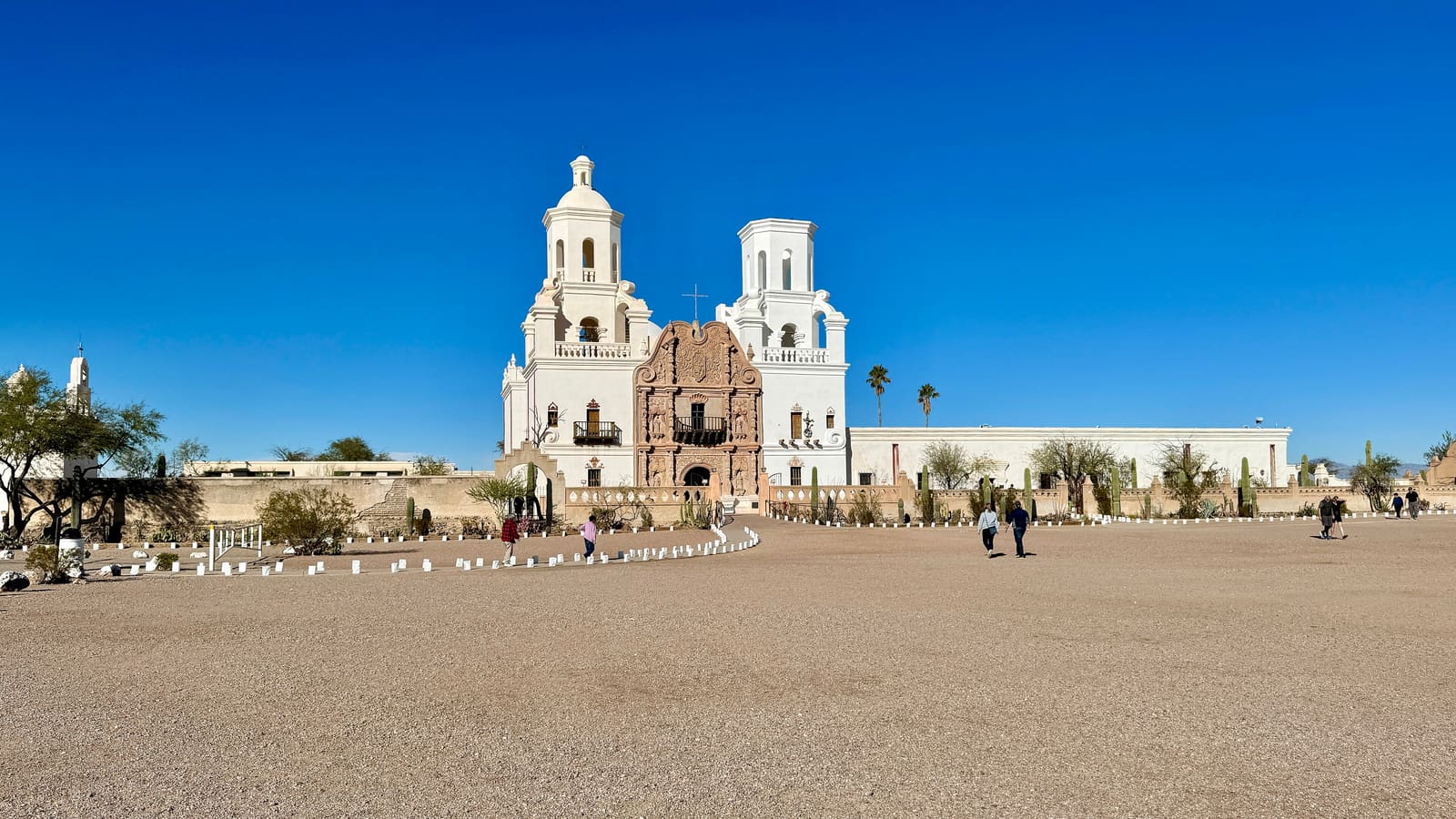
The mission is generally described as an example of Spanish colonial architecture with Mexican Baroque influences, visible in its ornamented facade, asymmetrical twin towers, and domed roofline. The whitewashed exterior is the source of the "white dove of the desert" nickname, which the National Park Service uses as well -- the building's pale form stands out distinctly against the surrounding Sonoran Desert landscape. The NPS describes the church's Baroque styling as carrying Byzantine and Moorish influences, with two octagonal towers topped by belfries over a Latin-cross plan. The mission's own account calls the 1797 building the oldest intact European structure in Arizona; broader "best-preserved in the country" rankings turn up often in travel writing but are not a designation any authority actually confers, so treat them as characterization rather than fact.
The interior contains historic religious artwork and statuary consistent with the Baroque-influenced design tradition, including painted and sculpted decoration throughout the nave and side chapels. Conservation and restoration work has taken place over time to maintain the building and its artwork, and current interior conditions, any active conservation projects, and visitor access to specific interior areas are best confirmed with the mission directly before a visit, since these details can change.
An Active Church on Tribal Land
Mission San Xavier del Bac sits in the village of Wa:k, in the San Xavier District of the Tohono O'odham Nation, about nine miles south of Tucson. It is an active Roman Catholic parish of the Diocese of Tucson, not solely a historic monument -- Mass and other religious observances take place regularly, and the church continues to serve a congregation rooted in the Tohono O'odham community. The mission states plainly that it "is located on tribal land and adheres to tribal regulations." You are a guest on sovereign tribal land and in an active house of worship at the same time, and both of those contexts govern the visit.
How seriously the parish treats the church as a sacred space is easy to see in how tours are run: the free docent-led tours offered by Patronato San Xavier cover the mission grounds but deliberately do not go inside the church, in order to comply with parish directives preserving the interior as a space for worshippers. Visitors are welcome to enter the church on their own, before or after a tour, during public hours. Take that as the frame for your own conduct inside. The mission does not publish a blanket photography ban, so the standard applied here is the one you would bring to any active church rather than a posted rule: quiet voices, modest dress, leaving the historic artwork and statuary untouched, and not photographing worshippers or an active service. Where the mission does set explicit rules, follow them rather than guessing -- drones are covered by the mission's own published drone policy, and because the site is on tribal land it also adheres to tribal regulations. Confirm current access, photography, and drone rules with the parish before your visit; posted guidance at the site takes precedence over anything in this guide.
Supporting vendors from the Tohono O'odham community, where present at the site, is a way to engage with the visit that extends beyond simply viewing the building.
Visiting Respectfully
Because the mission is both a historic landmark and an active parish on tribal land, the most useful frame for a visit is closer to visiting a working church than touring a museum. This means checking whether a service is scheduled during your planned visit window and adjusting accordingly, rather than assuming the building operates purely on tourist-visitor hours. It also means treating the site with the same conduct expected at any active Catholic church -- quiet voices, appropriate dress, and awareness that other visitors may be there specifically to pray rather than to sightsee.
The mission lists the church as open to the public 9 a.m. to 4 p.m., with the gift shop open 8 a.m. to 5 p.m. and the museum and mausoleum open 9 a.m. to 4 p.m. There is no admission charge for a visit, and the docent-led grounds tours are offered free on a donation basis; the parish accepts donations toward the building's upkeep. Access closes off during weddings, funerals, and other special church functions, which are not published far in advance, so confirm hours and any service schedule with the parish before building a trip around a specific arrival time. The surrounding plaza area has historically hosted small vendors selling food and crafts connected to the Tohono O'odham community -- current availability varies and is worth checking if that is part of what you hope to see.
Getting There from Tucson
The mission is about nine miles south of Tucson, at 1950 W. San Xavier Road, reached off I-19 south of the city. That is a short drive from central Tucson, but check a current mapping app for your own timing rather than working from a fixed figure, since it depends entirely on where in the metro area you start and on traffic. It is commonly visited as part of a broader day-trip itinerary that includes other south-Tucson or southern-Arizona destinations, since it sits along routes that also lead toward Green Valley and other points south.
A car is effectively required to reach the mission, as it is not within walking distance of downtown Tucson or served by frequent public transit connecting directly to the site. Parking is generally available near the mission grounds -- confirm current arrangements directly with the mission if you have specific accessibility needs, since facilities and access can vary.
Practical Notes
Because the mission is an active parish, its schedule can differ from a typical tourist attraction -- confirm current visiting hours, Mass times, and any temporary closures for conservation work directly with the mission before planning your trip around a specific arrival time.
Two heat-related points matter here more than at a typical museum stop. First, the church has no modern climate control -- the mission tells visitors to come prepared for the weather, bringing water and sun protection in the hot months and dressing warmly in winter, because the building will not insulate you from either. Second, the docent-led grounds tours are suspended outright when the temperature exceeds 95°F, a policy Patronato San Xavier states is for the safety of visitors and docents alike. In a Tucson summer that threshold is crossed routinely, so if a guided tour is the reason you are going, plan for a cooler month or an early start and check before you drive out. The plaza is open and largely unshaded in any season.
If the historic and architectural aspects of the mission are your primary interest, consider pairing the visit with other south-Tucson history sites for a fuller day, but keep the central point in mind throughout: this is first a place of worship and community significance to the Tohono O'odham Nation and the Catholic parish it serves, and a landmark of Spanish colonial architecture second.