Why Start at the Presidio
Tucson traces its founding to Presidio San Agustín del Tucsón, a fort whose construction was authorized by Hugo O'Conor in 1775. The date most often given for the city's founding is August 20, 1775. After Mexico gained independence from Spain in 1821, the town became part of the Mexican state of Sonora. The United States acquired the region through the Gadsden Purchase, with the treaty dated 1853 and the transfer effective in 1854, and American forces formally took control in 1856.
That sequence is why downtown Tucson feels different from a city planned in a single era. Spanish colonial, Mexican, territorial, and modern layers sit within a few blocks of one another.
El Presidio: The Oldest Neighborhood
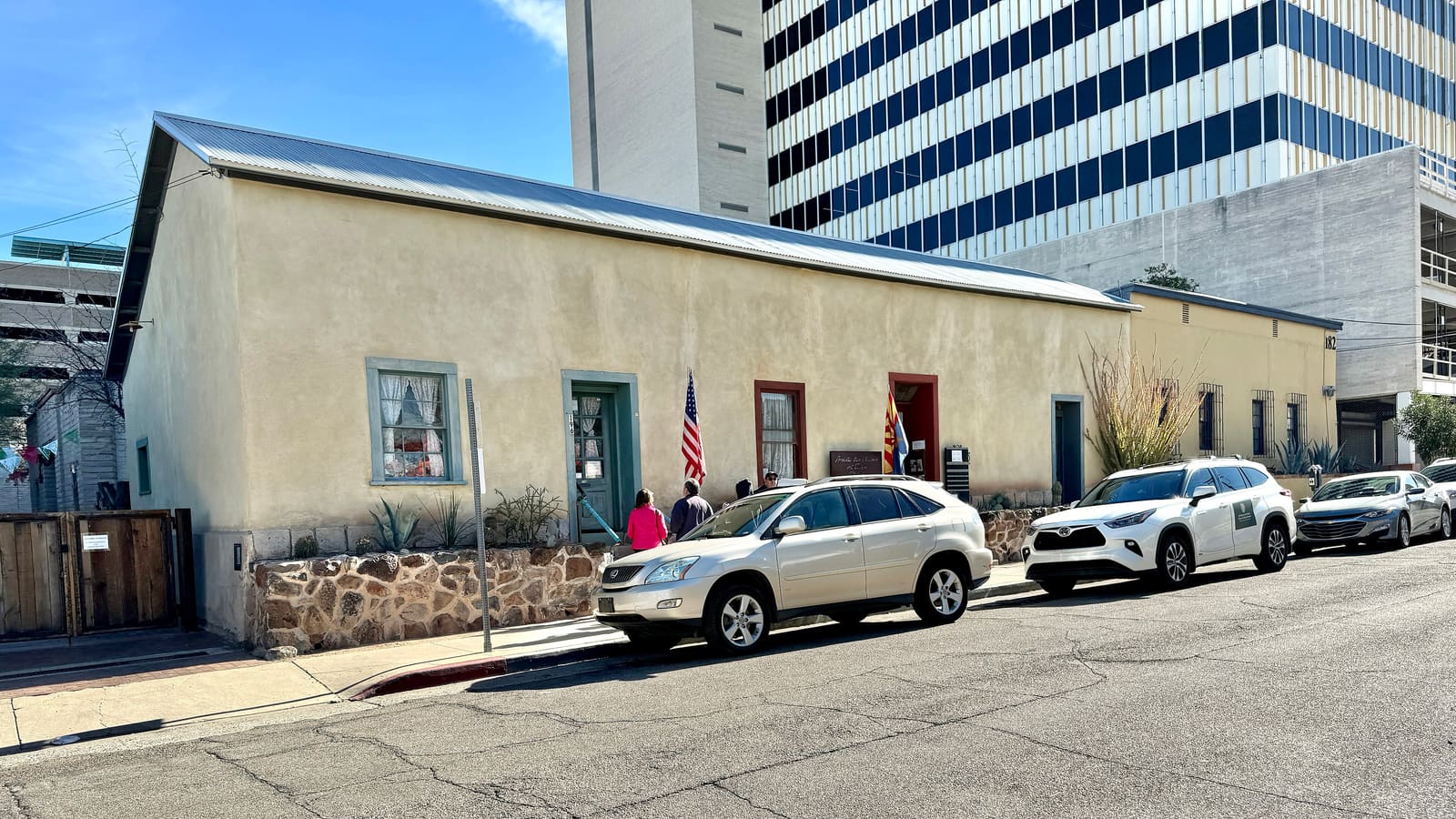
El Presidio is Tucson's oldest neighborhood, named for the fort that started it all. A museum building on Court Avenue reconstructs the northeast corner of the original presidio, built in the 2000s as a modern interpretation of the old walls rather than a surviving original structure. That is worth keeping in mind: you are looking at a reconstruction on or near the original footprint, not a 1775 building.
Check the museum's current hours, tour options, and admission directly with the operator before you go, as these change.
El Presidio Park is also nearby. It hosts the Tucson Folk Festival, which has traditionally been held on the first weekend of May, though you should verify the current schedule.
Barrio Histórico and Its Neighbors
South of the downtown core, Barrio Histórico, also known as Barrio Libre, is among the neighborhoods that preserve Tucson's Mexican-American heritage. Local usage of the names varies, and you will also hear it called Barrio Viejo, so expect to see more than one name on maps and signs.
Other historic barrios came later. Barrio Santa Rosa dates from the 1890s and is listed as a historic district on the National Register of Historic Places. Barrio Anita sits between Granada Avenue and Interstate 10. Barrio El Hoyo was largely cleared for the convention center, a reminder that preservation here was shaped by urban renewal decisions as much as by time.
A Simple Way to Walk It
You do not need a rigid route. A workable loop looks like this:
- Begin at the reconstructed presidio corner and the surrounding El Presidio blocks.
- Walk toward the downtown core and look for the older adobe-style buildings along the way.
- Continue south into Barrio Histórico, where the narrow streets and rows of adobe-style houses are the draw.
- Look for the Fremont House, an original adobe saved from the urban renewal that cleared an early barrio near the convention center. Confirm whether and when it is open to visitors.
Wear sun protection and carry water, even in cooler months. Tucson sun is strong, shade is uneven, and this is a walking-heavy outing. Keep to public sidewalks and remember that these are lived-in neighborhoods; be considerate when photographing homes.
Adding to the Day
The murals and public art guide covers art you can see on the same side of town. For deeper background, the art and culture guide puts the museums and galleries in context. And if you want to see where Tucson's food traditions come from, the Mission Garden guide covers a site west of downtown tied to the same early history.