Why Tucson's Streets Double as a Gallery
A meaningful share of Tucson's civic public art -- work at parks, transit stops, and other publicly funded sites -- exists because cities and counties across the country, Tucson and Pima County included, commonly fund public art through a percentage of capital construction budgets, often administered locally through the Arts Foundation for Tucson and Southern Arizona (known as the Tucson-Pima Arts Council until a 2016 rename). On top of that civic-funded layer, community groups and nonprofits -- including youth-focused organizations such as the Tucson Arts Brigade -- have painted a substantial number of the neighborhood murals you'll come across, particularly on the south and west sides of the city. The result is a mix: some pieces are formally commissioned and well documented, others are community or student projects, and a few are informal enough that finding them is part of the appeal.
Because pieces get repainted, replaced, or weathered over time, treat any specific list -- including this one -- as a starting point rather than a permanent map, and check the Arts Foundation for Tucson and Southern Arizona's current public art information if you want an up-to-date inventory before you go looking for a specific piece.
The Rattlesnake (Diamondback) Bridge
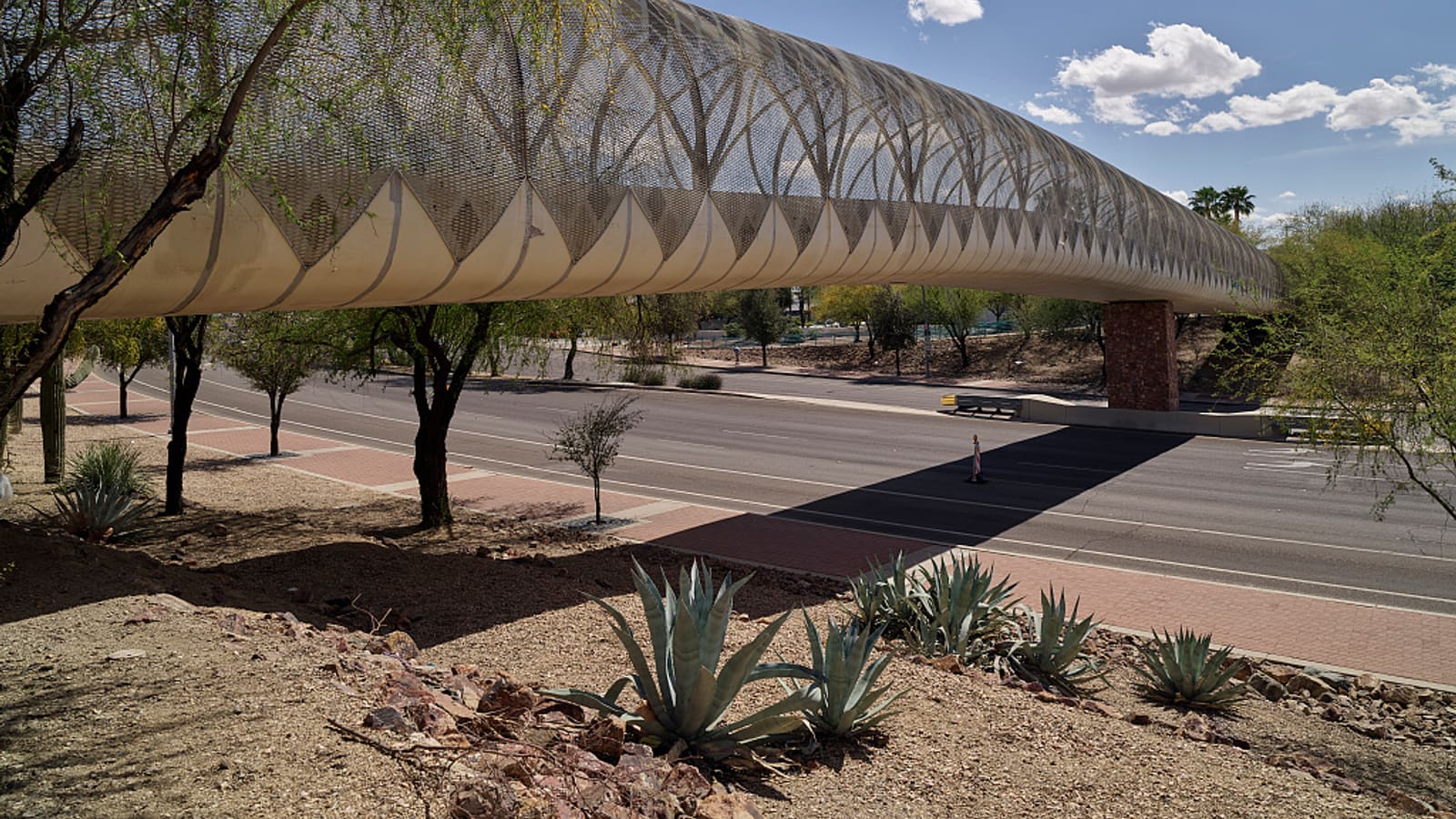
The best-known single piece of public art in the city is the Rattlesnake Bridge, a pedestrian bridge spanning Broadway Boulevard, designed by artist Simon Donovan and completed in 2002. Its structure is built to mimic a rattlesnake -- the mesh-and-rib design reads as a snake's skeleton from below, and the bridge has both a sculptural head and a tail at either end of the overpass, a detail that surprises people the first time it's pointed out to them. The design plays on how common actual rattlesnakes are in the desert around Tucson, including in parts of the city itself.
It's a functional pedestrian bridge as well as a piece of art, so the best way to see it is simply to walk or drive along Broadway Boulevard where it crosses -- there's no ticket, no gate, and no set visiting hours, though it photographs best in the low, warm light of morning or late afternoon rather than the flat light of midday.
Downtown Tucson
Downtown Tucson's Congress Street corridor and the area around the Ronstadt Transit Center have carried building-wall murals and civic art installations for years, in a mix that updates as new work goes up and older pieces are retired. The city's modern Sun Link streetcar, which opened in 2014 and runs between downtown and the university area, put several of these murals and installations within easy walking distance of its stops, which makes downtown one of the more efficient places to see a cluster of pieces without a long walk between them.
Because downtown is also where much of the city's dining and nightlife concentrates, this is the easiest district to pair with a meal -- walk a few blocks before or after eating rather than treating mural-spotting as a separate trip.
Fourth Avenue and the University-Adjacent Underpass
The Fourth Avenue district, a walkable strip of independent shops, bars, and restaurants connecting downtown to the university area, has its own scattering of murals and street-facing art on shop exteriors, which shifts somewhat as storefronts change hands. The pedestrian and streetcar underpass connecting the Fourth Avenue district to downtown is itself decorated with public art, making the walk between the two districts part of the sightseeing rather than a stretch to get through.
This is also one of the more comfortable districts to explore on foot in the evening, since it stays active later than most of the rest of the city.
Barrio Viejo and Barrio Histórico
South and west of downtown, the historic Barrio Viejo (also referred to as Barrio Histórico) neighborhood is known less for large-scale murals and more for blocks of vividly painted historic adobe rowhouses -- saturated pinks, blues, and purples on buildings that in some cases date back well over a century. It reads as a different kind of public art: the neighborhood's color palette itself, rather than any single commissioned piece.
Because these are private residences along public streets, the respectful way to enjoy the neighborhood is to walk the public sidewalks and photograph from there rather than stepping onto private property for a closer shot.
Finding Current Murals and Respecting the Art
Because Tucson's public art changes -- pieces are repainted, buildings change ownership, and new work goes up every year -- the most reliable way to find what's currently on view is to check the Arts Foundation for Tucson and Southern Arizona's current listings rather than relying on an older blog post or a single social media photo, this one included.
A few basic courtesies apply everywhere in this guide: photograph from public sidewalks and streets rather than private property, don't touch or lean on painted surfaces (adobe in particular can be fragile), and if a piece includes a visible artist credit, use it if you share the photo. Most of this art exists because a city program or a community group chose to fund and maintain it, and it stays around longer when visitors treat it with the same care as an indoor gallery piece.