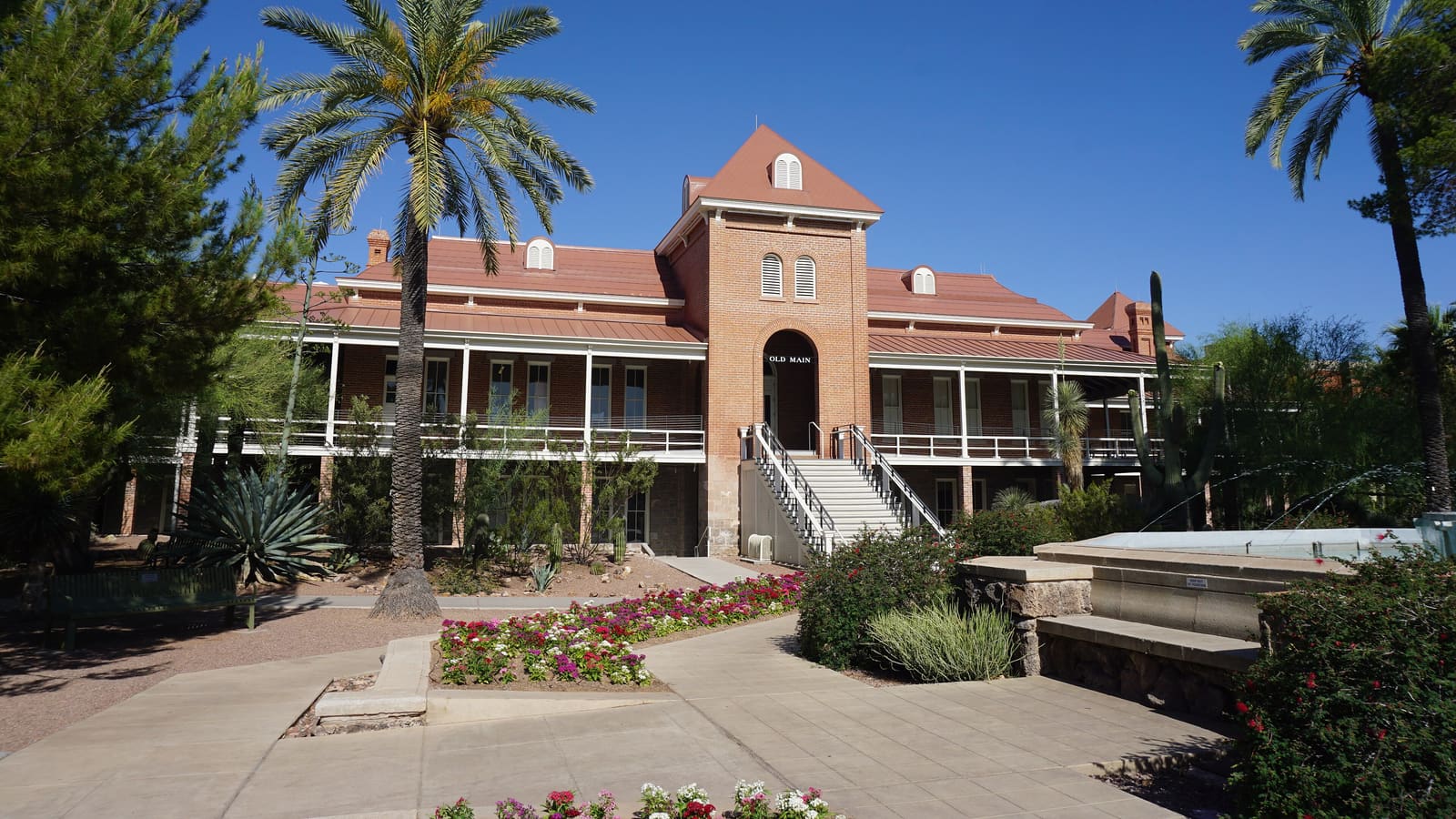
A Public Research University in the Middle of the City
The University of Arizona was chartered in the Arizona Territory in 1885, and as Tucson history is often told locally, the city landed the territorial university partly as a consolation prize after losing out on the territorial capital and a couple of other institutions to Phoenix and Prescott. Whatever the exact politics behind it, the result is that Tucson's flagship public research university sits inside the city rather than on a separate suburban campus, which is a large part of why it works as a visitor stop: it is a short trip from downtown, the Fourth Avenue district, and several hotel corridors.
Today the university is one of Arizona's two major public research institutions (alongside Arizona State University in the Phoenix area) and, following the mid-2020s conference realignment that broke up the Pac-12, its athletic programs compete in the Big 12 Conference. None of that history is necessary to enjoy a campus visit, but it explains why the school shows up so often in Tucson's civic identity.
Old Main and the Historic Core
Old Main, completed in 1891, was the university's first building and is still the campus's signature landmark -- a red-brick, territorial-style structure with a wraparound veranda that now anchors the university's central mall. It is generally recognized as one of the university's most historic structures and is the building most first-time visitors photograph. The mall in front of it is the closest thing the university has to a town square: a long, shaded, grassy corridor lined with palm trees that students cut across between classes and that visitors can walk through freely.
The area immediately around Old Main and the mall is the easiest part of the campus to see on foot in a short visit, and it is where most of the university's oldest buildings cluster. If you only have thirty or forty minutes, this is where to spend them.
Museums and Landmarks Worth a Detour
The Arizona State Museum, founded in 1893, is generally described as the oldest and largest anthropology museum in the American Southwest, with collections focused on the Indigenous peoples of Arizona and the broader border region. It sits just inside the campus's main gate and is a reasonable first stop for visitors interested in the region's Native American history rather than campus architecture alone.
The Flandrau Science Center has historically combined a public planetarium with science exhibits, and Centennial Hall hosts touring theater, dance, and music acts through the university's performing-arts programming. Sports fans will recognize McKale Memorial Center, home to Arizona Wildcats basketball, and Arizona Stadium, home to Wildcats football. Exhibits, showtimes, and public hours change by season, so check each venue's current listing before building a visit around a specific one.
The Mirror Lab Hidden Under the Stadium
One of the more genuinely surprising facts about this campus: the university's astronomy program casts and polishes giant telescope mirrors -- some of the largest in the world -- in a lab built into the base of Arizona Stadium, underneath the football seating. The Richard F. Caris Mirror Lab, run through the university's Steward Observatory, has produced primary mirrors for major observatory projects, and the stadium-basement location is a widely reported piece of Tucson trivia rather than an urban legend. It is not generally open for casual drop-in visits, so check the Mirror Lab's own tour information if this is the reason you're coming.
The mirror lab is one piece of a broader pattern: University of Arizona astronomers are closely tied to observatories across southern Arizona, including Kitt Peak southwest of the city and Mount Graham to the east, which is part of why Tucson and Pima County maintain strict outdoor-lighting rules to protect dark night skies for research telescopes as well as stargazing visitors.
Getting There, Parking, and Walking the Mall
The campus sits close enough to downtown and to several hotel corridors that a rideshare or a short drive is usually the simplest way in. Once you're there, the core historic area is genuinely walkable and mostly flat, which makes it easy to cover Old Main, the mall, and the nearby museums in one loop on foot.
Parking on an active university campus is the one part of a visit that benefits most from checking current information before you arrive: visitor parking generally means a public garage or a metered zone rather than free curbside parking, and availability and pricing shift around game days, move-in week, and graduation. The university's parking and visitor-services pages are the source to check rather than guessing, since rules can change semester to semester.
When to Visit
A quiet weekday during the regular semester, outside finals week and outside a home football or basketball game, is the easiest time to park, walk the mall without crowds, and get into campus museums without competing with student foot traffic. Move-in week in August and graduation in May are the two periods most likely to complicate both parking and simple pedestrian access, so if your visit is flexible, those are the weeks to avoid.
Game days bring their own energy -- tailgating around Arizona Stadium and a genuinely busy campus -- and can be worth building a visit around if you specifically want that atmosphere, but expect parking to be tighter and plan extra time.