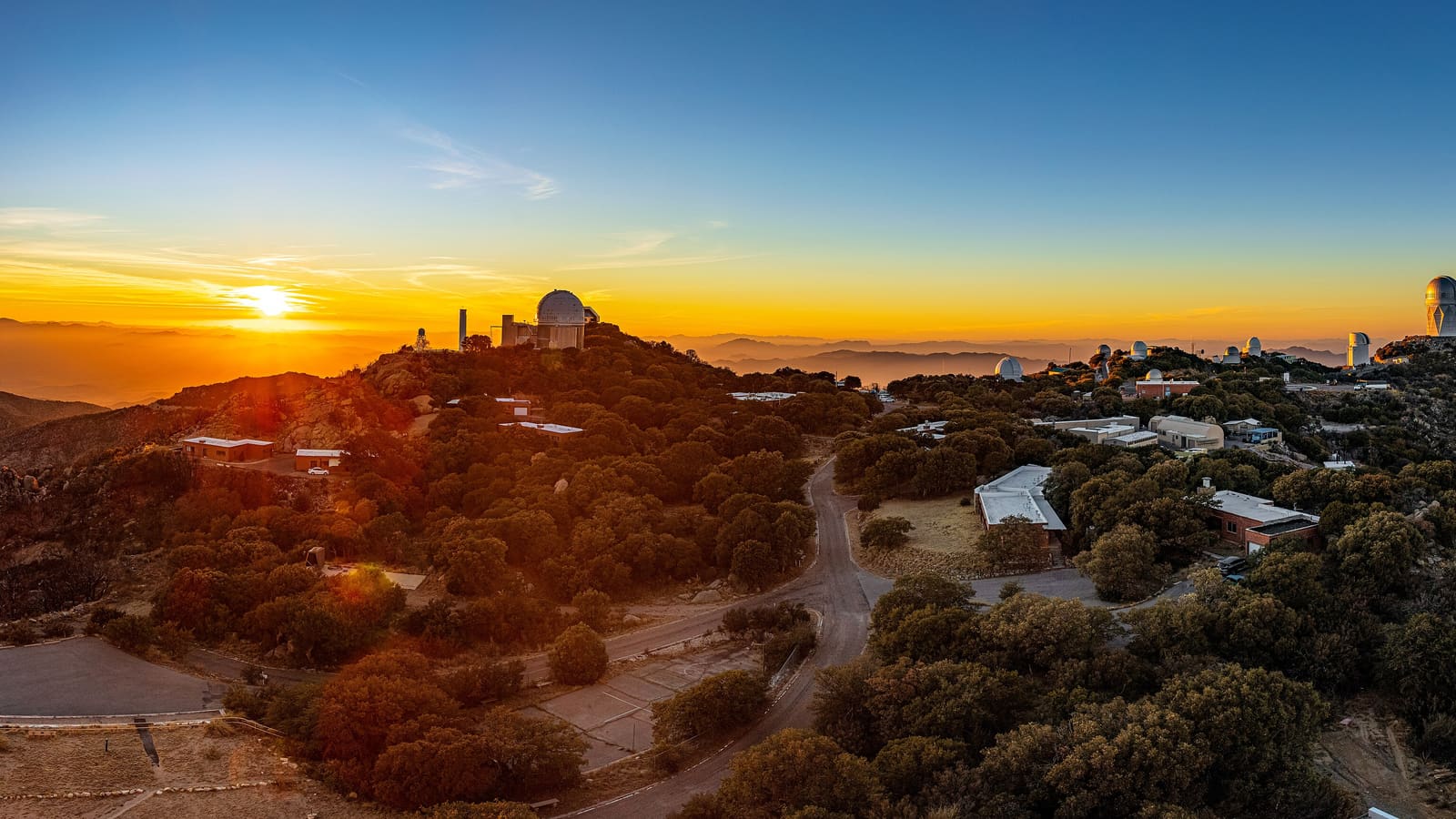
What Kitt Peak National Observatory Is
Kitt Peak National Observatory (KPNO) is a major astronomical research site and a program of NOIRLab, the US National Science Foundation's national center for ground-based nighttime optical and infrared astronomy. The mountain hosts facilities belonging to consortia that between them operate more than a dozen optical telescopes and two radio telescopes -- NOIRLab describes nearly two dozen active telescopes on the peak in total. That concentration of instruments in one place, rather than a single flagship dome, is what distinguishes Kitt Peak from a typical observatory.
Three of those active telescopes are dedicated solely to public viewing in the nightly stargazing programs, which is unusual -- most research observatories do not set instruments aside for visitors. The public side of the mountain has a long history of its own: the Kitt Peak Visitor Center opened in 1964 and, now in its sixth decade, has hosted more than two million people. Research access and public tour access are handled separately, so what you can see and where you can walk depends on which program you book.
Location on the Tohono O'odham Nation
Kitt Peak sits in the Schuk Toak District of the Tohono O'odham Nation, and the observatory's presence there rests on a long-standing agreement with the Nation rather than on federal land ownership. Visitors driving in are entering tribal land, which is worth keeping in mind as a matter of respect during the visit, similar to the etiquette that applies at Mission San Xavier del Bac closer to the city. State Route 386, the road up the mountain, is a public roadway -- cyclists and motorists are welcome on it without reservations -- but the observatory grounds above are not open to wander.
The summit stands at about 7,000 feet (2,096 meters), well above the Tucson valley floor, and NOIRLab notes that temperatures on the peak typically run 15 to 20 degrees Fahrenheit cooler than in Tucson, often with wind. That elevation, combined with the region's generally dry, clear air, is central to why this particular peak was chosen as an astronomical research site in the first place.
The Drive and Elevation Change
Kitt Peak is 54 miles (87 km) southwest of Tucson, at the end of State Route 386. NOIRLab's directions are simple: take Route 86 (Ajo Way) west out of Tucson to the SR 386 junction, turn left at the sign, and follow the road to the top of the mountain. The climb itself is a winding mountain road, so the drive takes noticeably longer than the mileage suggests. The changing landscape along the way -- desert floor giving way to higher, cooler terrain near the summit -- is part of what makes the trip feel worthwhile even before reaching the telescopes themselves.
Fill your tank in Tucson. NOIRLab states plainly that there are no gas stations, full-service restaurants, or hotels on Kitt Peak, and advises arriving with a full tank. Snacks and drinks are sold in the Visitor Center during opening hours, a box lunch can be added to a daytime tour, and a meal is included with evening tours -- but there is no fallback if you arrive low on fuel. There is also no overnight camping near the peak and no overnight parking on observatory property, so a night program means driving back down to Tucson afterward. Because SR 386 is a state route, current highway conditions are available from ADOT at az511.gov or by calling 511; build in extra time rather than cutting a tour start time close.
Daytime Visits vs Nighttime Stargazing Programs
The Kitt Peak Visitor Center is open seven days a week, 9 am to 4 pm, and no ticket is required to enter it. The observatory itself, though, can only be visited as part of a tour. NOIRLab lists three guided daytime tours: the McMath-Pierce Solar Telescope at 10 am (the only one of the three with no stairs), the KPNO 2.1-meter Telescope at 11:30 am, and the Nicholas U. Mayall 4-meter Telescope at 1:30 pm. Tours are capped at 25 guests, so reserve ahead rather than counting on walk-up space. Discounts are offered for seniors 62 and up, groups of eight or more, active-duty military with ID, and students with ID. Because times, prices and availability shift, confirm the current schedule with Kitt Peak when you book.
Evening programs are back and running. Kitt Peak was closed to visitors for more than three years by the combination of the COVID-19 pandemic and the 2022 Contreras Fire, and held a soft reopening in 2023; the evening offerings, including the Nightly Observing Program and the Dark Sky Discovery Program, returned after that. The Nightly Observing Program is the most popular of them and runs year-round. Evening programs have limited capacity and their own reservation requirements, and there is also a multi-night Overnight Telescope Observing Program for a deeper experience. If a night visit is the whole reason for the trip, book it directly with Kitt Peak well ahead -- do not assume a nighttime visit works like a daytime tour.
Why Tucson's Dark Skies Matter for Astronomy
Southern Arizona's astronomical reputation is tied directly to conditions that also make the region appealing to travelers -- generally clear, dry weather and comparatively low light pollution in the areas surrounding major research sites like Kitt Peak. Cities and counties in the region have taken deliberate steps over the years to manage outdoor lighting specifically to protect dark-sky conditions for astronomical research.
That same dark-sky commitment is part of why nighttime stargazing programs at sites like Kitt Peak can offer a genuinely different view of the night sky than what most visitors see from a typical city. It is a reminder that the region's desert climate serves both its tourism appeal and its scientific value at the same time.
Planning a Visit from Tucson
Kitt Peak works well as a standalone half-day trip from Tucson for a daytime visit, or as an evening outing if a stargazing program is the goal, though the two require different planning given how reservation requirements and timing differ between them. Pack for a temperature drop at the summit regardless of season: NOIRLab puts the peak 15 to 20 degrees Fahrenheit cooler than Tucson, often windy, and strongly advises hats, gloves, warm socks and an insulated jacket from late fall through mid-spring. That advice matters most for evening programs, which keep you outdoors in the dark at nearly 7,000 feet.
As with any site where hours, tour formats, and program availability can shift, confirm current details directly with Kitt Peak before building a trip around a specific visit type, particularly if a nighttime program with limited capacity is the main draw.
Safety and the Rules of a Working Observatory
Headlights are restricted on the way down at night. This is a real, enforced rule, not a courtesy: white light interferes with the research going on around you. The restricted-lighting rules prohibit the use of headlights on the first mile of the road during nighttime programs. Staff brief you on it before you leave, and it means driving that first stretch slowly in the dark on a mountain road. If night driving on a winding unlit road is not something you are comfortable with, choose a daytime tour instead -- and never plan to leave a night program in a hurry.
Arrive self-sufficient. There is no fuel, no full-service restaurant and no lodging on the mountain, and no overnight parking on observatory property, so a full tank, water, food and any medication you need should be in the car before you leave Tucson. Cell coverage on remote stretches of Route 86 and SR 386 should not be assumed -- download your route and your tour confirmation before you go rather than relying on live navigation at the junction.
Summer afternoons are the wrong time to be on a summit. The National Weather Service in Tucson runs monsoon season from June 15 through September 30 and calls it the most dangerous stretch of the year weather-wise in the Southwest; thunderstorms typically build in early to mid-afternoon and form first over higher terrain. NWS guidance is to plan activities to avoid being outdoors between mid-afternoon and evening, especially at higher elevations, and that if you can hear thunder you are close enough to be struck -- shelter in a substantial building or a fully enclosed vehicle and wait 30 minutes after the last thunder. On the drive itself, never enter water running across the road: NWS notes as little as ten inches can float an average car and that depth is easy to misjudge. Turn around, don't drown.
In winter, check ADOT's conditions at az511.gov or by calling 511 before starting out, since SR 386 is a state route and can be affected by snow and ice at elevation. ADOT's cold-weather guidance is to keep at least a three-quarter-full tank, tell someone your route and expected arrival, allow extra travel time, brake gently rather than hard, and carry blankets, extra clothes, a flashlight, a fully charged phone, food and water.