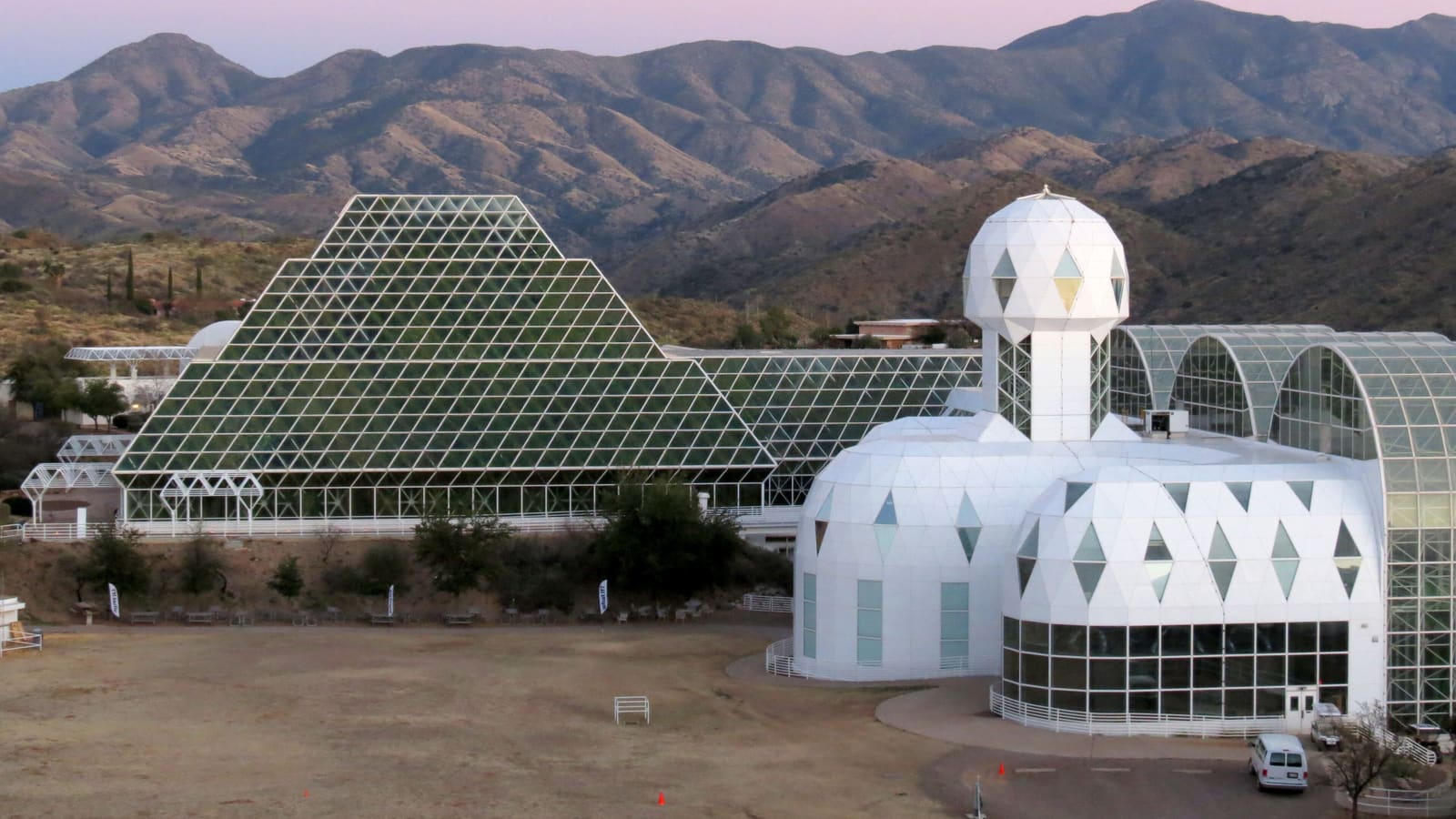
What Biosphere 2 Is
Biosphere 2 is a large research complex near Oracle, Arizona, begun in 1986 by Space Biospheres Ventures and designed as a sealed structure that modeled several of Earth's ecosystems inside a connected glass-and-steel enclosure. The facility describes five distinct ecosystems under that glass: an ocean, mangrove wetlands, a tropical rainforest, savanna grassland, and fog desert. The numbers are still striking -- a 3.14-acre research facility with 7,200,000 cubic feet under sealed glass and 6,500 windows, on a 40-acre campus at 3,820 feet elevation. The name references Earth itself as "Biosphere 1," with the built structure intended as a second, artificial biosphere for research and, eventually, experimentation with closed-loop living systems.
The scale of the project set it apart from typical scientific facilities -- rather than a lab studying ecosystems from the outside, Biosphere 2 was built to contain working versions of those ecosystems under one roof, sealed off from the surrounding desert. That ambition is what generated worldwide attention when the facility began its early closed-system missions.
The Sealed-Ecosystem Experiments of the 1990s
Biosphere 2 became internationally known when crews were sealed inside the structure for extended periods -- two missions between 1991 and 1994 -- living entirely off the systems contained within it -- growing food, managing water, and relying on the enclosed biomes to help regulate air and resources, with no direct exchange with the outside environment. The first and longest of them ran from September 1991 to September 1993, with a crew of eight -- four men and four women -- growing all of their own food and recycling their air, water and waste. The missions were framed as tests of whether humans could sustain themselves inside a fully closed ecological system, a question with obvious relevance to long-duration space travel and off-world habitats.
The experiments surfaced real challenges in maintaining a sealed system at that scale, including complications with oxygen levels and food production, and they generated significant scientific and public debate at the time about the project's methods and conclusions. That history remains central to how the site presents itself to visitors today, since it is what put Biosphere 2 on the map in the first place.
From Closed Experiment to Research Facility
After the sealed missions ended, Biosphere 2 moved through different phases of ownership and purpose -- including a period leased to the University of Arizona from 2007 -- before the University assumed outright ownership in July 2011 and settled it into its current role as an open research and education facility. It is no longer operated as a sealed environment -- researchers and visitors move through the space under normal conditions rather than as part of a closed-system experiment.
Today the facility is used to study large-scale environmental and ecological questions -- how ecosystems respond to changing conditions -- using the original biomes as living laboratories rather than as a habitat for a sealed human crew. One of its flagship current projects is the Landscape Evolution Observatory, a large-scale experiment in how water moves through and shapes landscapes. This shift from headline-making closed experiment to working research site is part of what makes a visit interesting beyond the original 1990s story.
What a Visit Generally Involves
As of 2026 the standard visit is self-guided, not a guided tour. You walk the route yourself using the Biosphere 2 Experience app, which the facility says takes roughly an hour and 15 minutes and moves through and around the structure, with views into the biomes and context on both the original sealed missions and the site's current research. Bring a charged phone and headphones, since the app is the narration. The scale of the structure itself -- a massive glass-enclosed complex rising out of the high desert north of Tucson -- is part of what makes the visit distinctive.
Two practical notes worth planning around. The route includes stairs and a fair amount of walking, so check the facility's accessibility page ahead of time if that matters for your group -- Biosphere 2 maintains a dedicated accessibility page and can be reached at (520) 621-4800. And the site is open 9 am to 4 pm daily except Thanksgiving and Christmas, so a late-afternoon arrival does not leave time for the full route; aim to arrive with at least two hours of opening left. Tour formats and hours can change, so confirm current visitor information directly with Biosphere 2 before you go.
Getting There from Tucson
The address is 32540 S Biosphere Road, Oracle, AZ 85623, north of Tucson at 3,820 feet elevation -- reached by driving out of the city into the surrounding high desert and foothill terrain on the far side of the Santa Catalinas. The drive itself is part of the appeal for some visitors, since it moves through a different stretch of landscape than the trips toward Saguaro National Park or Sabino Canyon closer to the city.
Biosphere 2 does not publish a drive time from Tucson, and travel time depends on traffic and your specific starting point within the metro area, so route it from the street address above rather than relying on a remembered figure. In monsoon season -- June 15 through September 30, per the National Weather Service in Tucson -- afternoon thunderstorms can put running water across desert roads on the way out or back; never drive into water crossing a roadway, since the NWS notes as little as ten inches can float an average vehicle and the depth is easy to misjudge.
Planning It as a Day Trip
Biosphere 2 works well as a standalone half-day or full-day trip from Tucson, and it can also be combined with other stops along the same general route north of the city depending on how much time you have. Because it is an indoor-and-outdoor mix, it holds up reasonably well even during the hotter months, when a fully outdoor day trip elsewhere might be harder to plan around.
As with any attraction whose programming and hours can shift, confirm current admission information, tour schedules, and any seasonal closures directly with Biosphere 2 before building your day trip around a specific arrival time.