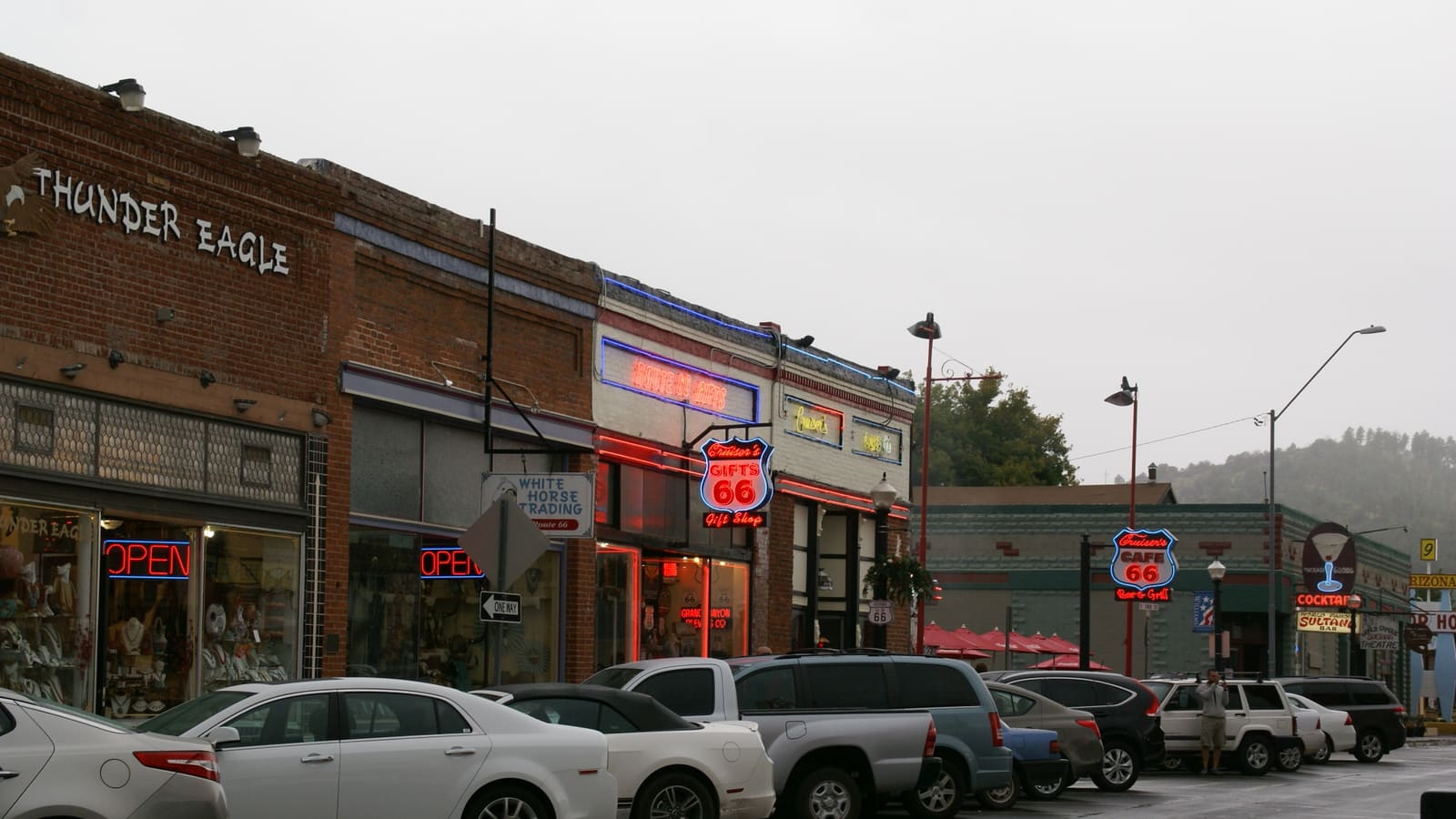
What Counts as Historic Downtown Williams
When people say "downtown Williams," they generally mean Bill Williams Avenue, the street Route 66 was routed through in 1926 and the town's main commercial corridor ever since. The district was added to the National Register of Historic Places in 1984, the same year Williams became the last Route 66 town in the country to lose its through-traffic to the interstate. For the fuller history behind that fight, see the Williams Route 66 guide.
The Fray Marcos Hotel and Williams Depot
At one end of downtown sits the Williams Depot and the adjoining Fray Marcos Hotel, built in 1908 by the Atchison, Topeka & Santa Fe Railway and the Fred Harvey Company in the Mission Revival style, using poured concrete for nearly the entire structure -- one of the largest and oldest buildings of its kind in Arizona. The hotel no longer takes overnight guests; the building today houses the Grand Canyon Railway's ticket counter and gift shop. Both structures were added to the National Register of Historic Places in 1984 alongside the rest of the downtown district. Walking the depot grounds and viewing the vintage rolling stock parked outside is free, whether or not you are riding the train that day.
Walking Bill Williams Avenue
From the depot, Bill Williams Avenue runs through the heart of downtown, lined with original commercial buildings, vintage signage, and a number of murals depicting the town's railroad and Route 66 history. Because these are working storefronts rather than a recreated set, the mix of shops and restaurants changes over time, so it is worth simply walking the full length of the street rather than relying on a fixed list of stops.
A slow, unhurried walk from one end of the historic strip to the other and back, including time to look at the vintage signage and building facades, takes about an hour. Add another hour if you plan to stop into shops or sit down for a meal along the way.
Shops, Dining, and Where to Pause
Downtown Williams has a concentrated stretch of restaurants and shops along Bill Williams Avenue, from casual diners to sit-down steakhouses. For specific recommendations, see the Williams dining guide. Because the district is compact, it is easy to break up a walk with a coffee stop or a longer meal without adding much to your overall time downtown.
Getting There and Parking
Downtown Williams is compact enough to cover entirely on foot once you arrive, and most downtown lodging is within walking distance of the depot and the restaurant strip. If you are driving in, street parking is generally available along and near Bill Williams Avenue, though availability and any posted restrictions can change, so check current signage on arrival. For a fuller look at getting around Williams beyond downtown, see the getting around Williams guide.
Best Times to Walk Downtown
Early mornings and weekday visits tend to be quieter, while summer weekends and the Grand Canyon Railway's winter holiday season draw the largest crowds downtown. Weather also shapes the experience: summer afternoons can bring monsoon storms, and winter can bring genuine snow at this elevation, both of which change how a downtown walk feels rather than closing it off entirely. See the seasonal guides for more on planning around either.