By The Lowdown Guide Editorial Team · Last updated: 2026-07-26
Types of Boats You Can Rent
Pontoon boats are flat-decked, stable, and slow-handling, making them a common choice for groups, families, and anyone who wants a relaxed day of cruising, anchoring in a cove, and swimming rather than high-speed handling. Deck boats offer a similar family-friendly experience with a bit more speed and a more traditional hull shape.
Wakeboard and ski boats are built for towing a rider and require more attention and boat-handling skill, particularly around other traffic in busy coves. Personal watercraft, often called jet skis regardless of brand, are agile, quick to learn the basics of, and popular for exploring the shoreline or covering more distance in less time, though they demand their own kind of attentiveness around other boats and swimmers. Local marinas and rental operators typically offer some mix of these categories, so match the boat type to what your group actually plans to do on the water.
Personal watercraft carry extra rules in Arizona that renters routinely get caught out by. Per the state boating law summary maintained by the U.S. Coast Guard's recreational boating program, it is illegal to operate a personal watercraft between sunset and sunrise or during periods of restricted visibility; the operator must wear a Coast Guard-approved flotation device rather than merely carry one; a kill switch is required equipment; and a personal watercraft may not enter a motorboat's wake within 60 feet in a way that causes more than half its length to leave the water. If a sunset cruise is what you had in mind, rent a boat, not a jet ski.
Rental fleets, available boat sizes, and seasonal availability all vary by operator, so treat any specific model or capacity you read about elsewhere as a starting point rather than a guarantee, and confirm what is actually on the water the week you plan to rent.
Where Rentals Launch: The Channel and Marinas
Many rental operators are based around the Bridgewater Channel near the London Bridge and the English Village, a convenient spot given how much of the day's boating traffic passes through that corridor anyway. Other marinas are located at points around the broader lake, offering more direct access to the open water and the anchor-out coves further from town.
Some rental operators hand-deliver the boat to a dock or beach rather than requiring you to launch it yourself, which can simplify things for a first-time renter. Confirm the exact launch location, check-in process, and any orientation the operator provides directly with them when you book, since these details vary by operator and season.
Licensing Basics for First-Timers
Two points are worth knowing before you call an operator. Arizona does not mandate boating-safety education for the general boating public, though it accepts NASBLA-approved courses and recognizes reciprocal out-of-state certificates -- so a visitor is usually not blocked from renting for lack of a card. Separately, a person under 12 may not operate a motor exceeding 8 horsepower unless an adult 18 or older is aboard or an emergency exists, which rules out handing the wheel to a young child on almost any rental in the fleet.
Beyond those, requirements vary by the operator's age, the type of vessel, and the rental company's own minimum-age and deposit policies, and the rules are periodically revised. Rather than assuming the requirements from a past trip or another state still apply, confirm current rules directly with Arizona Game and Fish Department or with your chosen rental operator before you book.
Most rental operators will walk first-timers through basic operation and local hazards before departure, and it is worth asking specific questions during that orientation -- how to slow for the no-wake zone, what to do if another boat approaches too closely, and where the nearest fuel or return dock is -- rather than assuming you will remember everything from a quick briefing.
It also helps to ask about the rental operator's own policies -- cancellation terms, what happens if weather turns, and any deposit or damage procedures -- before you pay, since these vary operator to operator and are easier to clarify beforehand than to sort out after the fact.
Life Jackets and Basic Safety Gear
Arizona law, not operator preference, sets the baseline. Under A.R.S. 5-331 a watercraft must carry one Coast Guard-approved wearable flotation device in good and serviceable condition for each person on board, stowed so it is readily accessible for immediate use. And a child twelve years of age or under must wear a properly fitting Coast Guard-approved wearable life jacket the whole time the watercraft is underway. Reputable rental operators supply jackets as part of the rental, but confirm when you book that they carry properly sized child jackets -- an adult jacket on a small child does not satisfy the law and does not work in the water.
Do not drink and drive the boat. A.R.S. 5-395 makes operating or being in actual physical control of a motorized watercraft while impaired unlawful, with a presumptive 0.08 blood alcohol limit and zero tolerance for minors. Arizona Game and Fish runs multi-agency OUI checkpoints on the Colorado River with the Mohave County Sheriff's Office and the U.S. Fish and Wildlife Service, and those stops include inspections for required life jackets and fire extinguishers. AZGFD notes alcohol is a factor in roughly one in five boating deaths nationally. Decide who is driving before the cooler is loaded -- and note a rental agreement will not shield you from an OUI.
There are no lifeguards on this lake. Arizona State Parks states of the Lake Havasu State Park beaches: "There are no lifeguards on duty. Please swim and use beaches at your own risk." The same is true at the anchor-out coves your rental will take you to. Assign one sober adult to watch swimmers as their only job. And keep everyone away from the stern of a running boat: the CDC warns that carbon monoxide collecting under and around the swim platform can kill in seconds, so no hanging off the platform of a moving boat, watch children closely on rear decks, and anchor at least 20 feet from any boat running an engine or generator.
Beyond life jackets, bring more sun protection and drinking water than feels necessary. Water reflects ultraviolet radiation back at you on top of what arrives directly from the sun -- the EPA and CDC both list water, sand, and snow as reflective surfaces that raise sunburn risk -- and dehydration sneaks up faster on the water than most first-timers expect. Bear in mind, too, that the water is often colder than the air suggests: the National Weather Service warns that involuntary gasping on sudden immersion can be triggered by water as warm as 77°F, which becomes a drowning emergency if someone inhales water during it. Ease in rather than jumping in.
The Channel and No-Wake Zones
The Bridgewater Channel beneath the London Bridge is a no-wake zone, meaning boats must idle through at low speed rather than accelerate, both for safety around the concentrated foot and boat traffic there and to protect the shoreline and moored boats from wake damage. First-timers should treat the channel as a slow, social corridor rather than a place to test a rental boat's speed.
Other no-wake or reduced-speed zones exist around marinas, swim areas, and certain coves, and signage and buoys mark most of these, but it is worth asking your rental operator for a quick overview of local zones before you head out, since a new renter unfamiliar with the lake can easily miss a posted marker in a crowded area.
Summer Heat and Crowds
Lake Havasu's summer heat is extreme by any standard: the hottest temperature ever recorded at an official National Weather Service observing site in Arizona was 128°F, set at Lake Havasu City on June 29, 1994, hotter than Phoenix has ever been, and days above 110°F are routine in summer. A boat rental keeps you on and near the water, but the heat itself does not go away. Drink far more water than feels necessary, watch everyone aboard for confusion, nausea, or sweating that stops, get anyone showing those signs into shade and cool water, avoid leaving anyone on hot vinyl seating for long stretches, and start earlier to bank a few cooler hours before midday. Never leave a child or a pet in a parked vehicle at the marina lot, even briefly.
Weather is the other reason to start early. The National Weather Service fixes Arizona's monsoon season at June 15 through September 30, when thunderstorms and their hazards are most likely, and notes lightning can strike as far as 60 miles from the nearest rainfall. If you hear thunder in a rental boat, head in and get into a substantial building or an enclosed vehicle rather than waiting to see what the storm does. Ask your operator what their bad-weather and early-return policy is when you book.
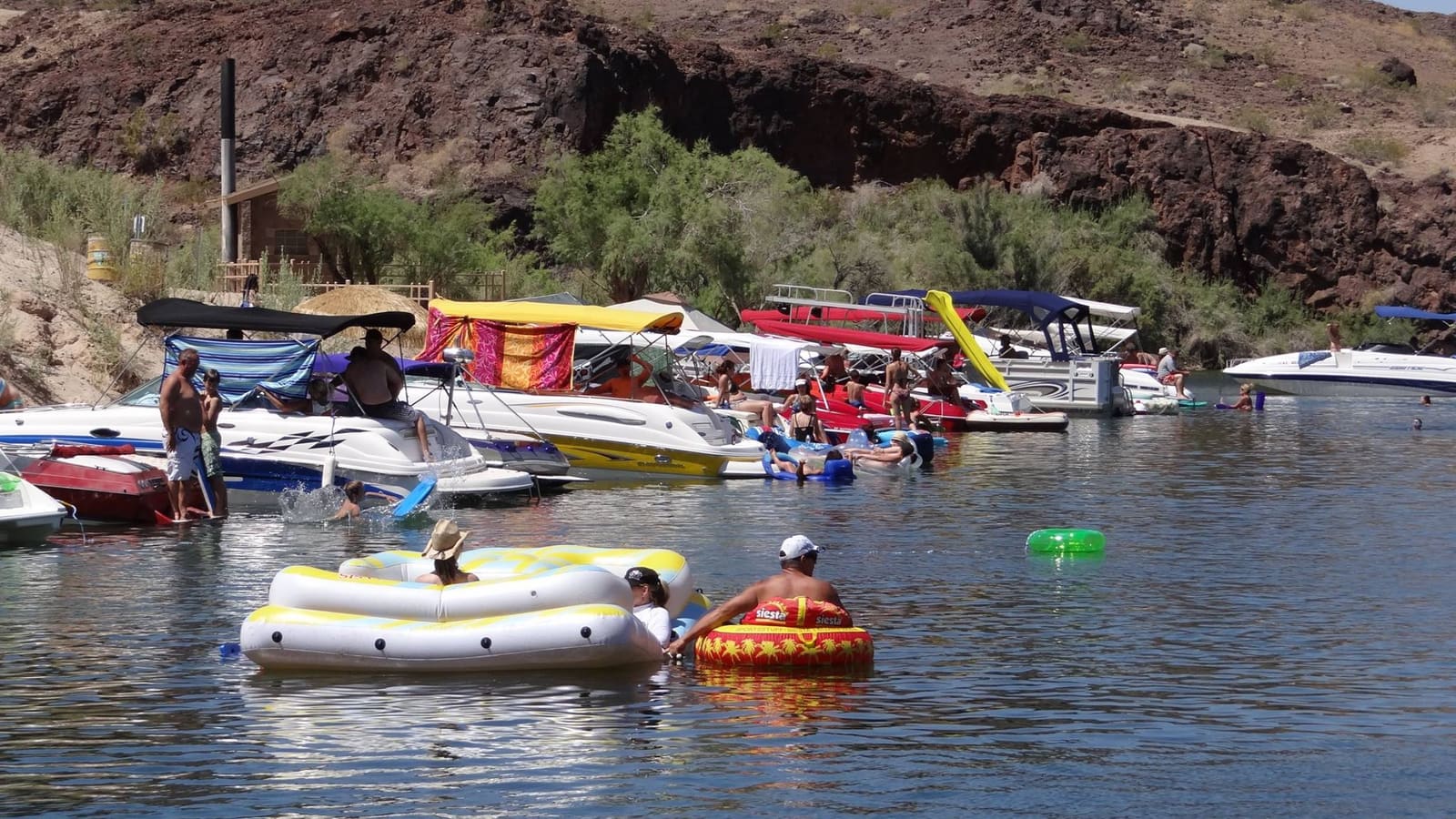
Peak weekends -- spring break, Memorial Day, and the Fourth of July in particular -- bring heavy boat traffic and crowded coves, which can make handling a rental boat more demanding for a first-timer. If you have flexibility, a weekday or an off-peak weekend gives new renters an easier introduction to the lake before tackling a busier date.