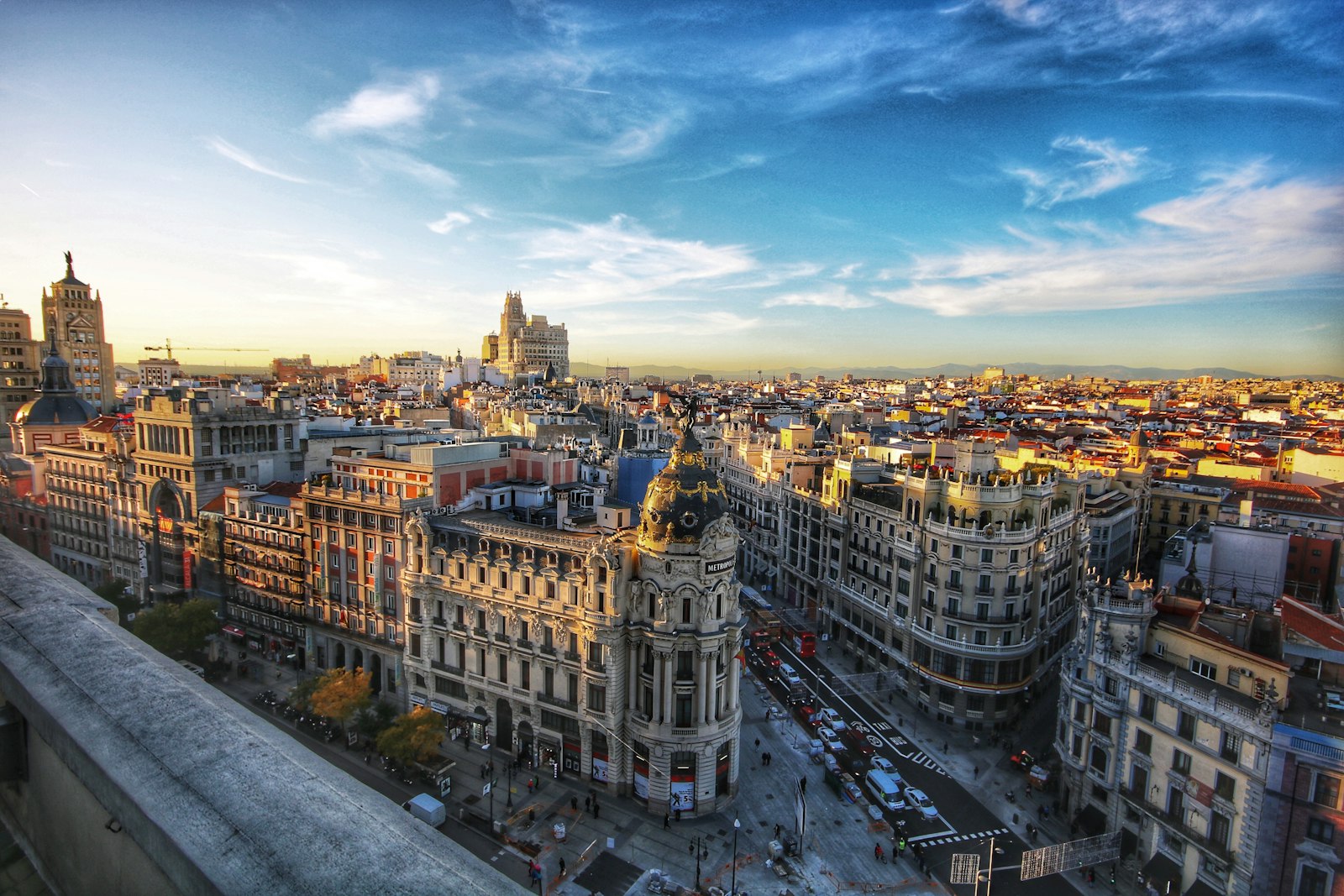
Madrid is flat, compact, and endlessly walkable. The historic center sits on a gentle plateau above the Manzanares River, and the major landmarks — Puerta del Sol, Plaza Mayor, the Palacio Real, the Prado, Retiro Park — are all within a 30-minute walk of each other. No hills to speak of, wide pedestrian boulevards, and a street life that rewards every detour. The best way to experience Madrid is on foot.
Every neighborhood has its own personality. La Latina is old-world tapas bars and Sunday flea markets. Malasaña is vintage shops and specialty coffee. Barrio de las Letras has literary history etched into the pavement. The Art Triangle holds three of Europe's finest museums within a 10-minute walk. This guide covers five self-guided walking routes and the best guided tour options — everything you need to explore Madrid at your own pace.
New to the city? Start with our Madrid travel guide for the big picture, and check where to stay if you haven't booked yet — location matters when you're planning to walk everywhere.
Before You Walk
Madrid gets hot in summer — plan walks for mornings (before 11 AM) or evenings (after 7 PM) from June through September. Wear comfortable shoes; the old town has cobblestone streets. Madrid tap water is excellent and safe to drink — carry a refillable bottle. Google Maps works perfectly for navigation, and the metro is always there as backup when your feet need a break.
Self-Guided Walking Routes
These five routes cover the essential Madrid on foot. Each one works as a standalone walk or can be combined with others for a full day. All routes start and end near metro stations.
Historic Madrid Route (Madrid de los Austrias)
This is the walk to do first. It covers the heart of Habsburg Madrid — the oldest part of the city, built when Spain was the most powerful empire on earth. Start at Puerta del Sol, the geographic center of Spain (look for the Km 0 plaque in the pavement outside the old post office). Walk southwest to Plaza Mayor, the grand 17th-century square that once hosted bullfights, royal ceremonies, and public executions. The arcaded galleries house restaurants (overpriced, but the square itself is magnificent) and the Sunday stamp and coin market.
From Plaza Mayor, walk south through the Arco de Cuchilleros — the old knife-makers' arch — into La Latina, Madrid's oldest neighborhood. The winding medieval streets here predate the grid layout of the rest of the city. Continue west to the Palacio Real (Royal Palace), the largest functioning royal palace in Europe by floor area. The palace is worth entering (admission around 13 euros), but the exterior and the Plaza de Oriente gardens are impressive on their own.
Finish at the Templo de Debod, an authentic 2nd-century BC Egyptian temple that was gifted to Spain in 1968 and reassembled in Parque del Oeste. It's one of the most unexpected sights in Madrid, and the hilltop park offers the best sunset viewpoint in the city — looking west over the Casa de Campo parkland.
Start: Puerta del Sol (metro: Sol, lines 1/2/3). End: Templo de Debod (metro: Plaza de España, lines 2/3/10). Best time: Morning start, or late afternoon to catch sunset at Templo de Debod.
Art Triangle Route (Triángulo del Arte)
Madrid's three world-class art museums sit within a 10-minute walk of each other along the Paseo del Prado, a tree-lined boulevard that earned UNESCO World Heritage status in 2021 as part of the Landscape of Light designation. This is the shortest route in distance but the longest in time — you could spend a full day here.
Start at the Museo del Prado, home to the deepest collection of European art anywhere — Velázquez, Goya, El Greco, Bosch, Titian, and Rubens. Visit the Prado first; it's the largest and most demanding. Walk south along the Paseo del Prado to the Museo Thyssen-Bornemisza, which fills the gaps the Prado leaves — Impressionists, German Expressionists, American art, and a chronological walk through Western painting from the 13th century to the present. Continue south to the Museo Reina Sofía, Spain's modern art museum, where Picasso's Guernica — the most powerful anti-war painting ever made — hangs in a room of its own.
Money-saving tip: Buy the Paseo del Arte combo ticket (about 32 euros) for entry to all three museums. Alternatively, each museum offers free admission during the last 2 hours of the day — the Prado is free Monday to Saturday from 6 to 8 PM. Visit the Prado first (arrive at opening, 10 AM), Thyssen after lunch, and Reina Sofía last.
Start: Museo del Prado (metro: Banco de España, line 2). End: Museo Reina Sofía (metro: Atocha, line 1). Best time: Weekday mornings for smaller crowds.
Gran Vía to Malasaña
This route is about architecture, street life, and the contrast between Madrid's grand commercial spine and its most creative neighborhoods. Start on Gran Vía, the broad boulevard that Madrileños call their Broadway. Built in the early 20th century by demolishing 300 buildings and 14 streets, Gran Vía is lined with ornate Beaux-Arts and Art Deco buildings — look up at the Edificio Metrópolis (the one with the winged angel statue) and the Telefónica Building (Spain's first skyscraper, 1929). The Schweppes and Tío Pepe signs are iconic pieces of Madrid's skyline.
Turn north into Chueca, Madrid's vibrant LGBTQ+ neighborhood centered on Plaza de Chueca. The streets are filled with independent boutiques, design shops, and terrace bars. Continue northwest into Malasaña, the neighborhood that defined the Movida Madrileña — Madrid's explosive cultural movement after Franco's dictatorship ended in the late 1970s. Today, Malasaña is the epicenter of Madrid's specialty coffee scene, vintage shopping, and independent restaurants. The heart of the neighborhood is Plaza del Dos de Mayo, named for the 1808 uprising against Napoleon's troops.
Start: Gran Vía / Calle de Alcalá intersection (metro: Gran Vía, lines 1/5). End: Plaza del Dos de Mayo (metro: Tribunal, lines 1/10). Best time: Late morning or late afternoon when the shops and cafés are alive.
Retiro Park & Literary Quarter
This route pairs Madrid's finest park with its most literary neighborhood. Start at the northern entrance of Parque del Buen Retiro (El Retiro), the 125-hectare royal park that was opened to the public in 1868. Head to the Palacio de Cristal (Crystal Palace), an all-glass conservatory from 1887 that hosts free rotating art exhibitions — it's one of the most photogenic buildings in Madrid. Walk to the Rosaleda (rose garden), which blooms spectacularly from May through June, then to the Estanque Grande (boating lake) where you can rent rowboats for a few euros.
Exit Retiro from the western side and cross into the Barrio de las Letras (Literary Quarter), the neighborhood where Cervantes, Lope de Vega, Quevedo, and Góngora lived and wrote during Spain's Golden Age. The streets are paved with quotes from their works — look down as you walk along Calle de las Huertas. Visit the Casa-Museo de Lope de Vega (free, reservation required), a beautifully preserved 17th-century house where the playwright lived for 25 years. The neighborhood is also packed with independent bookshops, wine bars, and some of Madrid's oldest taverns.
Start: Puerta de Alcalá (metro: Retiro, line 2). End: Plaza de Santa Ana (metro: Sol or Antón Martín). Best time: Morning for the park, then lunch in Barrio de las Letras.
La Latina Tapas Walk
This is Madrid's best food-and-walking combination, and it's best done on a Sunday. Start at the Rastro (El Rastro de Madrid), the city's famous open-air flea market that fills the streets around Calle de la Ribera de Curtidores every Sunday morning. The market has run continuously since the 15th century — today it's a sprawling mix of antiques, leather goods, vintage clothing, and curiosities. Get there before 11 AM for browsing space; by noon it's shoulder-to-shoulder.
From the Rastro, walk northwest to Cava Baja, the most famous tapas street in Madrid. This short street in the heart of La Latina has more than 30 bars and restaurants in a few hundred meters. The tradition is to move from bar to bar — one tapa and one drink at each place, then move on. Try croquetas (Spanish ham croquettes), tortilla española (potato omelette), patatas bravas (fried potatoes with spicy sauce), and a caña (small draft beer) at each stop. The street comes alive around 1 PM on Sundays.
Finish at the Basílica de San Francisco el Grande, a neoclassical church with the fourth-largest dome in Europe and paintings by Goya and Zurbarán. The interior is rarely crowded and worth a quiet visit after the bustle of the market and tapas streets.
Start: Rastro flea market, Calle de la Ribera de Curtidores (metro: La Latina, line 5). End: Basílica de San Francisco el Grande (metro: La Latina). Best time: Sunday, starting at 10 AM for the market and working toward Cava Baja by 1 PM.
Walking Tours of Madrid
Guided walking tours, tapas crawls, and skip-the-line museum experiences with local guides. Free cancellation on most tours.
Browse Madrid Walking ToursWe earn a small commission if you book — at no extra cost to you.
Guided Walking Tours
If you want local stories, historical context, and insider recommendations that you won't find in a guidebook, a guided walking tour is the best investment of your first day in Madrid. Here are the main options.
Free Walking Tours (Tips-Based)
Several companies run daily free walking tours of historic Madrid — they're genuinely free, and you tip what you think the tour was worth at the end. Sandemans New Europe and OgoTours are the two most established operators. Tours typically last 2 to 2.5 hours, leave from Puerta del Sol or Plaza Mayor, and cover the Habsburg quarter, Plaza Mayor, the Royal Palace area, and the major landmarks. Guides are energetic and knowledgeable — these tours are a strong introduction to the city. A tip of 10 to 15 euros per person is standard for a good experience. No reservation required for most departures, but booking online guarantees your spot.
Tapas Walking Tours
A local guide takes you to 4 to 6 tapas bars that you'd never find on your own, handles the ordering in Spanish, explains what you're eating, and shares the food culture that makes Madrid one of Europe's great eating cities. Expect to visit La Latina, Cava Baja, and possibly the Mercado de San Miguel. Most tapas tours include all food and drinks. Budget 60 to 80 euros per person for a quality experience lasting 3 to 4 hours. These consistently rank as the most-loved tours in Madrid — book early, especially for weekend departures.
Nighttime Madrid Tours
Madrid comes alive after dark — the locals don't eat dinner until 9 or 10 PM, and the streets stay animated until well past midnight. Evening walking tours cover the illuminated landmarks (the Royal Palace and Gran Vía are spectacular at night), hidden plazas, rooftop bar recommendations, and the history of Madrid's legendary nightlife. Some include a drink or tapa. Typical duration: 2 hours, starting at 8 or 9 PM. Budget 15 to 25 euros per person.
Historical & Literary Madrid Tours
For deeper context, specialized tours cover the Spanish Inquisition, the Spanish Civil War, the Movida Madrileña cultural explosion of the 1980s, or Madrid's Golden Age literary heritage (Cervantes, Lope de Vega, Quevedo). These attract smaller groups and more knowledgeable guides. Typical cost: 20 to 40 euros per person, 2 to 3 hours.
Flamenco & Walking Tour Combos
Several operators combine a walking tour of La Latina or Barrio de las Letras with a live flamenco show in a traditional tablao. This is one of the most efficient ways to experience two essential Madrid activities in a single evening. Budget 50 to 80 euros per person including the show and a drink. The quality of the flamenco varies — look for tours that use established tablaos like Corral de la Morería or Cardamomo.
Typical costs: Free tours (tip-based, 10–15 euros), standard guided tours (15–30 euros), tapas walking tours (60–80 euros), flamenco combos (50–80 euros).
Book a Guided Experience
Tapas crawls, night tours, flamenco combos, and expert-led walking tours — book with free cancellation.
See Guided ToursWe earn a small commission if you book — at no extra cost to you.
GPS Audio Tours of Madrid
If you want the depth of a guided tour with the freedom of a self-guided walk, our GPS audio tours are built for exactly that. They run on your phone as a progressive web app — no download required. As you walk, the GPS triggers location-specific commentary about the history, architecture, and stories behind what you're seeing. Pause whenever you want, take detours, and pick up where you left off.
Our Madrid audio tours cover the Historic Madrid route, the Art Triangle, and the La Latina tapas walk — with more routes in development. They're the best option for travelers who want expert context without being tied to a group schedule.
Practical Tips for Walking in Madrid
Best times to walk: Mornings before 11 AM or evenings after 7 PM, especially in summer (June–September) when midday temperatures regularly exceed 35°C (95°F). Spring (March–May) and autumn (September–November) are ideal — comfortable temperatures, clear skies, and manageable crowds.
Shoes: Wear comfortable walking shoes with good support. The old town has cobblestone streets that punish thin-soled shoes. Sneakers or cushioned walking shoes work perfectly — Madrid is casual, and nobody will judge your footwear.
Water: Carry a refillable bottle. Madrid's tap water comes from the Sierra de Guadarrama mountains and is some of the best-tasting municipal water in Europe. You'll find public fountains throughout the city, especially in Retiro Park.
Safety: Madrid is a very safe city for walking, day and night. The main concern is pickpocketing in tourist-heavy areas — Puerta del Sol, Plaza Mayor, Gran Vía, and the metro. Keep valuables in front pockets or a cross-body bag. Avoid anyone who approaches you with petitions, bracelet offers, or card tricks — these are common distraction scams.
Navigation: Google Maps works perfectly in Madrid and accurately routes through pedestrian-only zones. Download the offline map of Madrid before your trip in case of connectivity issues. The metro is excellent as backup for longer distances — a single ride costs 1.50 to 2 euros depending on distance.
Siesta hours: Many small shops and some restaurants close between 2 PM and 5 PM. This is a good time to rest at your hotel, sit in a park, or visit a museum (which stay open). Plan your tapas walks and shopping around these hours.
More Walking Tour Guides
Historic Madrid Route
Detailed street-by-street guide from Puerta del Sol through Plaza Mayor and La Latina to the Royal Palace and Templo de Debod.
3 hoursArt Triangle Route
Prado, Thyssen-Bornemisza, and Reina Sofía — museum tips, combo tickets, and the best order to visit.
4+ hoursLa Latina Tapas Walk
Sunday Rastro market to Cava Baja tapas crawl — the quintessential Madrid food-and-culture experience.
SundaysGPS Audio Tours
Self-paced audio tours with GPS-triggered commentary — expert context without a group schedule.
AudioFrequently Asked Questions
Is Madrid a walkable city?
Madrid is one of the most walkable capitals in Europe. The historic center is compact and mostly flat, with wide pedestrian boulevards and well-maintained sidewalks. You can walk from the Palacio Real to the Prado Museum in about 25 minutes. The major neighborhoods — Sol, La Latina, Malasaña, Chueca, and Barrio de las Letras — are all within walking distance of each other. Madrid also has an excellent metro system for longer distances or when your feet need a break.
How long do walking tours of Madrid take?
Self-guided walking routes typically take 2 to 4 hours depending on the route and how long you spend at each stop. The Historic Madrid route (Puerta del Sol to Templo de Debod) takes about 3 hours. The Art Triangle route takes 4 hours or more if you visit the museums. Guided walking tours usually run 2 to 3 hours. Tapas walking tours tend to be longer — 3 to 4 hours — because you stop to eat and drink along the way.
What are the best free walking tours in Madrid?
Several companies operate free (tips-based) walking tours in Madrid. Sandemans New Europe and OgoTours are the most established, running daily tours of historic Madrid that cover Puerta del Sol, Plaza Mayor, the Royal Palace area, and the Habsburg quarter. Tours typically last 2 to 2.5 hours and leave from Puerta del Sol or Plaza Mayor. They are genuinely free — you pay what you think the tour was worth at the end. A tip of 10 to 15 euros per person is standard for a good tour.
Should I do a self-guided or guided walking tour in Madrid?
It depends on what you want. Self-guided routes give you complete flexibility — walk at your own pace, stop where you want, and skip what doesn't interest you. They work best if you've done some research or have a GPS audio tour for context. Guided tours are better if you want historical depth, local stories, and insider tips that you won't find in a guidebook. Tapas tours are almost always better guided, because a local guide knows which bars to visit and what to order. Many visitors do both — a guided tour on day one for orientation, then self-guided exploration after that.
What is the best neighborhood in Madrid to explore on foot?
La Latina is the most rewarding neighborhood for walking, especially on Sundays when the Rastro flea market fills the streets and the tapas bars along Cava Baja are packed. For architecture and street life, Gran Vía and Malasaña offer the best visual experience. For culture, the Barrio de las Letras (Literary Quarter) has literary quotes embedded in the streets and some of the city's oldest taverns. For a mix of everything — food, history, architecture, and atmosphere — the loop from Puerta del Sol through Plaza Mayor to La Latina and back covers the essential Madrid experience in about 2 hours.
