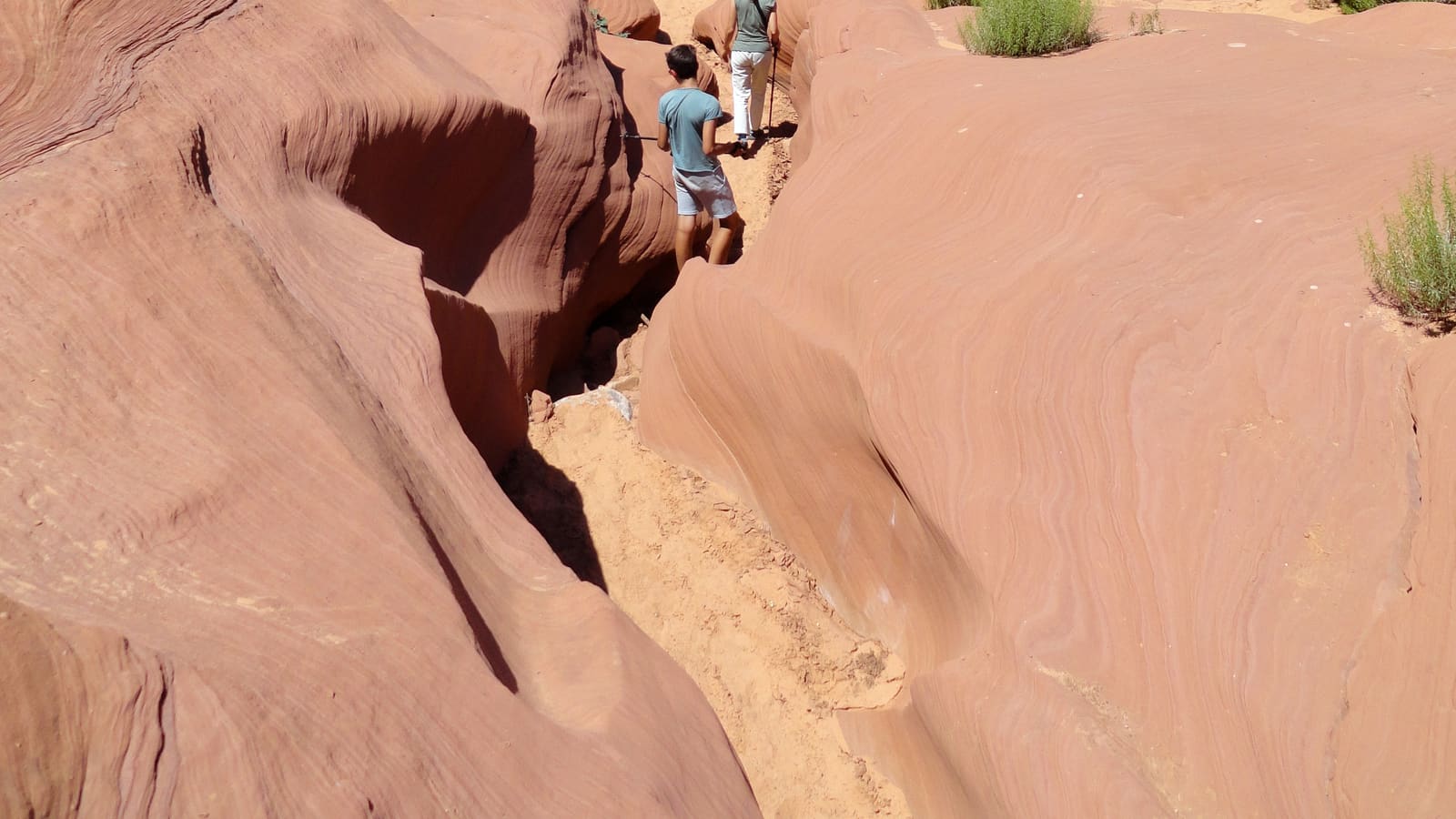
What Waterholes Canyon Is
Waterholes Canyon -- East Waterholes on the Navajo Nation Parks & Recreation site list -- is a slot canyon carved into sandstone south of Page, with its lower access point just off Highway 89 at milepost 542. Like Antelope Canyon, it sits on Navajo Nation land, and its walls show the same kind of sculpted, flowing forms that come from water moving repeatedly through narrow sandstone passages over a very long span of time.
Where Waterholes Canyon differs most from Antelope Canyon is in its profile among visitors. It receives far less tourist traffic and has a less commercially developed tour infrastructure, which gives a visit here a different feel -- quieter, less structured, and in parts more physically involved than the well-worn walking path through Upper Antelope Canyon.
Because access, routes, and operator availability for Waterholes Canyon can change, treat any specific route description as general orientation rather than a fixed itinerary, and confirm current details directly with a Navajo-authorized guide or tour operator before your visit.
Navajo Nation Permit and Access Requirements
Waterholes Canyon is Navajo Nation land, and the two sections have different entry mechanisms. Navajo Nation Parks & Recreation states that the upper part of East Waterholes is accessible by guided tours only, with reservations made through Horseshoe Bend Slot Canyon Tours. The lower part requires a Navajo Nation backcountry permit, listed at $15 per person, per night, and its access is just off Highway 89 at milepost 542. Backcountry permits are purchased at the Lake Powell Visitor Center or any other Navajo Tribal Park location, and you must sign in and out before hiking.
Do not read the lower-section permit as a green light to wander in unaccompanied. Navajo Nation Parks states that all areas on the Navajo Nation are closed to non-Navajos without a valid camping, hiking, or backcountry permit issued by the department, and its permit guidance also says the backcountry permit lets you hike the location with a guide and that all Navajo tour guides are to be utilized. The cleanest way to resolve exactly what your permit does and does not allow on the day is to ask the Lake Powell Visitor Center directly when you buy it. This structure reflects both the cultural significance of the land to the Navajo Nation and canyon-specific safety considerations.
Because the tour infrastructure at Waterholes Canyon is less developed and less widely marketed than at Antelope Canyon, availability and the list of current authorized operators can shift more noticeably over time. Navajo Nation Parks names a single operator for the upper section, so if that changes there may be no guided option at all for a period. Check the current roster at navajonationparks.org, or call the Lake Powell Visitor Center, before assuming a specific operator is still running tours here.
Respect whatever access rules and guide instructions apply during your visit. Treating the permit and guide requirement as a formality to work around rather than a real boundary is both disrespectful to Navajo Nation land and, in a slot canyon environment, a genuine safety risk.
How It Compares to Antelope Canyon
Antelope Canyon, particularly the Upper section, is famous for smooth, sculpted walls and the light beams that appear during a seasonal window when the sun angle is high. It is also the more commercially developed of the two, with an established tour infrastructure, higher visitor volume, and a well-worn walking route.
Waterholes Canyon offers a quieter alternative with fewer other visitors on a given tour, and parts of the route can feel more exploratory. It does not have the same reputation for light-beam photography that Upper Antelope Canyon has built, but the sculpted rock and the sense of moving through a narrow, enclosed space is a similar core experience.
Visitors with time for only one slot canyon and a strong interest in the light beams should prioritize Antelope Canyon. Visitors who want a quieter, less crowded slot canyon experience, or who have already visited Antelope Canyon and want a second stop with a different character, are the better fit for Waterholes Canyon.
Physical Difficulty and What to Expect
Some sections of Waterholes Canyon involve more scrambling, uneven footing, or narrower passages than a standard Antelope Canyon walking tour, depending on the specific route your guide takes. This is not uniformly true of the entire canyon, but it means visitors should ask their guide or operator directly about the physical demands of a specific tour rather than assuming it mirrors an Antelope Canyon visit.
Closed-toe shoes with good grip are a sensible baseline for any slot canyon visit in this region, and Waterholes Canyon is no exception. Bring water and sun protection for the approach, since the walk to and from the canyon entrance is exposed desert terrain regardless of how sheltered the canyon interior itself is.
If you have mobility concerns or are visiting with young children or older family members, raise these directly with the tour operator before booking so they can advise on whether the specific route planned for your visit is a good fit.
Flash Flood Risk and Weather Awareness
Waterholes Canyon is flash flood terrain, just like Antelope Canyon and every other slot canyon in this region. The National Park Service states plainly that slot canyon floods are often caused by storms miles away, that slot canyons are particularly dangerous during inclement weather, and that you cannot outrun a flash flood. A thunderstorm entirely out of sight from the canyon floor can send water through the passage with little to no warning at your location. Watch for the warning signs the NPS lists: building clouds or thunder, water turning from clear to muddy, floating debris, rising water or stronger current, and an increasing roar from upstream. If you see them, do not stop to collect gear -- get to higher ground.
This risk is a core reason the guide requirement exists on the upper section. Guides monitor current weather and regional conditions and will cancel or reroute a tour when there is meaningful flood risk, and you should follow that judgment even if conditions at the canyon entrance look calm. On the lower section, where you are there on a backcountry permit rather than with a tour, nobody is making that call for you -- check the forecast for the entire upstream drainage, not just the trailhead, and turn around rather than gamble. Never enter without the required permit or guide.
The National Weather Service puts the official monsoon season at June 15 through September 30, though NWS Flagstaff notes that monsoonal moisture typically does not reach northern Arizona until the first week of July, and it calls flash flooding the biggest threat in northern Arizona during the monsoon. Navajo Nation Parks & Recreation gives the same window -- July through September -- but is explicit that flash floods can occur at any time of the year. Do not treat a visit outside the monsoon as risk-free. If your visit falls inside that window, build flexibility into your schedule in case a tour is postponed or canceled for safety.