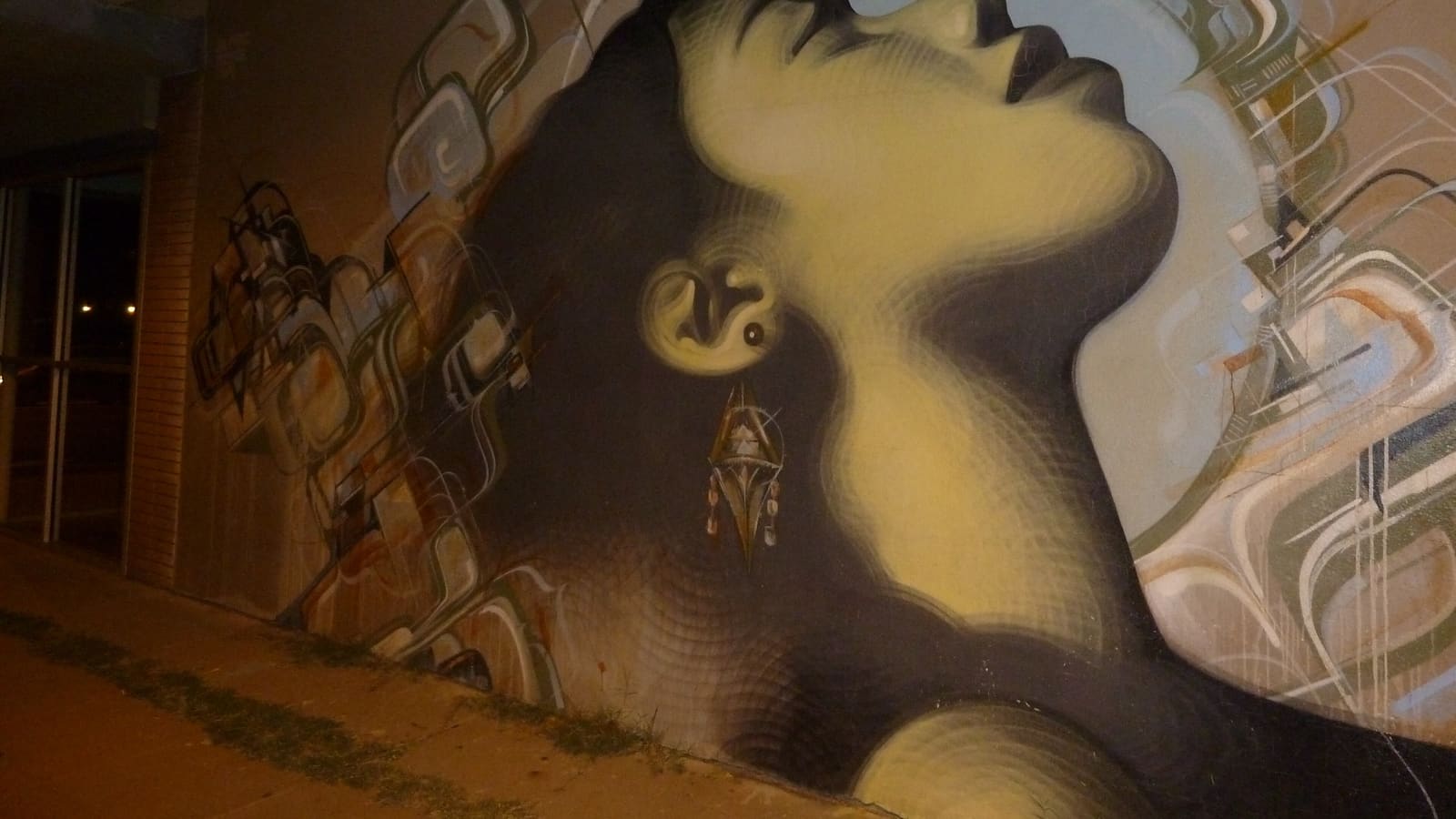
Roosevelt Row and Grand Avenue: Downtown's Gallery Districts
Downtown Phoenix has two adjoining arts districts that most visitors treat as one continuous stretch: Roosevelt Row, running roughly from 16th Street to 7th Avenue with the bulk of its gallery and studio space concentrated between Central Avenue and 7th Street, and historic Grand Avenue, a diagonal street on downtown's western edge known for its mix of vintage architecture, adaptive-reuse studio spaces, and street murals along a stretch running roughly from 7th to 19th avenues. Roosevelt Row traces its start to the early 1990s, when artists began converting vacant buildings into studio space, and the nonprofit Artlink launched the first First Friday art walk in 1994. Alwun House, a longtime gallery, performance space, and arts nonprofit in the neighborhood, has been part of the district for decades and is a good anchor stop if you're exploring on foot.
First Fridays: A Monthly Self-Guided Art Walk
First Fridays happens on the first Friday of every month, roughly 6 to 10 p.m., and has grown into one of the largest self-guided art walks in the country -- galleries, studios, small stages, food trucks, and pop-up vendors fill both Roosevelt Row and Grand Avenue simultaneously. Because it spans two separate districts a short distance apart, plan on walking or a short rideshare hop between them rather than assuming everything is within one compact block. Parking fills up fast downtown on First Fridays specifically, so arriving early or using rideshare is worth planning for rather than counting on street parking near the action.
Art Detour: The Annual Deep Dive
Art Detour, organized annually by the nonprofit Artlink, is a free, self-guided weekend tour that goes deeper than a typical First Friday -- it opens up artist studios and art spaces across a wider stretch of downtown, including Roosevelt Row, Grand Avenue, and the Calle 16 corridor along 16th Street. It runs once a year rather than monthly, so if studio visits specifically are what you're after, checking the current year's Art Detour dates before your trip is worth the extra step, since exact scheduling shifts year to year.
Symphony Hall: Home to the Symphony, Opera, and Ballet
Downtown's Symphony Hall, at 75 N 2nd St, is the shared performance home of the Phoenix Symphony, Arizona Opera, and Ballet Arizona -- a single multi-purpose hall seating just over 2,300 that hosts everything from classical programs to holiday productions across all three resident companies' seasons. Because it's one venue shared by three different organizations, checking each company's specific schedule matters more here than at a single-tenant theater -- a given week might have a symphony program, an opera, or a ballet performance, not necessarily all three in rotation.
Herberger Theater Center: Downtown's Theater Hub
A short walk from Symphony Hall, the Herberger Theater Center at 222 E Monroe St opened in 1989 and houses three stages under one roof, including an 800-seat main theater and two smaller stages. Multiple resident theater companies stage productions here across the year, spanning drama, dance, and improv, and Arizona Opera and Ballet Arizona have also used its stages for select performances outside their Symphony Hall home. It's a reliable pick if you want a live show without committing to a specific touring production -- check the center's current listings for what's running during your visit.
Phoenix Center for the Arts: A Community Anchor
Phoenix Center for the Arts, at 1202 N 3rd St just north of downtown, is a nonprofit community arts hub founded in 1975 that runs year-round classes across ceramics, metals, photography, painting, glass, and the performing arts, alongside resident galleries and youth programs. It's less a tourist stop than a working community arts center, but its gallery spaces and occasional public events are open to visitors, and it's a useful stop if you want a sense of Phoenix's arts scene beyond the gallery-and-museum circuit.
Beyond This Guide: The Big Museums
If your trip includes the Heard Museum, the Musical Instrument Museum, or the Phoenix Art Museum, our Phoenix museums guide covers those in depth, including what each collection focuses on and how to plan a museum day around the summer heat. This guide is meant to pick up where that one leaves off -- the gallery districts, the monthly art walk, and the performing-arts venues that don't fit under "museum" but are just as central to how Phoenix's arts scene actually works.