Tombstone's History: A Silver Boomtown
Tombstone was founded in 1879, after prospector Edward Schieffelin's silver strike in the area set off a mining boom that built the town up fast in the Arizona Territory. Cochise County was created by a vote of its citizens in 1881 with Tombstone as the county seat, and the town incorporated the same year. Like many Western mining boomtowns of the period, Tombstone grew rapidly around the promise of silver wealth, drawing miners, merchants, and the broader mix of people who followed a mining boom in the 19th-century American West.
The boom did not last indefinitely. By the traditional account, water flooding the mine workings combined with the broader decline of silver mining to undercut the industry that had built the town, and Tombstone's population and economy contracted well below its boomtown peak. What makes Tombstone unusual among Western mining towns is that it did not become a ghost town in the way many boomtowns did -- it persisted, and over time leaned into tourism built around its own frontier-era history as a new economic base.
The OK Corral and October 26, 1881
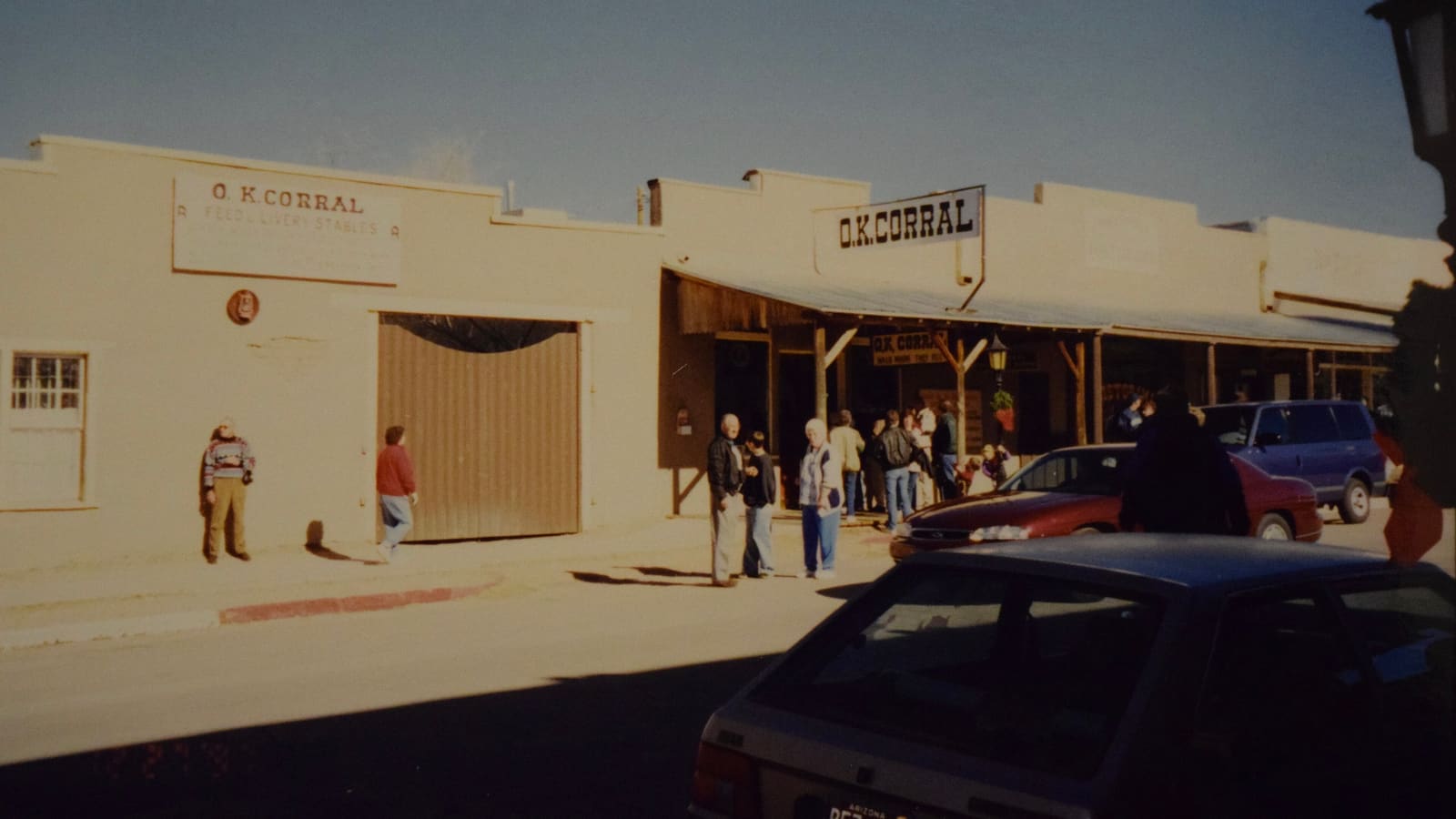
The event Tombstone is most associated with nationally is the gunfight near the O.K. Corral on October 26, 1881. It is worth getting the sides right, because popular retellings blur them: Virgil Earp was the marshal of Tombstone, his brothers Wyatt and Morgan were part-time deputies, and John "Doc" Holliday -- routinely described as a lawman in film and in casual summaries -- was not one. The National Park Service describes him simply as their friend. They confronted a group of men associated with cattle rustling in the area, including Billy Clanton and members of the McLaury family. Three men on the Clanton-McLaury side were killed, and both Virgil and Morgan Earp were wounded.
The fight was over almost immediately -- the National Park Service calls it simply a brief gunfight. The figure of "about 30 seconds" that appears in nearly every retelling is a traditional number carried forward through later accounts rather than something a federal or state historical source states as established fact, so treat the precise duration as folklore-adjacent even though the brevity is not in doubt.
The exact sequence of events, including who drew or fired first, has been debated by historians for well over a century, and the story has been substantially reshaped by decades of film and television dramatization that added invented dialogue and staged confrontation on top of the historical record. The National Park Service puts it bluntly: the facts have been severely blown out of proportion in books and movies. Approach any single narrated version of the story, including reenactments performed at the site today, as one telling of genuinely disputed history rather than a settled account.
The Town Too Tough to Die
Tombstone's nickname, "The Town Too Tough to Die," is the town's own billing, and the City of Tombstone still uses it. As traditionally told, it points to a run of setbacks that finished off many other Western boomtowns -- fires in the downtown, water flooding the mine workings, and the broader collapse of the silver industry that had built the town in the first place. We have not been able to confirm the specifics of those fires and the mine flooding against a state or federal historical source, so treat that chain of events as the received local account rather than a verified sequence. What is not in dispute is the outcome: rather than being abandoned, the town held on through its leaner decades and eventually rebuilt an economy around tourism tied to its own frontier history.
That survival story is part of what gives Tombstone a different character than a purpose-built Old West attraction elsewhere -- the town's historic core includes genuinely old buildings that predate the tourism economy built up around them, even as much of the modern visitor experience is organized specifically around presenting that history to travelers.
Walking Tombstone Today
Tombstone's compact historic district is generally walkable, with wooden boardwalks along the main street and a mix of historic buildings, museums, and shops built around the town's mining and gunfight history. The O.K. Corral site itself, along with several other historic buildings, forms the core of what most day-trip visitors come to see, and staged elements -- including gunfight reenactments -- run alongside the more straightforwardly historical exhibits and buildings.
Tombstone's historic core is a designated National Historic Landmark district, recognized as one of the best-preserved specimens of the rugged frontier of the 1870s and 1880s. That designation covers the district; it does not mean the attractions inside it are publicly run, and this is the single most common misunderstanding visitors arrive with. Only one is a state park: Tombstone Courthouse State Historic Park, the red-brick 1882 Victorian courthouse, operated by Arizona State Parks -- and notable in its own right as Arizona's first operational state park, opened to the public in 1959. Boothill Graveyard, laid out in 1879 by the Tombstone Townsite Company, is run by the City of Tombstone. The O.K. Corral site and the Bird Cage Theatre are separately operated attractions, each setting its own hours and admission independently of the state park or the city.
Practically, that means there is no single ticket, no single set of hours, and no one authority to call. Because the town leans heavily into its tourism identity, expect a mix of genuine historic character and a more theatrical, staged presentation layered on top of it. Check current hours, admission, and reenactment schedules with each site individually before planning your day -- this guide intentionally does not list fixed prices or times, because they are set separately and change.
The Drive from Tucson
Tombstone sits southeast of Tucson in Cochise County, and The normal route is I-10 east to Benson and then south on State Route 80; check a mapping app for current drive time. Exact drive time depends on your starting point within the Tucson area, traffic, and road conditions, so check a current mapping app for your own estimate rather than relying on a fixed number. One pleasant surprise on arrival: Tombstone sits at about 4,540 feet of elevation, meaningfully higher than Tucson, so it usually runs cooler than the city you left.
A rental car or personal vehicle is the practical way to make this trip, since Tombstone is not well served by public transit from Tucson. Fuel up before leaving the city and build in extra time if you plan to combine the trip with other stops in Cochise County.
Blowing dust on I-10 is the real safety issue on this drive, and it kills people. Arizona's monsoon and dust-storm season runs from late spring through early fall, and ADOT warns drivers to expect blowing dust and sharply reduced visibility on I-10. Its guidance, branded "Pull Aside, Stay Alive," is specific and worth knowing before you need it: do not drive into a dust storm. If one overtakes you, check the traffic around you and begin slowing immediately -- do not wait until visibility is already gone to look for a way off the road. Exit the highway completely if you can and pull entirely off the paved surface, away from where other vehicles travel; never stop in a travel lane or the emergency lane. Then turn off all your vehicle lights, including the emergency flashers, set the emergency brake and take your foot off the brake pedal, so no lit taillight tempts a following driver to steer toward you. Stay in the vehicle with your seat belt buckled and wait for the storm to pass. Check az511.gov for current conditions before you set out.
Optional Add-On: Bisbee
Travelers with more time can extend a Tombstone day trip further into Bisbee, another historic Cochise County town built around a different mineral boom -- copper rather than silver -- with its own distinct character. Bisbee's old downtown is built into hillside terrain and has a notably different feel from Tombstone's flatter, more staged Old West main street, with a mining-town history reflected in its architecture and the large open-pit mine visible near town.
Combining both towns in a single day is workable for travelers comfortable with a longer day on the road, but it does mean less time at each stop than a dedicated visit to either one alone. Check current road conditions for the route beyond Tombstone before committing to the combined itinerary, and consider splitting the two towns across separate trips if you want unhurried time in each.