What Makes Sonoran Mexican Food Different
Sonoran Mexican food is the regional cuisine of the Mexican state of Sonora and the borderlands on both sides. Its defining characteristics separate it from the Tex-Mex, Cal-Mex, and New Mexican food traditions that many American visitors arrive familiar with. The flour tortilla is central to the Sonoran kitchen in a way it is not in most other Mexican regional cuisines, where corn tortillas dominate. Sonoran flour tortillas -- particularly hand-rolled ones from local tortillerias -- are thin, pliable, and made with lard, giving them a texture and flavor that differs substantially from the mass-produced flour tortillas sold in grocery stores. A well-made Sonoran flour tortilla cooked on a comal is worth seeking out on its own.
Carne seca is another Sonoran specialty rarely found outside the region. It is dried, shredded beef -- typically dried in the sun and then shredded and rehydrated, seasoned, and often incorporated into burritos or served as a filling. It has a drier, more concentrated beef flavor than braised or grilled preparations. El Charro Cafe claims credit for the Tucson-style preparation and is one of the restaurants where visitors first encounter it.
Chiltepín is the wild chile of the Sonoran Desert -- small, round, and very hot compared to its size, with a flavor that is fruity and sharp rather than the earthy heat of dried anchos or mulatos. It grows wild in the canyons of the Sky Islands and is harvested, dried, and incorporated into table salsas, soups, and marinades. It is a genuinely wild crop, not a cultivated one: the US Forest Service designated a Wild Chile Botanical Area in the Tumacacori Mountains of the Coronado National Forest in 1999 -- about 2,500 acres protecting the largest wild chile population in Arizona and the northernmost reach of the species. Chiltepín-based salsas are common at Tucson Mexican restaurants and worth trying if you encounter them -- the flavor is specifically Sonoran in a way that is hard to replicate elsewhere.
4th Avenue and Congress Street
4th Avenue is one of Tucson's most concentrated dining and bar corridors, running north from the University Boulevard area toward downtown across a walkable stretch of blocks known officially as the North Fourth Avenue historic district. The avenue has a range of restaurants, coffee shops, bars, and food vendors that skew toward the independent and casual end of the market. The concentration here is higher than most other Tucson neighborhoods and the walkability makes it practical to assess options before committing. It is also the area most accessible to visitors staying in the downtown hotels or near the university.
Congress Street, running east-west through the center of downtown, has a smaller but growing cluster of restaurants and bars associated with the renovation of the Hotel Congress and surrounding blocks. The Congress Street strip is more oriented toward the evening and late-night crowd and tends toward cocktail bars, music venues, and restaurants with some ambition in their menus. The Hotel Congress itself, which the hotel's own history dates to a November 1918 soft opening and a 1919 build, still operates the Cup Cafe plus several bars that serve as a social anchor for the block.
Neither 4th Avenue nor Congress Street is the place to find the best traditional Sonoran Mexican food -- for that, the south side of Tucson and the family-run restaurants spread across the city's older neighborhoods are generally considered better. The downtown/4th Avenue corridor is the best area for variety, walkability, and the broader range of food types including non-Mexican options. Visitors who want both traditional food and the evening social scene will find themselves moving between the downtown corridor and the neighborhood restaurants on different outings.
Sonoran Hot Dogs
The Sonoran hot dog is a distinct regional food with a specific construction that is not interchangeable with the American hot dog preparation. The dog is a beef frankfurter wrapped in bacon and cooked on a plancha or grill until the bacon is cooked through and lightly crisped. It goes into a bolillo-style bun -- a partially split, somewhat soft roll that is different from a standard American hot dog bun, with more structure and a denser crumb. The standard Tucson toppings are pinto beans, chopped fresh tomato, mayonnaise, mustard, and crumbled cotija cheese. Some preparations add jalapeño salsa, avocado, or other variations. Our Sonoran hot dog guide covers what goes on one and how to order.
The combination sounds unusual to people who have not had one, but it works -- the bacon fat bastes the dog during cooking, the beans and tomato add bulk and freshness, and the cotija provides a salty, slightly dry contrast to the rich elements. It is a genuinely different eating experience from a Chicago dog or a New York dirty-water dog, and the regional specificity makes it worth seeking out if you are in Tucson.
El Güero Canelo is the restaurant most often cited for popularizing the Sonoran hot dog in Tucson and has multiple locations in the city. Street vendors (dogueros) also operate around the city, particularly on the south side and near downtown on weekend evenings. Verify current vendor locations before seeking one out, as outdoor food vendors can shift schedules and locations. The Sonoran hot dog is primarily a casual, inexpensive food -- expect to pay a few dollars per dog, not a restaurant meal price.
El Charro Cafe and the Historic Restaurants
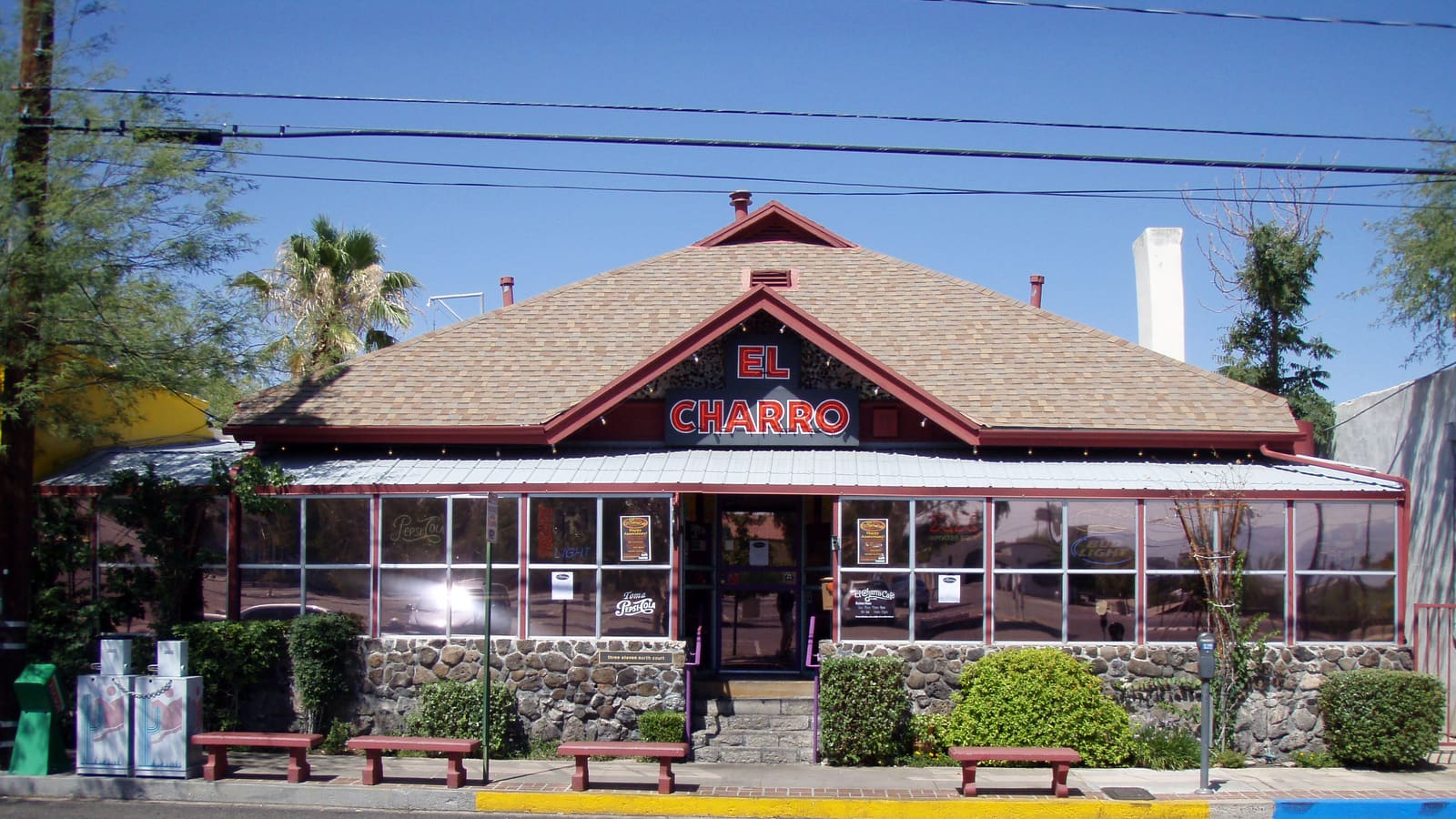
El Charro Cafe is one of the most historically significant Mexican restaurants in the United States. The restaurant states it was established in 1922 and describes itself as "The Nation's Oldest Mexican Restaurant in continuous operation by the same family" -- a claim that is difficult to independently verify across the full restaurant landscape, so read it as the restaurant's own. The original location is at 311 N Court Ave in downtown Tucson's El Presidio Historic District, in the family residence that stonemason Jules Flin built in 1896. The restaurant is credited with inventing the chimichanga -- a deep-fried burrito -- and its own history tells the story as founder Monica Flin accidentally dropping a burrito into a frying pan and catching herself mid-curse in front of children. El Charro does not put a year on it, and other Arizona restaurants also claim the origin, so treat the invention story as a good story rather than a settled fact.
Whether or not the chimichanga origin claim is definitive, El Charro is worth visiting as a historical artifact of Tucson's food culture and for its carne seca, which the restaurant describes as sun-dried shredded beef and notes the Sonoran Desert is "one of only a handful of places in the world where Carne Seca is made." The food is traditional rather than modern, the setting is atmospheric, and the history is real in a way that is uncommon for restaurant claims. El Charro now lists four locations -- the original at 311 N Court Ave downtown, plus Oro Valley (7725 N Oracle), Ventana (6910 E Sunrise), and Tucson International Airport -- so check which one you are booking if the historic building is part of the appeal.
One correction worth making loudly, because older Tucson food writing is full of it: Café Poca Cosa is closed. Suzana Davila's downtown restaurant at 110 E Pennington St -- for decades the most-cited chef-driven Mexican restaurant in the city, famous for a daily changing chalkboard menu -- shut in March 2020 and announced in October 2020 that the closure was permanent, with Davila citing fixed rent, rising food costs and restricted seating. Plenty of guides, lists and older articles still recommend it. Do not build an evening around it. That leaves El Charro as the historic anchor of the Tucson Mexican dining scene; for the more chef-driven end, check what is currently open rather than working from any published list, including this one, and verify hours and menu format directly with the restaurant before you go.
Mercado San Agustin
Mercado San Agustin is a public market at 100 S Avenida del Convento, on Tucson's west side in the Menlo Park neighborhood -- west of Interstate 10 and south of Congress Street, between the Santa Cruz River and Avenida del Convento. It marked its 15th anniversary in 2026, so it opened around 2010-2011, and it is now the anchor of the wider Mercado District development. The market describes itself as an open-air courtyard of retail shops, restaurants, and services, all locally owned and operated, including specialty foods and artisan-made goods. The design references the traditional Mexican mercado concept while being a contemporary development.
The west side location makes Mercado San Agustin somewhat removed from the downtown and university-area corridors where most visitors base themselves, but it is worth the drive for visitors with an interest in the local food culture beyond the tourist-accessible restaurants. The market has a community character -- it serves the west-side neighborhood and the Tucson food community rather than being primarily a visitor attraction. Time your visit to one of the recurring markets if you can (see below). Verify current vendor roster and hours before visiting, as individual vendors change.
Recurring markets run at the MSA Annex across the way rather than in the mercado courtyard itself: the Mercado District currently lists the Santa Cruz River Farmers' Market on Thursdays from 4 to 7 p.m., a Summer Night Market on fourth and fifth Fridays from 6 to 10 p.m., and a seasonal Mercado Flea Market on second Sundays from 9 a.m. to 3 p.m., October through April. Confirm the current schedule on the Mercado District website before you plan around any of them. The farmers market in Tucson reflects the growing interest in native and desert-adapted crops, and vendors sometimes carry ingredients specific to the Sonoran Desert food tradition including chiltepíns, nopales, and native corn varieties that are not commonly available in mainstream grocery channels.
Practical Notes for Eating in Tucson
Tucson's food culture is casual. Even the restaurants with reputations for good food tend not to require reservations for most meals, and the dress code expectation is effectively nonexistent outside of a handful of upscale hotel restaurants. This is both an asset and something to calibrate expectations around -- a Tucson "lunch spot" that a local raves about may be a counter-service operation with no air conditioning and plastic chairs that produces some of the best food in the city. The environment is rarely the point.
Reservations are worth making for any restaurant you identify as a specific dinner destination -- the popular spots do fill, particularly in the winter months when Tucson's population effectively increases with snowbirds. For the traditional taco shops, neighborhood Mexican restaurants, and lunch counters, walk-in is standard. Weekend brunch can generate waits at popular spots on 4th Avenue.
Parking in the downtown and 4th Avenue area is available in city lots and on-street, but 4th Avenue itself is a pedestrian-oriented street and parking is easier a block or two off the main strip. The downtown area has paid parking structures that are generally not expensive. For restaurant districts outside the downtown core -- the south side, Mercado San Agustin, neighborhood spots -- parking is generally easier. If vegetarian eating is a priority, Tucson is workable but requires some menu research in advance, particularly for traditional Sonoran Mexican restaurants where lard-based preparations are common.