What the North American Monsoon Actually Is
The North American Monsoon is a seasonal shift in wind patterns that draws moisture up into the desert Southwest. The National Weather Service in Tucson defines the season by fixed calendar dates: "June 15th through September 30th has been defined as 'The Monsoon.'" Because the window is fixed, the season starts and ends on the same dates every year regardless of the weather -- so a dry first week of July does not mean the monsoon "has not started yet," and a storm in early June is not officially a monsoon storm. It is not a single storm but a season-long pattern of increased humidity punctuated by often-dramatic afternoon and evening thunderstorms.
Storm activity within the monsoon window is genuinely variable -- some stretches bring near-daily storms, while others stay dry for a week or more. The NWS Tucson office describes the season as moving through phases (a mid-June to early-July ramp-up, a late-June to mid-July onset, a mid-July to mid-August peak, then a late-August through late-September decay), but those are descriptions of how a typical season behaves, not promises about any given week. The season dates are fixed; the weather inside them is not, so check a current forecast close to your travel dates.
How Hot Tucson Summers Actually Get
Tucson's summer heat is not subtle, and the numbers are worth knowing before you book. In NOAA's 1991–2020 climate normals for Tucson International Airport, June is the hottest month with an average high of 101.2°F, followed by July at 100.2°F and August at 98.6°F. The same normals put the airport at an average of about 68 days a year at or above 100°F. Overnight relief thins out too: July's average low is 76.3°F. The weeks just before the monsoon arrives are the driest of the year (May normal rainfall is 0.20 inches, June 0.23 inches) and can feel the most intense despite similar temperatures to the humid weeks that follow.
Once monsoon humidity sets in, the heat can feel different -- muggier, with less relief from evaporative cooling -- even if the thermometer reading is similar to a dry pre-monsoon afternoon. Either way, heat exhaustion and heat stroke are real risks. Saguaro National Park's own hiking guidance is specific: drink one quart of water per hour of hiking in hot conditions, and "avoid the intense heat during the hours of 10 am - 4 pm. Start early in the morning or close to sunset." The National Weather Service adds that it is "very easy to become dehydrated in our desert climate without realizing it," and asks people to check on elderly neighbors and family during heat events. Know the warning signs of heat exhaustion and heat stroke before you head out, and treat an afternoon desert hike in July as a decision, not a default.
Flash-Flood and Wash Safety
Flash flooding in desert washes is one of the most serious hazards of monsoon season, and it is a well-documented risk across the Tucson area -- normally dry channels can fill with fast-moving water within minutes of a heavy storm, even one that fell miles away upstream. Water depth is genuinely difficult to judge from inside a vehicle, and a wash that looks shallow can carry far more force than it appears to.
The National Weather Service mandate is three words: Turn Around, Don't Drown. Its Tucson office is blunt about why -- "Never ever drive into a flooded roadway," because "as little as ten inches of water can float average-sized cars, mini-vans, SUVs and trucks," and one to two feet will float most vehicles outright. The Pima County Regional Flood Control District adds that it takes only about a foot of flowing water to sweep most vehicles downstream, that the depth is not always obvious, and that the roadbed itself may have washed away under the water.
So: never drive or walk into a flowing wash, and never go around a barricade. Barricades are placed for your protection, and in Arizona driving past one has a price beyond the risk -- under state law (A.R.S. § 28-910, widely known as the "Stupid Motorist Law") a driver who enters a public road that is barricaded because of flooding can be held liable for the cost of the emergency response needed to get them, their passengers, and their vehicle out, including police, fire, and rescue costs. Before setting out during monsoon season, check current road-closure and flood advisories; Pima County's ALERT gauge network publishes live rainfall and stream data for the region.
Lightning Safety
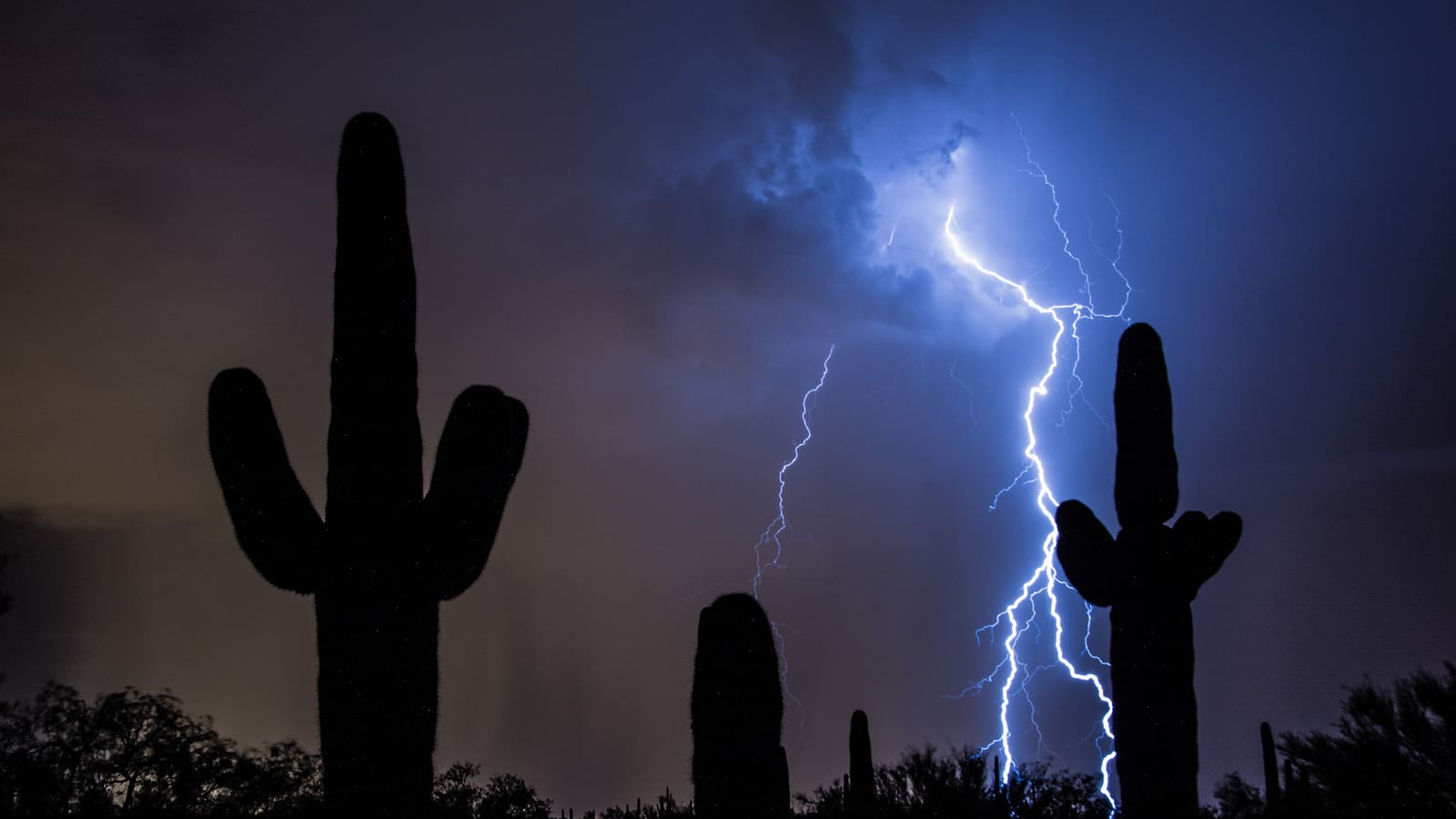
Monsoon thunderstorms are the reason the desert Southwest takes lightning seriously, and the National Weather Service guidance here is short and absolute: "NO PLACE outside is safe when thunderstorms are in the area." The trigger for acting is sound, not sight -- if you can hear thunder, you are close enough to be struck. The NWS Tucson slogans are worth remembering literally: "When thunder roars, go indoors" and "When you see a flash, dash inside."
Safe shelter means a substantial, enclosed building or a hard-topped metal vehicle with the windows closed. A ramada, a picnic shelter, a tent, a dugout, or standing under a tree is not shelter. If you are caught out with no shelter within reach, the NWS advice is to get off elevated ground such as hilltops and ridges, move away from isolated trees, cliffs, water, and anything metal or conductive, and keep moving toward real shelter -- and never lie flat on the ground. The old "lightning crouch" is no longer recommended by the National Weather Service; it offers no meaningful protection, and the only real answer is to get inside. Once you are sheltered, stay there at least 30 minutes after the last sound of thunder before going back out.
Practically, this is the single strongest argument for the early-morning schedule that experienced desert hikers keep in summer. Monsoon storms typically build in the afternoon, so a trail that is safe at 6 a.m. can be genuinely dangerous at 3 p.m. -- especially on exposed ridgelines and sky-island summits, and especially in narrow canyons, which combine the lightning risk with the flash-flood risk described above. Saguaro National Park's guidance for storms is to avoid hiking in canyons and washes, and to move quickly to a safe place if you see lightning.
Dust Storms and Driving Safety
Haboob-style dust storms can occur in the Tucson region during monsoon season, typically forming ahead of a thunderstorm's outflow winds and capable of dropping visibility to near zero within a matter of moments. They are most common as a storm approaches, which means clear skies can turn into a wall of dust with relatively little warning.
Arizona's official guidance is the Pull Aside, Stay Alive sequence, and ADOT and the National Weather Service both spell out the steps in order. Check the traffic around you and start slowing down as soon as you see dust ahead -- do not wait until visibility is already bad. Exit the highway completely if you can; do not stop in a travel lane or the emergency lane. Pull as far off the paved roadway as possible. Turn off all of your vehicle's lights, including the taillights -- drivers behind you will steer toward any light they can see, and a lit parked car becomes a target. Then put the vehicle in park, set the parking brake and take your foot off the brake pedal so your brake lights stay dark, keep your seatbelt buckled, and wait for the storm to pass. Treat any sudden loss of visibility on the road the same way.
What's Still Worth Doing in Summer
Summer is not a dead season for a Tucson trip. Storm-watching from a safe, covered vantage point is a genuine draw for some visitors, since the desert light and cloud formations around a monsoon storm can be striking. Indoor and shaded attractions -- museums, the air-conditioned hangars at Pima Air & Space Museum, downtown dining -- work well as a midday escape from the heat.
Higher-elevation stops like the Mount Lemmon corridor stay noticeably cooler than the desert floor and remain a reasonable outdoor option even in summer, provided you still watch for afternoon storm development at elevation. Hotel rates in Tucson also tend to run lower during the hottest months compared to the busier cooler season, which is worth factoring into a summer trip's overall value.
Planning a Summer Trip Around the Heat and Storms
Front-loading outdoor activity into the early morning is the single most useful habit for a summer Tucson trip, both because temperatures are lowest then and because most monsoon storms tend to build later in the day rather than at dawn. Save indoor or shaded plans for midday and afternoon, when both heat and storm risk are typically highest.
Check the National Weather Service forecast and any active flood or heat advisories each morning of your trip rather than relying on a general seasonal pattern, since day-to-day conditions during monsoon season can shift quickly. A flexible itinerary that can absorb a storm delay or a heat-driven schedule change will serve you better than a tightly packed plan.