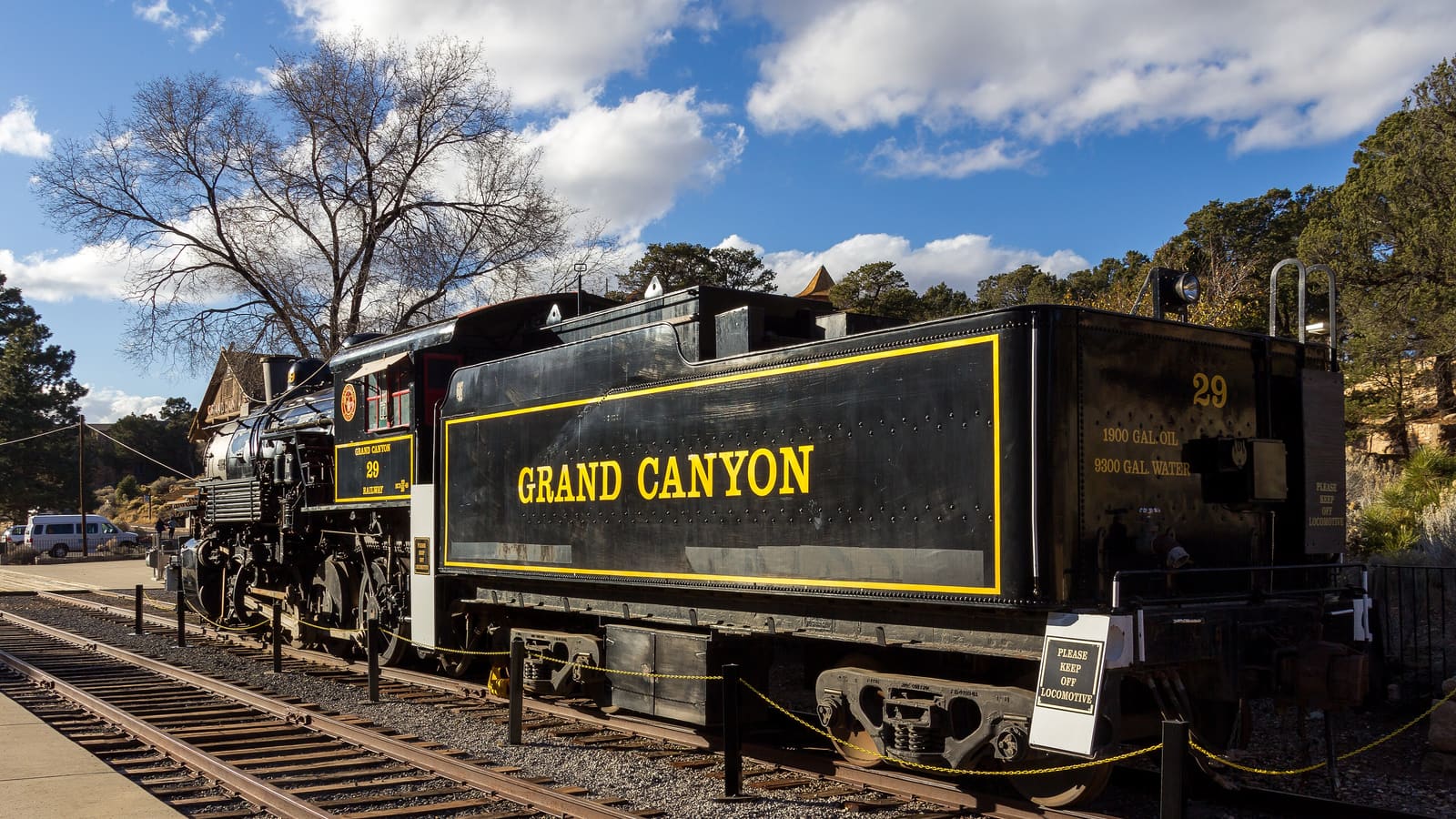
What the Grand Canyon Railway Actually Is
The Grand Canyon Railway is a historic rail line that carries passengers from a restored depot in downtown Williams to the Grand Canyon Depot near the South Rim, a route that has been run in some form since the early 1900s and was revived as a tourist excursion in the late 1980s. The train uses a mix of vintage and vintage-styled passenger cars, and the equipment in service varies by season, so do not expect a specific locomotive type to be guaranteed on any given day.
The appeal is not just the destination, it is the ride itself. Rather than driving north on Highway 64 and dealing with parking at the South Rim, riders board a few blocks from where they are staying in Williams, settle into a train car, and let someone else handle the trip. The route runs through ponderosa pine forest and high desert grassland, with the terrain opening up as the train climbs toward the canyon's south entrance. It is a scenic ride in its own right, not just a shuttle.
The Ride: Timing and What Happens On Board
The trip from Williams to the South Rim runs a little over two hours each way, so budget roughly two hours and fifteen minutes in each direction plus time at the canyon itself before you plan the rest of your day. Most itineraries built around the train end up as a full-day commitment once you account for boarding, the ride out, several hours at the rim, and the ride back.
On board, the railway leans into its Old West identity. Musicians sometimes move through the cars, and the train is well known for a staged trackside shootout re-enactment that plays out near the Williams depot, typically before departure or on return, as part of the theatrical experience rather than anything historically literal. It is aimed squarely at making the trip feel like an event, especially for kids, and it generally succeeds at that even for skeptical adults.
Seating Classes and Choosing a Car
The railway sells several tiers of seating, ranging from standard coach-style cars up through more premium options with wider seats, better sightlines, and in some cases separate service. Exact class names, amenities, and pricing change from season to season, so treat any specific figure you see online as provisional and check the official Grand Canyon Railway site for current offerings before you book.
As a general rule, the higher tiers add comfort and sometimes a snack or beverage service, while standard coach gets you the same route, the same views, and the same amount of time at the canyon. Families traveling with young kids often find the added legroom in a premium car worth it; budget-focused travelers do fine in standard seating. Book early during peak season, especially around holidays, since the train does sell out on popular dates.
The Williams Depot and Railway Hotel
The Williams depot is the anchor of the whole experience and sits right in town, within easy walking distance of the historic Route 66 strip. The depot building itself has been restored and functions as both the departure point and something of an attraction on its own, with train memorabilia and a general sense of stepping back into an earlier era of Southwest travel.
Adjacent to the depot is the Grand Canyon Railway Hotel, a property built specifically to serve railway passengers, which makes it a convenient choice if you want to walk to the platform on the morning of your ride rather than drive across town. Staying here removes any worry about parking or traffic on departure day. For a broader look at where to base yourself in Williams beyond this one hotel, see our guide to where to stay in Williams.
Why Take the Train Instead of Driving
Driving from Williams to the South Rim is a straightforward option, and plenty of visitors do it, particularly if they want flexibility to stop along the way or plan a longer day trip from Williams to the Grand Canyon that includes other stops. The train trades that flexibility for a different kind of ease: no driving, no parking search at the rim, and a built-in sense of occasion that a car trip does not really replicate.
The honest trade-offs are cost and schedule rigidity. The train is a fixed-departure, fixed-return experience, so you get a set window at the canyon rather than an open-ended day. It also generally costs more per person than the gas and parking for a self-driven visit. Families with young kids, first-time visitors who want the classic experience, and anyone who would rather not drive mountain highway curves tend to be the best fit. If you want to combine both, some visitors ride the train one trip and drive on a separate visit, especially if home base is Flagstaff rather than Williams itself.
The Polar Express: Holiday Season
During the November and December holiday season, the Grand Canyon Railway runs a Polar Express themed excursion, inspired by the children's book and film, complete with hot chocolate service, costumed characters, and a nighttime departure from the Williams depot. This is a separate, shorter round-trip excursion rather than a run to the canyon itself, and it is consistently one of the most popular things to do in Williams during the holidays.
Because of that popularity, Polar Express dates sell out well in advance, often months ahead of the actual holiday season. If a winter visit built around this experience is the plan, check the official schedule and book as early as the railway opens sales rather than waiting until closer to your travel dates. It pairs naturally with a broader look at Williams in winter, since snow on the ground adds a lot to the atmosphere of both the train ride and the town itself.
Planning Your Trip
Book your seats through the official Grand Canyon Railway website well ahead of your visit, particularly for weekends, holidays, and the Polar Express season, since availability tightens fast. Arrive at the Williams depot with time to spare before departure; boarding and the pre-departure entertainment start earlier than the listed departure time, and you do not want to be rushing across town.
Dress in layers regardless of season. Williams sits at 6,770 feet in elevation and the South Rim is higher still, so mornings can be genuinely cold even when Phoenix or Tucson are warm, and weather at the canyon can shift quickly. Bring water, sun protection for the time spent outdoors at the rim, and comfortable shoes, since you will be walking along the rim during your time at the canyon before the return trip. For current rates, exact departure times, and seating options, always check the official Grand Canyon Railway site rather than relying on older published figures, since schedules and pricing are adjusted by season.