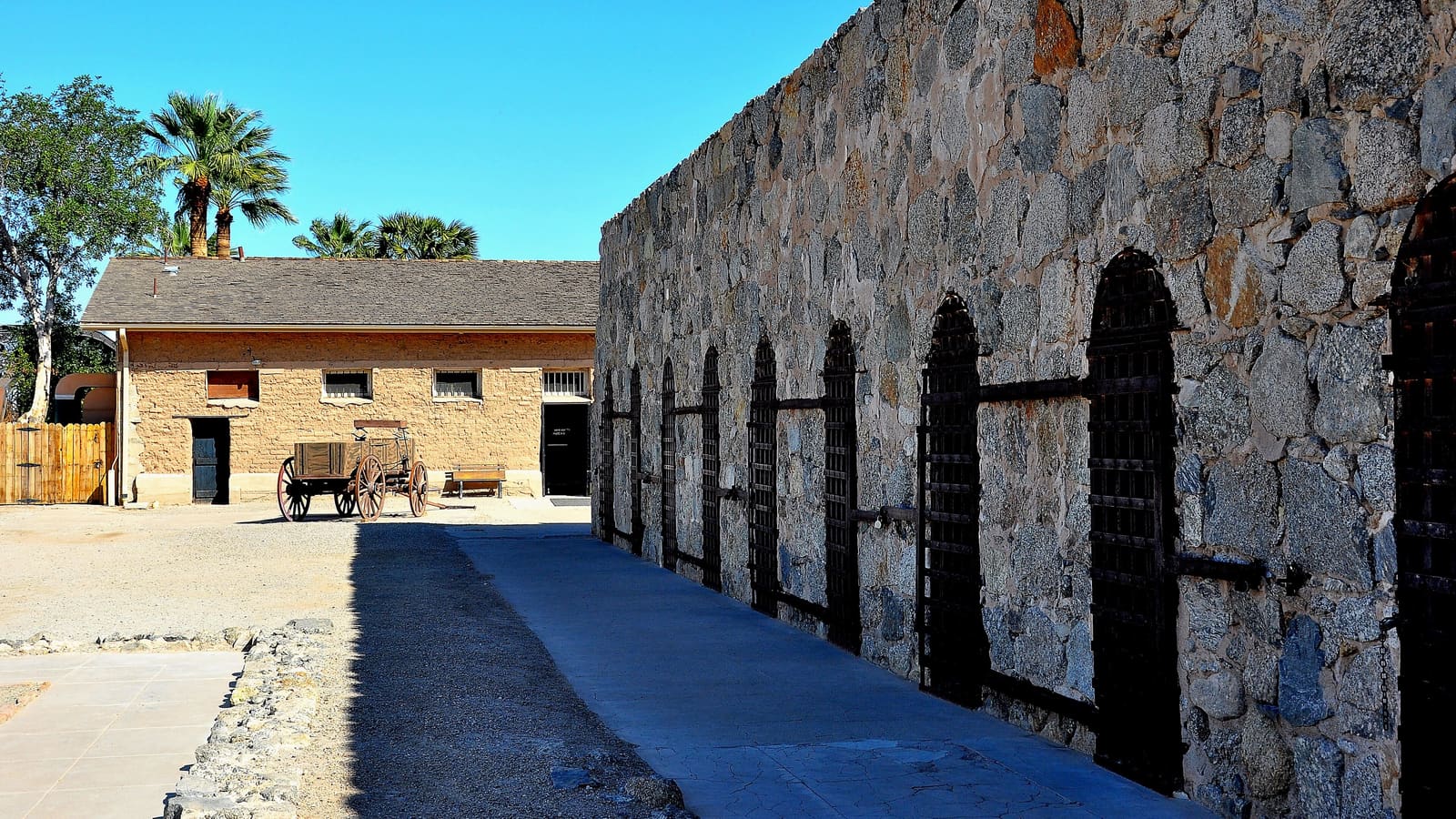
Yuma Territorial Prison State Historic Park
Yuma Territorial Prison is the town's best-known attraction, preserving cellblocks and exhibits from its operating history between 1876 and 1909. The site sits on a bluff overlooking the Colorado River, which gives the grounds a genuinely commanding view alongside the historical exhibits inside the preserved buildings. Because much of the site is outdoors on an exposed bluff, an early-morning visit is generally more comfortable than an afternoon one, especially outside the cooler winter months.
For a deeper look at what's on site and how to plan your visit, see our full Territorial Prison guide, which covers the layout, the exhibits, and how the site pairs naturally with the river-crossing history next door.
The Historic River Crossing and Quartermaster Depot
Yuma earned its historical significance as the primary crossing point of the Colorado River for travelers, freight, and eventually the U.S. Army moving into the Southwest. The Quartermaster Depot was a supply installation tied to that crossing, and the depot grounds are preserved today as part of Colorado River State Historic Park, which interprets the site's role in regional transportation and military history. One naming note, since older guides and signage still use the previous name: the state park covering the depot grounds is now called Colorado River State Historic Park, not Yuma Crossing State Historic Park. Arizona State Parks describes it as occupying part of the grounds of the old U.S. Army Quartermaster Depot established in 1864, a roughly 10-acre park whose five surviving Depot-era buildings are among the oldest and best-preserved in Arizona. Do not confuse the state park with the separately designated Yuma Crossing National Heritage Area, which is a much larger federally designated district rather than a single park.
Because this site sits right alongside the Territorial Prison grounds, most visitors pair the two into a single outing, using the river-crossing history to add context to the prison's own story about the town's frontier-era development.
The Imperial Sand Dunes Day Trip
West of Yuma, across the California line, sit the Imperial Sand Dunes, managed by the Bureau of Land Management as the Imperial Sand Dunes Recreation Area and a well-known destination for OHV riding, photography, and general sightseeing. It is a genuinely large dune system, though you'll see competing superlatives about exactly how large -- check the BLM's own description rather than trusting a ranking you read somewhere. The dunes have also served as a filming location for a number of productions, including scenes shot in the Buttercup Valley area; the BLM is the authority on which areas are open and what is permitted. Because there's little shade on open sand and surface sand temperatures run far above air temperature, plan a dunes trip for the cooler months rather than the height of summer, and confirm current access, permits, and closures with the BLM before you go.
See our dedicated dunes guide for details on location, permits for OHV use, and how to plan a safe, well-timed visit.
Colorado River Outings
Beyond its historical role, the stretch of the Colorado River near Yuma supports a range of present-day outdoor activities, including river-history parks, birding and wetland areas, and options for boating and paddling. The river corridor is part of what gives Yuma its distinct sense of place -- a desert town built around a working river crossing rather than a generic Southwest highway stop.
Specific outfitters, rental locations, and access points change over time, so check current listings before planning a river outing, and see our full river guide for a deeper look at the parks and activities along the corridor.
Winter-Lettuce Agritourism
Yuma is widely known as a major winter produce growing region, and during the November-through-March growing season, the surrounding farmland becomes a legitimate agritourism destination. The scale is easy to underestimate: University of Arizona Cooperative Extension calls Yuma the "Winter Salad Bowl of the nation," producing over 90% of the winter leafy greens and vegetables consumed in the United States, and describes Yuma as the epicenter of U.S. salad-greens production between November and March. Field-to-fork tours and related farm experiences let visitors see the industry firsthand -- something most first-time visitors don't expect from a desert border town, and a genuinely distinct addition to a Yuma itinerary alongside the more familiar historic sites.
Because the crop is only in the ground during the cooler months, these tours are strictly seasonal. See our dedicated agritourism guide for more on how the growing season works and what a field tour typically covers.
Putting Together Your Itinerary
Heat here is a safety issue, not just a comfort issue. Most of what's on this list -- the prison bluff, the depot grounds, the dunes, the river corridor -- is outdoors and exposed, and Yuma sits in one of the hottest corners of the United States. The National Weather Service notes that everyone is vulnerable to heat, with young children and infants at particular risk because their bodies adapt to heat less well than adults, and older adults at elevated risk, especially those with pre-existing conditions or who take certain medications. That last group describes a large share of Yuma's winter visitors.
If you are visiting outside the cool season, treat the outdoor sites as early-morning-only, carry more water than you think you need, watch for the signs of heat illness, and never leave a person or a pet in a parked vehicle. Check the current NWS forecast and any active heat warnings for Yuma before you set out, and follow NWS heat-safety guidance rather than a fixed rule of thumb. Local authorities open cooling centers during extreme-heat events -- treat their activation as a signal to move your plans indoors.
Nearly every major Yuma attraction is more comfortable, and in several cases only fully available, during the November-through-March window -- the prison and river-crossing grounds are more pleasant outside peak summer heat, the sand dunes are genuinely safer to visit, and the agritourism tours simply don't run in summer because the crop isn't in the ground. If your trip is flexible, build it around that same seasonal window covered in our best-time-to-visit guide, and treat a summer visit as a shorter, more indoor-weighted stop rather than a full multi-day exploration.