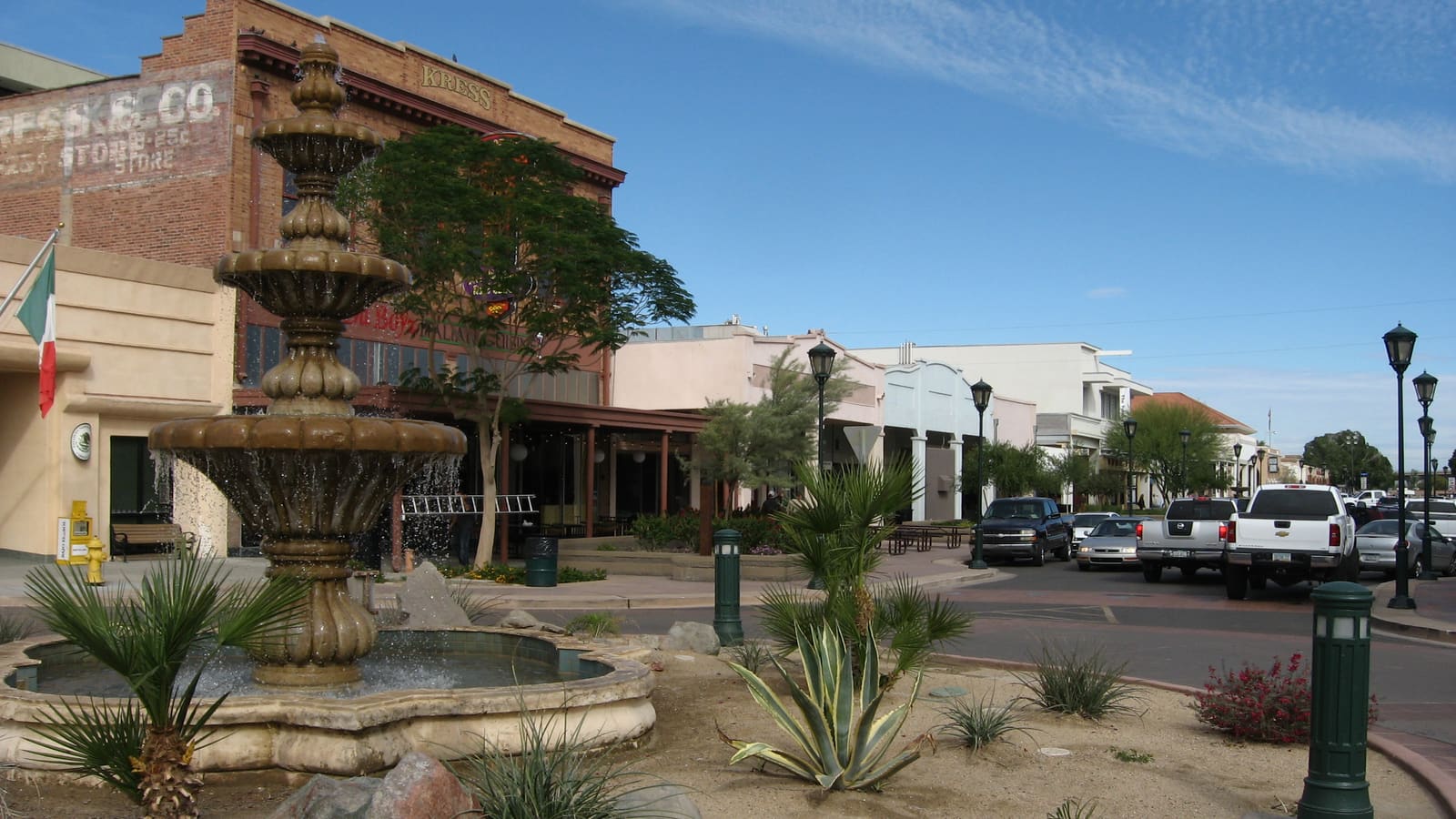
Historic Downtown / Old Town Near I-8
Historic Downtown, generally referred to as Old Town, sits near the I-8 corridor and within easy reach of the two state historic parks that anchor Yuma's river-crossing story: Yuma Territorial Prison State Historic Park at 220 N. Prison Hill Road, on the bluff above the Colorado River, and Colorado River State Historic Park at 201 N. 4th Avenue, which preserves five buildings of the old U.S. Army Quartermaster Depot established in 1864. (If you have older guidebooks, that second park is the one they call the Yuma Quartermaster Depot -- same site, current name.) Basing yourself here keeps day one of a typical itinerary walkable and puts you within a reasonable drive of everything else, from the river parks to the day-trip routes.
This area tends to suit first-time visitors and shorter stays best, given the mix of walkability and highway access. Specific property types and price points vary and change over time, so compare current listings rather than assuming a fixed range.
The Foothills: Yuma's Winter-Visitor Area
What locals call "the Foothills" is Fortuna Foothills, an unincorporated community east of the city along the I-8 corridor -- a census-designated place in Yuma County rather than part of the City of Yuma proper. It is closely associated with the winter-visitor and snowbird season, with a concentration of RV parks and resort-style properties built around that extended-stay audience. Travelers planning a full winter season, rather than a short trip, tend to gravitate here.
Because this area caters heavily to the snowbird season, availability can tighten well ahead of the November-through-March window. See our RV parks and snowbird guide for more on how that season generally works and what to expect when booking.
River-Adjacent Lodging
For travelers who plan to spend significant time along the Colorado River corridor -- the river-history parks, wetland and birding areas, and paddling or boating options -- a base closer to the river can cut down on driving between stops. This is less a distinct district than a proximity preference, since river-adjacent options can appear near both Old Town and other parts of the city.
Actual walking or driving distance to the river corridor varies by specific property, so verify that distance directly rather than assuming "river-adjacent" means immediate river access.
Matching an Area to Your Itinerary
If your trip centers on the historic sites and a day-trip or two, Historic Downtown's I-8 proximity is generally the most practical choice. If you're settling in for an extended winter stay with an RV or in a resort-style setting, the Foothills is the area built for that. If the river corridor is the main draw, prioritize proximity to the river over either of the other two considerations.
Many visitors find Historic Downtown offers a reasonable middle ground when no single factor dominates the itinerary, since it keeps most destinations within a manageable drive.
Booking Timing and Season
The winter snowbird season is Yuma's busiest travel period by a wide margin, and the scale is worth understanding before you shrug off an early booking: Yuma County describes a year-round population of roughly 200,000 that swells by about 90,000 winter visitors. That is close to a fifty-percent seasonal jump in people competing for the same RV pads and rooms. Book well ahead if your dates fall inside that window, particularly for the Foothills' RV-park and resort inventory. Outside that season, booking timelines are generally more flexible.
Whatever the season, confirm current availability, cancellation policies, and any minimum-stay requirements directly with the property, since these details vary and change over time.
A Few Practical Notes
Plan on a car. Yuma County is not transit-free -- YCAT (Yuma County Area Transit), run by the Yuma County Intergovernmental Public Transportation Authority, operates fixed routes, vanpools and an on-call demand-response service reaching Yuma, Fortuna Foothills, San Luis, Somerton, Wellton, the Cocopah and Quechan Fort Yuma reservations, and across into Winterhaven and El Centro, California. But it runs Monday through Saturday and is built around residents and commuters rather than visitor itineraries, so it is a supplement, not a substitute, if your days involve the state parks, the river corridor and a day trip. Whichever neighborhood you pick, confirm current pricing, availability, and any seasonal rate differences directly with the property or booking platform before finalizing plans.