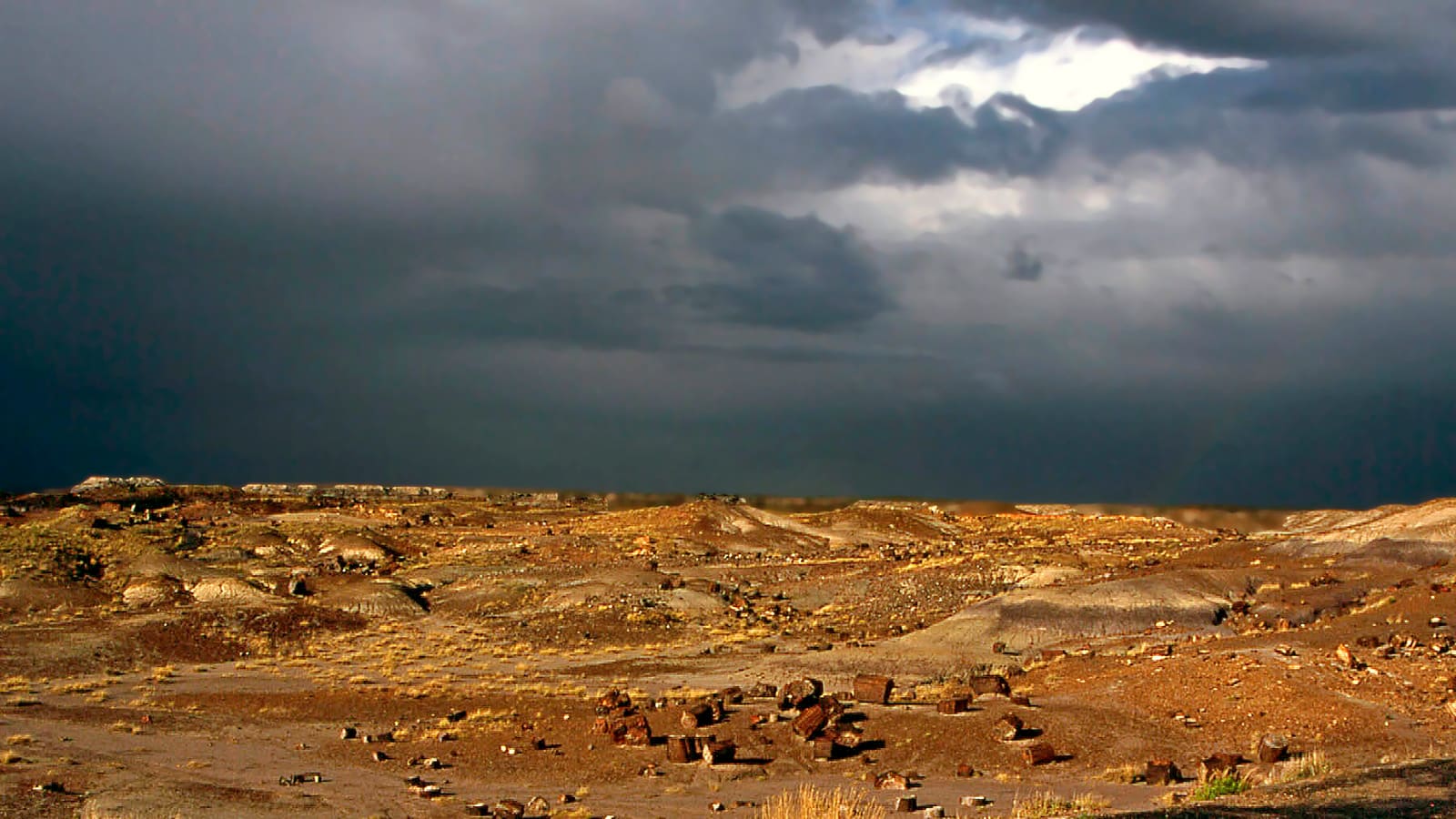
Petrified Forest National Park
Petrified Forest National Park sits east of the White Mountains basecamp area, roughly a two-hour drive from Show Low and Pinetop-Lakeside depending on your route and stops. The park protects one of the largest concentrations of petrified wood in the world, along with badlands scenery in the Painted Desert section, Puebloan petroglyphs, and a stretch of historic Route 66. A single paved road runs the length of the park, connecting short walks and overlooks, so it's realistic to see the highlights in half a day without much hiking.
Bring water and sun protection regardless of season — there's little shade along most of the park road. It is illegal to remove petrified wood from the park, and rangers do check bags at the exit, so buy any wood souvenirs from a shop outside the boundary instead. Verify current entrance fees, gate hours, and whether both entrances are open before you leave, since park hours shift seasonally.
Salt River Canyon
Salt River Canyon lies along US Highway 60 southwest of the White Mountains, on the route most visitors take between the Phoenix area and Show Low. The highway drops roughly 2,000 feet in a series of switchbacks to cross the Salt River, and it's often described as a smaller-scale answer to the Grand Canyon — multicolored rock layers, steep walls, and a historic 1934 steel bridge that's still open to pedestrians at the canyon floor.
Because it's on the way rather than a destination in itself, Salt River Canyon works best as a stop on a longer drive rather than a dedicated round trip from Pinetop-Lakeside or Show Low. The Salt Creek Rest Area at the bottom of the canyon has interpretive panels and a good spot to let your brakes cool after the descent, and there's a notable overlook near mile marker 42 with river and cliff views. If you're already planning to drive Highway 60 through the canyon as part of a longer scenic loop, this is the segment to budget extra time for — the road is narrow and switchback-heavy, not a quick pass-through.
Casa Malpais Archaeological Park
Casa Malpais sits just outside Springerville, at the eastern edge of the White Mountains basecamp region — a manageable day trip from Pinetop-Lakeside or Show Low along Highway 60/260. The site is a late Mogollon-culture pueblo built on a basalt lava flow, occupied roughly from the mid-1200s through the 1300s, and it was designated a National Historic Landmark. Features include a great kiva, an apparent solar calendar, rock art, and a system of natural caves the builders incorporated into the pueblo.
Access is by guided tour only — there's no wandering the ruins on your own. Tours typically depart from the Springerville Heritage Center on Main Street and involve a walk of roughly three-quarters of a mile over steep, rocky ground, so wear real shoes. Reservations are recommended and tour schedules can be seasonal, so call ahead or check the Heritage Center's current hours before driving out. The small museum at the Heritage Center, with exhibits on the Mogollon people and regional paleontology, is generally open on a separate, more flexible schedule. Combine this stop with a broader look at the Springerville-Eagar area if you want to make a full day of it.
Fort Apache Historic Park and Kinishba Ruins
Fort Apache Historic Park sits on the Fort Apache Indian Reservation, home of the White Mountain Apache Tribe, south of the basecamp towns. The fort began as a U.S. Army post in 1870 — General Crook's Cabin, the oldest structure on site, dates to 1871 — and operated as a military installation into the 1920s before the buildings and grounds passed to what is now the tribally run historic park. Nearly thirty historic buildings remain, and the Nohwike' Bágowa (Apache Cultural Center & Museum) tells the tribe's history through both permanent and rotating exhibits.
Admission to the historic park generally includes access to Kinishba Ruins, an ancestral pueblo about four miles west of the fort that was built and occupied from roughly 1150 to the 1300s and is itself a National Historic Landmark. Because this is reservation land and a working cultural institution, confirm current hours, admission, and any tour requirements before you go, and be respectful that this is active tribal ground, not a roadside attraction.
Elevation and Season Matter More Than You'd Think
These four destinations sit at very different elevations, and that changes what a "day trip" actually feels like depending on the month. Salt River Canyon drops to a much lower, hotter elevation than the White Mountains basecamp towns, so a summer afternoon at the bottom of the canyon can run considerably warmer than Pinetop-Lakeside or Show Low — bring more water than you think you need. Petrified Forest sits on the high desert with almost no shade along the park road, which makes spring and fall the more comfortable seasons to visit; midsummer midday heat there is real. Casa Malpais and Fort Apache/Kinishba sit closer to the basecamp elevation, so they track the same weather you're already experiencing in Pinetop-Lakeside or Show Low, though the Casa Malpais tour route is exposed and rocky underfoot regardless of season.
Winter changes the calculus for all four. Snow and ice can affect the switchback descent into Salt River Canyon, and tour availability at Casa Malpais and Fort Apache can shrink outside the main visitor season. If you're planning a day trip between late fall and early spring, call ahead to confirm a site is running its normal schedule rather than assuming it matches the summer version of this guide.
What to Bring
None of these are quick roadside stops, so treat each as a half-day-to-full-day outing. Water, sun protection, and comfortable closed-toe shoes cover most of it — the Casa Malpais tour in particular involves uneven, rocky ground that isn't sandal-friendly. Cell service can be inconsistent on the reservation and in the more remote stretches of Highway 60 through Salt River Canyon, so download offline maps or directions before you leave rather than counting on a signal along the way. Bring cash as a backup for small museum admissions or gift shops, since not every stop is guaranteed to take cards.
Planning the Day
None of these four trips overlap much, so picking between them comes down to what you want out of the day. Petrified Forest is the pure scenery-and-geology choice and the farthest drive. Salt River Canyon is a drive-through experience best combined with travel you're already doing. Casa Malpais and Fort Apache/Kinishba are both guided, history-focused stops that pair naturally with each other or with a night in Show Low or Pinetop-Lakeside. Whichever you choose, call ahead — several of these sites run on limited or seasonal hours, and a wasted drive is the one outcome worth planning around.